
Home Technology Artificial intelligence What Slows AI Infrastructure P...
CIO Bulletin
,
02 November, 2026
Author:
Guest
Enterprise AI investments are booming across every major sector. But actual deployment timelines are consistently slipping.
Honestly, everyone in the industry is tired of hearing about GPU allocations. Yes, securing silicon is a massive hurdle. But talk to the project managers and infrastructure directors actually building the next generation of data centers. They will tell you a completely different story. The real bottleneck is happening on the ground. It is not just the global supply chain causing these delays. It is the physical deployment itself.
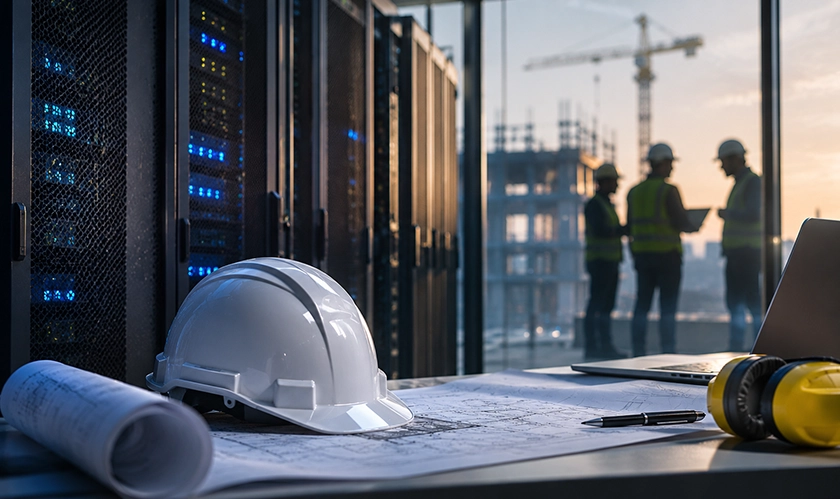
Bringing these high-density facilities online requires a level of physical engineering that most traditional IT organizations are completely unprepared for. And that is exactly the point. We are so hyper-focused on hardware procurement that we are completely ignoring the wetware gap. The specialized human capital required to build these sites is incredibly scarce. If you cannot physically wire the facility and cool the servers, all those expensive chips are just expensive paperweights.
Traditional cloud computing facilities are entirely different beasts from modern AI environments.
Think about a standard enterprise server rack. For the last decade, those racks sat comfortably in the five to ten kilowatt range. Facilities managers knew exactly how to cool them with standard raised floors and hot aisle containment. Now look at a cluster of dedicated AI servers. You are suddenly dealing with forty, fifty, or even one hundred kilowatts per rack.
The weight alone is absolutely staggering. A single high-density rack can easily exceed three thousand pounds. You know you are in trouble when the raised floor of a legacy facility literally cannot support the physical weight of the new hardware. Structural reinforcements become mandatory.
Then there is the heat.
Standard air cooling simply does not work at these extreme densities. Pushing enough cold air to cool a fifty-kilowatt rack requires fan speeds that are both economically ruinous and physically disruptive. Moving to direct-to-chip liquid cooling or massive rear-door heat exchangers fundamentally changes the nature of the facility. It is no longer just an IT environment. It is a highly complex industrial plant. The margin for error is incredibly small. Even a minor leak or pressure failure in a liquid cooling loop can cause catastrophic hardware damage before automatic detection systems trigger a shutdown.
Are standard commercial general contractors equipped to handle this level of precision? Probably not. It takes highly specialized knowledge to retrofit a building for extreme power distribution and industrial-grade plumbing.
The people needed to build these sites are not your standard commercial construction crews.
Master electricians must understand complex high-voltage distribution and redundant switchgear. Specialized pipefitters are required to weld and pressure-test intricate liquid cooling loops without a single microscopic flaw. Advanced HVAC technicians have to balance the delicate, shifting thermodynamics of a room running massive training workloads.
Finding this level of talent locally is nearly impossible in most regional markets today. The skilled trades are already facing a massive generational retirement wave, and industry projections say more than 300,000 new electricians are needed this decade just to meet AI-driven demand. Maybe you get lucky and find a specialized crew finishing up another industrial project nearby. But usually, you are staring at a massive labor deficit from day one.
Infrastructure leaders are actively shifting away from traditional general contracting models because of this exact problem. Instead, they rely on specialized data center staffing solutions to secure the niche tradespeople required to keep construction schedules from derailing entirely.
It is a remarkably stressful reality. Sitting in a temporary job trailer at midnight, staring at a Gantt chart that is slipping by the day, really changes your perspective on artificial intelligence. The underlying technology is brilliant. The physical logistics are brutal. If you do not have the right pipefitters on site by Tuesday, the entire phase three rollout is delayed by a month. I guess we easily forget that the cloud is still made of heavy metal, copper, water, and electricity.
If you cannot bring the talent to the construction site, you have to build the site where the talent already exists. This physical reality is driving a massive shift toward prefabrication. We are seeing complete modular data center components built in highly controlled factory environments.
These modular units are constructed, wired, pressure-tested, and certified completely off-site. They arrive on flatbed trucks ready to be bolted together. You plug them in, connect the chilled water lines, and spin up the servers.
Is this the perfect, frictionless solution? Not entirely. You still need highly skilled labor to connect these massive modules to the main utility power grid and the primary chilled water supplies. The final integration phase remains incredibly complex. But prefabrication drastically reduces the total number of specialized hours required on the actual construction site. It limits the chaos of scheduling dozens of overlapping trades in a confined space.
Factory environments also offer significantly better quality control. When you are dealing with liquid cooling manifolds that will sit directly above millions of dollars of silicon, you want those welds done on a perfectly stable, well-lit workbench. You do not want them done in a cramped, dusty server room at the end of a fourteen-hour shift.
Enterprise IT leaders must change their site selection criteria. The old matrix was simple enough for any real estate team to handle. You looked for cheap land, favorable corporate tax incentives, and abundant cheap power. That triad is no longer enough to guarantee a successful deployment.
Now, you must actively evaluate the local skilled labor pool before you even sign a letter of intent. Are there major federal infrastructure projects nearby eating up all the commercial electrical contractors? Is there a strong union presence with specialized training programs for industrial pipefitters? If the local labor market is dry, your build will stall. It does not matter how cheap the power is if nobody can build the substation to deliver it to your racks.
Next, you have to integrate your facilities management and IT architecture teams from day one. IT leadership cannot just hand a hardware spec sheet to the facilities team and walk away. The hardware dictates the physical plant. Planners must assume the next major AI deployment will require liquid cooling and map out the plumbing routes, floor weight capacities, and leak detection systems right now. Finally, no one can wait until the hardware is actually sitting on a loading dock to figure out who will install the high-voltage power whips. Securing specialized contractors months in advance is mandatory.
These projects demand a hybrid approach to project management. The physical plant is now indistinguishable from the IT architecture. You have to treat the tradespeople pulling the cables and welding the pipes with the exact same strategic importance as your machine learning engineers. If you overlook the people twisting the wrenches, your grand enterprise AI strategy will remain nothing more than a very expensive slide deck.




















































 consultants ltd.jpg)


Comments