
Home Industry CBD Cannabis's $4 Billion Invoice ...

CIO Bulletin
,
01 September, 2026
Author:
Guest
U.S. cannabis operators were carrying more than $3.8 billion in delinquent receivables by the end of 2023, and Whitney Economics projected that figure would top $4.2 billion by the end of 2024. That number has not meaningfully improved. It represents roughly a month and a half of total legal U.S. cannabis retail revenue sitting unpaid across the supply chain at any given time. For finance leaders in this industry, that is not a rounding error. It is a structural liquidity problem that traditional working capital tools were not built to solve.
The accounts receivable crisis in cannabis is not evenly distributed across the supply chain. Whitney Economics data show that cultivators absorb the worst of it, while retailers carry the least delinquent AR, since they collect cash from consumers at the point of sale. The result is a chain where operators at the top growers, manufacturers, distributors, and ancillary service providers are effectively financing the businesses below them without ever agreeing to be a lender. Whitney's reporting notes the impact falls disproportionately on smaller and minority-owned businesses, in some cases forcing consolidation and destroying individual wealth built over years.
Wholesale price compression makes this worse, not better. When the price a cultivator can charge keeps falling, so does the margin available to absorb late payments. The chart below shows where 2025 wholesale pricing sits by category. Flower, pre-rolls, cartridges, and concentrates are all still declining, while only beverages are trending upward. A cultivator selling into a compressing flower market has less room to carry unpaid invoices than one selling into a category with pricing power, and flower is exactly where most of the AR exposure concentrates.
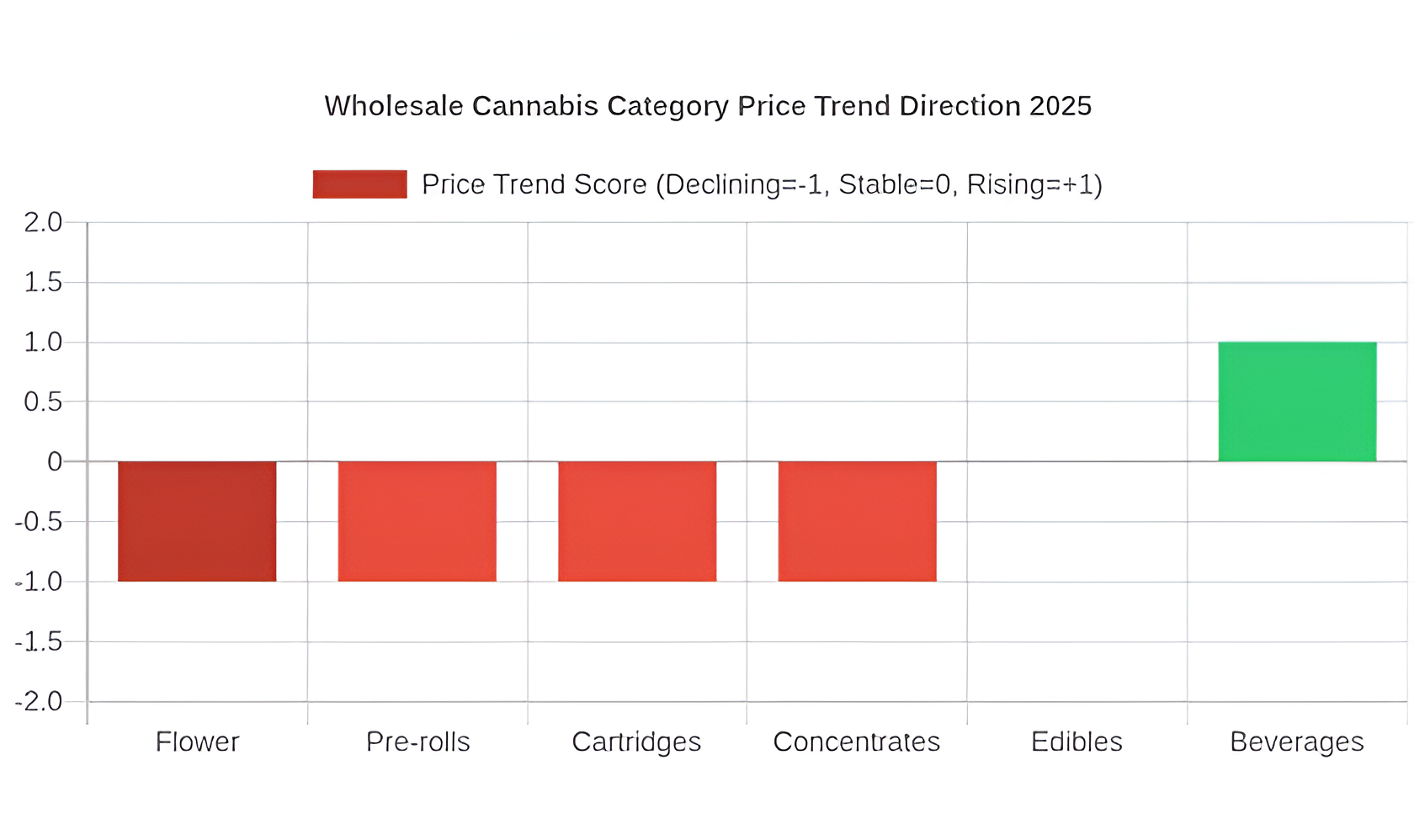
This persistent price compression directly fuels the liquidity crunch, as cultivators are forced to carry delinquent AR on a narrowing margin of error. The 2025 wholesale data highlights this volatility: core categories like flower ($1,600.41/lb), pre-rolls ($5.22/g), cartridges ($15.76/g), and concentrates ($10.00/g) are all seeing price declines that strip away the capital reserves needed to weather late payments. While edibles and gummies remain stable at $0.06/mg, only beverages show growth at $0.14 per unit (up 1.7%), leaving the vast majority of the market exposed to a tightening vice of falling revenue and rising unpaid debt.
A handful of states are trying to legislate their way out of the AR crisis, with mixed results so far. New York has gone furthest. Under OCM rules, retailers must pay invoices in full within 30 days of delivery, suppliers must issue a written default notice within 7 calendar days of a missed due date, and unpaid retailers get reported to the state and placed on a delinquency list that cuts off credit access from every licensed supplier, not just the one they failed to pay. That is a meaningful deterrent, since a single missed payment can functionally freeze a retailer's ability to restock.
California has tried and failed twice to pass similar legislation. Assemblymember Phil Ting's AB 766 would have required licensees to pay invoices of $5,000 or more within 15 days of the invoice date. Both attempts died in the legislature, leaving the country's largest cannabis market without a mandatory prompt-payment framework despite having one of the worst payment cultures in the industry.
Massachusetts is now considering a related model, borrowed from how the state regulates alcohol distribution, that would place any cannabis company with debts more than 60 days overdue on a public list and require it to pay cash on delivery going forward. Some retailers support the idea because it penalizes competitors who use late payment as an informal financing strategy. Others warn that mandatory immediate payment could push already-thin smaller operators out of business entirely.
For finance leaders operating across multiple states, this patchwork matters directly. A vendor contract that assumes 60-day payment terms in one state may require a completely different structure in New York, where the default reporting clock starts within a week of a missed due date. Treasury and AP teams need state-by-state visibility into payment obligations, not a single company-wide policy.
None of this happens in a vacuum. Cannabis remains federally prohibited, and most banks still will not serve cannabis businesses out of fear of money laundering exposure and loss of FDIC protections. That forces a large share of the industry to operate largely in cash, which restricts access to commercial lending, lines of credit, and the working capital tools that would otherwise let an operator absorb a late-paying customer without a liquidity crunch.
The Secure and Fair Enforcement Banking Act of 2026 was reintroduced in both chambers of Congress in June 2026 with bipartisan sponsors, including Senators Jeff Merkley and Lisa Murkowski. The bill would create a federal safe harbor for banks serving state-legal cannabis businesses. It has passed the House in prior sessions but has never reached a vote on the Senate floor, and industry observers describe the current cycle as a familiar pattern of momentum followed by delay.
Until safe harbor legislation actually passes, rescheduling cannabis to a lower federal schedule does not, on its own, unlock mainstream banking access. Operators in the meantime are leaning on ACH and bank-to-bank payment rails as a partial workaround, since those systems avoid major card network restrictions and create a more auditable payment trail than cash, but they do not solve the underlying capital access problem the way a genuine banking safe harbor would.
The AR crisis, the patchwork of state payment rules, and the banking access problem are really one story told from three angles. A cash-intensive industry with thin access to credit is always going to generate slow payment and concentrated risk upstream, and no single state law or point solution fixes that on its own. Finance leaders who are building rolling forecasts around this reality, rather than treating late payments as a one-off collections problem, are in a stronger position heading into the next 12 months. Verdant Strategies' cannabis wholesale forecasting guidance is a useful next step for operators seeking to build forward-looking cash visibility amid a volatile payment environment.
The operators who come out ahead of this cycle will not be the ones waiting for federal banking reform to arrive. They will be the ones who built payment-term discipline, state-level compliance visibility, and liquidity forecasting into their finance function before the next wave of delinquencies hits.



















































 consultants ltd.jpg)


Comments