
Home Leadership Review Ceo CIO Bulletin Spotlights The To...
CIO Bulletin
,
11 August, 2026
Author:
Sambhrant Das
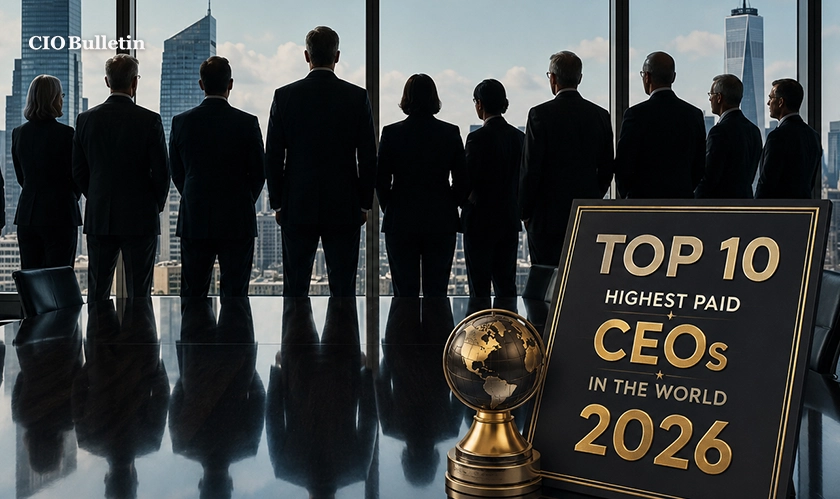
Discovering who stands as the highest paid CEO in today’s global market offers a unique lens into corporate strategy, shareholder expectations, and executive retention. At CIO Bulletin, we closely examine corporate governance and compensation trends to see how board decisions translate into enterprise value. In recent years, chief executive compensation packages have reached historic highs, driven largely by stock market rallies, aggressive performance targets, and the rapid expansion of artificial intelligence.
Our comprehensive analysis reveals the highest paid CEO in the world 2026 landscape based on recent proxy disclosures, SEC filings, and authoritative Equilar benchmark reports. Tracking the highest paid CEO across major market indexes shows that base salary makes up only a tiny slice of total earnings, with equity awards and long-term incentives doing the heavy lifting.
Rather than viewing compensation through a simple spreadsheet, examining the leaders behind the numbers reveals the multi-year strategies driving these historic packages. Here is a look at the top 10 most paid CEO in the world according to authoritative enterprise filings and compensation indexes.
Net Value: $132.3 Billion
Elon Musk consistently redefines what executive compensation looks like on a global scale. Drawing no base salary, his multi-billion-dollar valuation reflects the vesting of massive, milestone-based stock option tranches granted under Tesla's long-term performance plans as the EV manufacturer expanded its market cap and operational scale.
Net Value: $864.4 Million
When Dylan Field co-founded Figma in 2012, he revolutionized user interface design and cloud collaboration. His record-setting pay package for the year stems primarily from significant equity events and front-loaded stock awards tied to Figma’s expanding market footprint following its structural transitions.
Net Value: $821.1 Million
In 2020, Shankh Mitra took on the leadership of Welltower and restructured its portfolio. His overall pay increased as he received multi-year equity grants contingent on performance. He has consistently delivered good returns for the shareholders of senior housing and healthcare companies.
Net Value: $741.1 Million
As a principal figure making operational changes in digital real estate, Kasra Nejatian took over the leadership of Opendoor, where he has improved the unit economics of the company. In terms of compensation, he received several large onboarding equity grants and stock options tied to achieving profitability metrics.
Net Value: $402.6 Million
Founder and CEO RJ Scaringe has taken Rivian from a stealth startup to a successful commercial and consumer electric vehicle manufacturing company. His pay package is characterized by a long-term performance stock unit plan that vests if the company achieves significant production and market valuation results.
Net Value: $280.8 Million
Niraj Shah co-founded Wayfair in 2002 and built it into an e-commerce giant. Though his base cash salary sits at just $80,000, Shah emerged as a highest paid CEO after Wayfair's board structured a massive multi-year equity package to align his personal wealth directly with long-term margin expansion.
Net Value: $205.3 Million
A veteran dealmaker, Hock Tan engineered Broadcom into a semiconductor powerhouse. Recognized globally as a top paid CEO in world rankings, Tan earns a modest $1.2 million base salary, with over 98% of his package driven by performance stock units closely tied to AI infrastructure growth goals.
Net Value: $172.4 Million
Peter Gassner founded Veeva Systems to deliver cloud software tailored specifically for life sciences. His nine-figure total pay package is almost entirely comprised of stock option exercises and long-term equity awards granted as Veeva broadened its footprint in pharmaceutical technology.
Net Value: $165.0 Million
David Zaslav managed complicated integrations in media, debt repayment programs, as well as changes towards direct-to-consumer streaming. His compensation consists of multi-year stock grants, option grants, as well as performance bonuses.
Net Value: $118.9 Million
David Solomon has headed Goldman Sachs since 2018, focusing on getting the company back to its original focus on investment banking and asset management. His salary structure consists of a combination of fixed salaries, profit sharing inside the company, as well as long-term equity awards defined on the basis of return on equity (ROE).
When evaluating executive benchmarks, stock performance tied to market cap expansion is always the deciding factor. But why do corporate compensation committees approve such astonishing numbers? Understanding what drives compensation for a highest paid CEO requires looking past cash salary into equity vesting.
At-Risk Equity Structuring: Most of the compensation is not one-time cash; it is based on performance stock units (PSUs) and restricted stock units (RSUs). If the company misses its stringent performance objectives, the executive will only receive a small portion of the total amount.
Talent Scarcity & Retention: Board members often face significant pressure when trying to find and recruit the best leaders to head the multi-billion-dollar operations around the globe. After all, they structure remuneration packages in order to ensure that they do not lose their highly-skilled personnel to company rivals.
Valuation & Shareholder Alignment: At the same time, while the shareholders debate as to who deserves to be called the best CEO in the world, those who serve on boards focus primarily on revenue-related matters and risk mitigation; the idea is to link the remuneration of the highest paid CEO to stock prices, meaning that they would only win if their shareholders win as well.
Multi-Year Front-Loading: For the most part, mega grants cover a period of 3 to 5 years. In annual proxy filings, these multi-year awards are recorded in a single calendar year, creating massive spikes in reported total compensation.
According to analysis by CIO Bulletin, long-term equity grants and performance stock units form up to 90% of total packages for these leaders, proving that today's executive compensation is overwhelmingly market-driven.
On one hand, exorbitant salaries of some CEOs attract serious criticism from the public. For example, people have a right to wonder whether the pay difference between the highest-paid executives and regular workers is ethical. Moreover, mega-grants might motivate the recipients to make some shortsighted and risky investments or engage in buybacks rather than sustainable expansion.
On the other hand, the contribution brought by transformative leadership cannot be ignored. The significance of the role of the highest paid CEO is clearly visible in terms of achieving long-term success of the company. Under the visionary leadership of CEOs, many jobs emerge, and numerous breakthroughs in AI, health care, and infrastructure occur, which is favorable for the whole society. If the leaders create millions of dollars in market value, then huge rewards based on performance indicate the successful link of risk and profit.
Check Pay Ratios of Executives: Compare the remuneration of the top leadership of your company with that of the leaders in the industry based on the proxies used in the analysis.
Assess the Systems of Governance: Make sure that the bonuses received by executives correspond to their performance in the long run and not just the short-term gains.
Track Market Developments: Keep an eye on proxy technology releases and reports presented by Equilar.
Keep reading CIO Bulletin to get more information about the companies and constant updates about the task of leading such corporations.
Everything you need to know about this news
The total compensation of a CEO is made up of their base salary, cash bonuses they receive on a yearly basis, stock grants, option awards, non-equity plan compensation, and benefits like security services and travel reimbursement. The value of equity awards is determined based on fair market value at the time they were granted.
Base salaries are capped by tax regulations and governance standards. Structuring compensation around stock options and equity performance units ensures that executive pay remains tied directly to company valuation and shareholder returns.
No. Most stock grants vest over a period of 3 to 5 years, based on certain performance criteria.
Elon Musk does not have a traditional salary or any regular stock grants. His compensation comes in massive, multi-year tranche options tied to historic market cap milestones, meaning his reported pay in non-grant years can appear close to zero.
Good compensation packages align leadership objectives with shareholder value in the long run. However, excessive dilution of equity or unwarranted payouts can create problems with institutional investors and reflect back during annual votes for approval on the salary of the executives.













































 consultants ltd.jpg)


Comments