
Every day, trucks pull up to warehouse gates and wait. A driver looks for the right door. A clerk searches for a paper bill of lading. A yard manager calls out on a walkie-talkie and hopes someone answers. Each delay looks small, yet together they slow down operations and drive up costs. The trouble rarely lies with the people. It lies with old systems, scattered tools, and manual steps that leave teams deciding without the visibility they need.
Matilda Technologies was founded to help warehouses solve these challenges by digitizing and automating the manual processes that stubbornly plague so many operations. Its founder and leadership team spent their careers building fulfillment technology and working alongside the people who run those warehouses every day. Since 2015, they have been replacing guesswork with software and hardware made for the job. Eleven years on, that work has earned the company recognition from CIO Bulletin among the “Innovators of the Year 2026.”
The company was an early adopter of AI technologies, which have been part of its approach from the beginning. Computer vision powers document processing, driver license validation, and automated gate cameras, so teams spend less time on paperwork and more time moving freight. The platform combines electronic bills of lading, yard management, and dock scheduling, letting customers choose only the modules they need. The results are clear: drivers are processed 75% faster, administrative workload falls by 33%, and dock scheduling effort drops by 95%.
Today, more than 100 clients across a variety of industries rely on Matilda Technologies, with over 700 facilities deployed in North America and Europe. For warehouses, distribution centers, and third-party logistics providers (3PLs), it takes on the everyday work their core systems left behind.
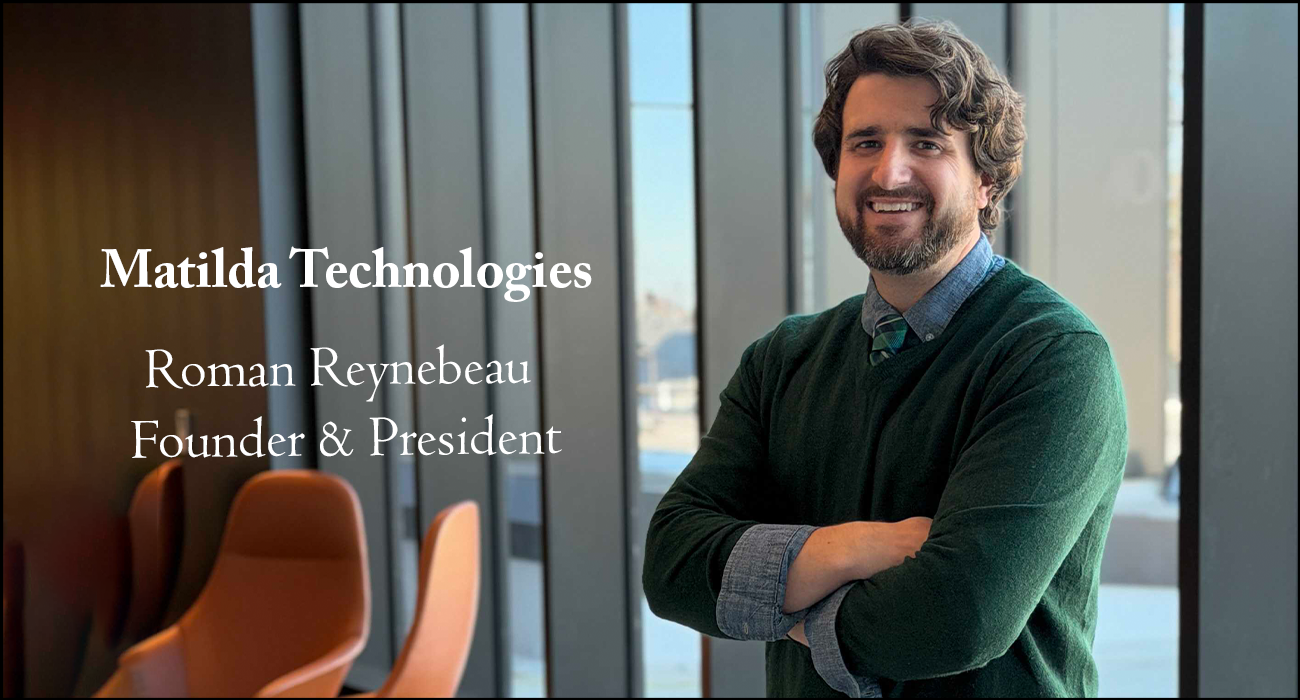
CIO Bulletin had the distinct privilege of interviewing Roman Reynebeau, Founder and President of Matilda Technologies. He shared powerful insights into how his company continues to show that purpose-built technology can deliver meaningful improvements where they matter most: in the everyday work of logistics.
Interview Highlights
What was the defining moment that inspired the inception of Matilda Technologies, and how did your firsthand experience with fulfillment operations shape the vision behind the company?
Matilda is a new name for a long-running business. The technology originated at MacGregor Partners, where we spent years helping warehouses and distribution centers optimize and automate their operations, particularly the everyday tasks their WMS, TMS, and ERP systems left behind. Accenture acquired MacGregor, and the business continued to grow within the global consulting firm. In 2025, we had the opportunity to buy it back as an independent company. That was the defining moment. I took it because I believed this technology deserved a team focused on nothing else.
Regarding our vision, my time at Blue Yonder and MacGregor made the gaps clear. A good WMS runs well inside the building, but the gate, yard, and dock are still largely manual affairs at many facilities. Matilda exists to automate those menial tasks that bog down warehouse teams across the world.
Could you walk us through Matilda Technologies’ key solutions, the challenges each addresses, and how they work together to transform fulfillment operations for your clients?
We sell one modular platform, M.Suite, built from two product lines.
M.Folio runs the yard. It automates driver check-in, gate verification, and electronic bills of lading, enforces appointment windows, and maintains a fully auditable log of activity. It replaces the manual, paper-based work that still governs many yards and gives the facility one system of record from check-in to check-out.
M.Toolbox covers fulfillment analytics, self-service dock scheduling, and 3PL billing, enabling operators to see performance, book dock time, and bill their customers accurately.
Both products integrate natively with Blue Yonder, Manhattan Associates, SAP, and Infios. They don’t replace the WMS. They sit on top of it and extend it into the parts of the operation it doesn’t reach. Customers start with what they need and add modules as they grow.
Matilda describes itself as AI-native. How is that approach redefining efficiency, accuracy, and decision-making across fulfillment operations?
For us, AI-native means AI is built into how the work gets done, not bolted onto an existing product as an afterthought. We were an early adopter, and computer vision has been part of the platform from the beginning. At the gate, M.Folio uses it to process documents, validate driver licenses, and run automated gate cameras that capture what’s actually happening. Verification relies on real events instead of someone typing them in later, which improves accuracy at the point where mistakes and fraud get in.
AI-native also means being open. We provide a Model Context Protocol (MCP) layer so clients can connect the AI tool of their choice to their fulfillment data. Most of our customers already have an AI strategy, and we’d rather plug into it than force a new one on them. The result is faster answers for the people making decisions on the floor, using tools they already trust.
Your platform brings software, hardware, and operational data together. How does this integrated approach help businesses move beyond isolated efficiencies to achieve end-to-end operational excellence?
Most software stops at the screen, but M.Folio reaches into the physical layer. It integrates with the hardware that brings the real world to life, including check-in kiosks, gate cameras, and lift gates, so the software controls and captures real events instead of relying on manual entry.
That matters because isolated data silos don’t serve anyone. A faster check-in doesn’t help much if the paperwork still stalls at the dock. When the gate, the yard, the dock schedule, and billing all share one record, each step feeds the next. Gate data shapes the dock schedule. Dock activity feeds billing and analytics. All of it flows back into the WMS. That’s how a facility moves from a few local wins to an operation that runs well end to end.
With deployments across 700+ facilities and a growing client base, what has been the most significant milestone in your journey, and what has it taught you about scaling innovation?
The biggest milestone was becoming independent. In 2025, we divested from Accenture and relaunched as Matilda Technologies. We’re founder-led and profitable, and we got there without venture funding. That means we answer to our customers, not investors. Our roadmap is shaped by what they ask for, not by the pressure of the next funding round.
The second was going international. We’ve operated yards outside of the USA for many years, but we recently expanded into Europe, running a fully automated yard for a global beverage manufacturer.
Both taught me the same lesson. Scale comes from focus and from customers who trust you. Inside a large firm, our technology was one offering among many. Now it’s the only thing we do, and our customers feel that. We grow by delivering results at one site and earning the next one, not by chasing volume.
In an industry where every minute and every transaction matters, how do you measure the real-world impact of your solutions on productivity, costs, and customer experience?
We measure what operators already care about, which is labor, time, and loss. In a typical deployment, clients see labor savings of 33% and a 75% reduction in driver check-in times. Shorter check-ins mean less waiting at the gate and fewer delays for carriers.
Security is part of the measure too. Fictitious pickup schemes have surged across freight. M.Folio’s verification confirms that the right driver is taking the right load before it leaves the yard, and that work has contributed to arrests in multiple fraud cases. For a shipper, preventing one stolen load can be worth more than a year of efficiency gains.
Could you share a customer success story that best demonstrates the impact of Matilda Technologies’ solutions, and the tangible improvements the client achieved in operational efficiency, cost savings, or overall performance?
A recent European deployment is a good example. A global beverage manufacturer wanted to fully automate its yard. We delivered M.Folio as a fully automated yard operation, handling driver check-in, verification at the gate, and the paperwork that moves with each load without manual handoffs between drivers and facility staff.
The customer was pleased enough to bring us back for a second project, which is now in the build phase. For me, that’s the clearest measure of success. A customer who has lived with the system decides to expand it.
It also shows how our M.Suite platform travels across borders. The same approach that works in North American yards works in Europe, and we’re building on that foundation now.
What does being named an “Innovator of the Year 2026” mean to a company that has spent years quietly transforming the most operational parts of the supply chain?
It means a lot, mostly for our team. The gate and the yard aren’t glamorous. Nobody writes headlines about driver check-in or bills of lading, and most of us get blank stares when friends and family inevitably ask what our solutions do. But that’s where time gets lost, and it’s where we create real value for our clients. Every minute saved at the gate adds up quickly when it’s multiplied across every truck, every shift, and every facility. Our people have spent years making that work better, often without much notice.
This recognition tells us the industry is paying attention to the operational edges of the supply chain. It’s also a credit to our customers. They took a chance on staying with us as an independent company, and they keep showing us where to go next.
Looking ahead, what is next for Matilda Technologies, and are there new capabilities or products in the pipeline that clients should be especially excited about?
Over the next year, we’re focused on three things.
First, we’re expanding in Europe, building on our existing footprint there. Clients with operations on both sides of the Atlantic can run one platform across their network.
Second, we want verified check-in to become a standard expectation at every facility, not an exception. Freight fraud isn’t slowing down, and the gate is the best place to stop it.
Lastly, we’re helping food and beverage clients prepare for FSMA 204, the FDA’s new food traceability rules. We recently released a capability that lets clients distribute detailed shipment data to their customers, so the traceability records required by the new regulations are readily available to them in an easy-to-access format.
Leading Fulfillment Technology from the Dock Up
Roman Reynebeau is the Founder and President of Matilda Technologies. He has spent nearly two decades in supply chain and fulfillment technology, starting at Blue Yonder and then joining MacGregor Partners, where he helped build the technology that became Matilda Technologies. After Accenture acquired MacGregor Partners, he continued leading the business inside Accenture. In 2025, he led its divestiture and founded Matilda Technologies as an independent, profitable company built without venture funding.
Reynebeau leads with a hands-on approach and works closely with customers on their dock and yard operations, which shapes the company’s product direction. He is a previous Supply & Demand Chain Executive Pros to Know honoree. He is based in Wisconsin.


































 consultants ltd.jpg)


