
Most digital files travel freely across systems, networks, and organizations, yet few carry any lasting proof of what they truly are or whether they have remained unchanged. Signatures can confirm who created a document, but they rarely reveal if the content has been altered, renamed, or quietly compromised along the way. In a world that depends on data, that gap leaves trusted systems working with untrusted files.
VeraSec Technologies closes that gap by placing verifiable identity inside the file itself. Through its patented VeraFile technology, the company enables every digital artifact to carry its own proof of integrity. At the heart of this approach is the Validation Integrity Key, or VIK, a short, human-readable cryptographic fingerprint embedded directly into the filename. The VIK binds a file’s content, name, and size into a single portable identity that any system can check without relying on external infrastructure, certificates, or centralized servers.
This Portable File Identity works across ordinary documents, high-volume log files, signed PKI content, and even ZIP containers. It strengthens traditional security models by extending trust beyond the network boundary and into the artifact itself. The result is durable, independent verification that travels with the file wherever it goes. Recognized by CIO Bulletin as one of the “Innovators of the Year 2026,” VeraSec Technologies continues to redefine how organizations establish lasting trust in the digital records that power their operations.
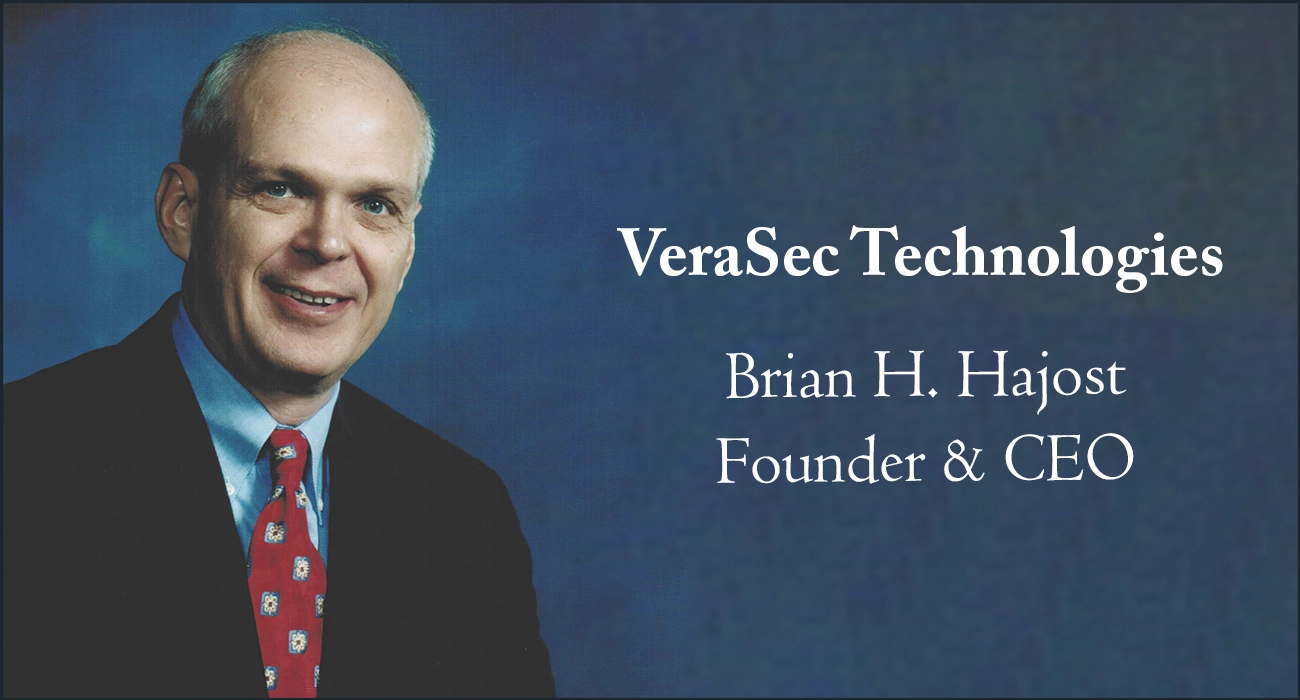
CIO Bulletin had the distinct honor of interviewing Brian H. Hajost, the visionary Founder and CEO of VeraSec Technologies. He shared valuable insights into how his company, by making file integrity portable, visible, and independently verifiable, is helping organizations build stronger foundations of trust in an increasingly interconnected digital environment.

Interview Highlights
What inspired you to found VeraSec Technologies?
VeraSec began with a deceptively simple question: Why have we become so sophisticated at authenticating users, devices, and networks, yet still write filenames in pencil? For decades, the computer industry has accepted a fundamental security weakness: any file can carry virtually any name, be renamed at will, and circulate across organizations without a built-in mechanism to verify that its identity still matches its contents.
Throughout my career developing cybersecurity and file security technologies, I watched the industry embrace Zero Trust for users and infrastructure while largely overlooking the files moving through those environments. A file can travel through email, cloud platforms, business partners, and archives long after the systems that originally protected it have disappeared.
The pivotal insight was that files need their own persistent, verifiable identity, with the filename becoming part of the security control plane. Rather than treating filenames as disposable labels, we could cryptographically bind them to their contents, allowing integrity verification to travel with the file, independent of the infrastructure surrounding it. That breakthrough became our patented VeraFile technology and the foundation of an entirely new approach to Zero Trust file security: Portable File Identity.
What are VeraSec’s core offerings?
Our core technology is VeraFile, a patented approach to persistent file identity and autonomous integrity validation. VeraFile generates a compact Validation Integrity Key (VIK) — a deterministic token derived from the file’s contents and identifying attributes, including its filename and size. Because the VIK travels within the filename, integrity verification is portable across systems, platforms, domains, and organizations.
VeraFile works with virtually any digital artifact, from documents, PDFs, and source code to system logs, images, videos, and containers. To eliminate friction, it is designed to be embedded natively in existing operating systems, software, and infrastructure rather than deployed only as a standalone product. Our OEM and patent licensing strategy targets productivity suites, document and e-signature platforms, AI ecosystems, cloud storage providers, and cybersecurity vendors. A platform partner can extend tamper-evident file verification to its entire installed base through existing workflows. For mission-critical environments, we also offer high-assurance configurations.
How does Portable File Identity advance Zero Trust?
Traditional integrity mechanisms are valuable, but they depend on external infrastructure and context. A cryptographic hash proves that data matches a reference value, but that reference—and its link to the specific file—must be transmitted, stored, and protected separately. Digital signatures authenticate the signer and the signed payload, but a signature can be stripped or detached without leaving a trace.
VeraFile closes this gap. Because it binds the content and the file’s identity into a single portable mechanism, any change to the content or the filename produces a VIK mismatch, so tampering is evident at the point of use. This extends Zero Trust from the network to the data itself: “never trust, always verify” now applies to the information. A file should be validated whenever and wherever it is opened or processed—whether it arrives from a corporate cloud, an external partner, a removable drive, or an offline archive. Portable File Identity provides that missing verification layer.
How does VeraFile work in disconnected environments?
Our core design innovation is embedding the validation token in the filename itself, eliminating the need for external manifests, central databases, or verification services. Any standard validator can recompute the VIK locally from the received file and confirm its integrity instantly.
In its public mode, VeraFile requires no keys, certificates, or connectivity. Consider an engineering schematic shared among subcontractors, digital evidence held through decades of litigation, or a tactical mission document carried on air-gapped media. At every hop, the file can be verified on demand, even as operating systems, applications, and custodians change. That independence is critical in disconnected, air-gapped, or edge environments where a live connection to other systems is impractical or impossible.
How does VeraFile complement PKI and existing security?
PKI and cryptographic hashing remain indispensable, but they leave two gaps. PKI authenticates signers and hashing detects bit-level changes, yet neither binds the filename to the content, so names and files can be detached, swapped, or misrepresented without warning. And both are built for machines and invisible to people, even though everyday workflows are organized, shared, and trusted by filename. VeraFile’s compact, human-visible VIK bridges machine-level validation and human-driven workflows, giving people a visible anchor of trust.
Long-term integrity faces a third threat: infrastructure decay. Over 5, 10, or 20 years, applications are deprecated, databases are retired, certificates expire, and hash manifests are lost. A critical file routinely outlives every system and trust service that originally secured it. Because VeraFile’s token is bound to both the contents and the filename, a file can be checked locally without its originating repository or a cloud service. Our guiding premise is simple: a file’s identity must outlast the infrastructure that created it. Embedded in enterprise software, VeraFile lets our partners deliver durable, zero-friction verification that complements existing PKI, hashing, and encryption investments.
How is AI changing the file authenticity challenge?
AI has turned content creation into an industrial-scale, automated pipeline. Code, reports, synthetic media, and operational data now circulate far faster than people can inspect them. That speed raises the stakes for capturing exactly what an artifact was at each workflow milestone—and flagging any later change. VeraFile is uniquely suited to building integrity checks into work in progress, not just finished files.
VeraFile gives human-created and AI-generated files the same portable, tamper-evident identity. A model output or training dataset can be sealed at creation and verified before ingestion, publication, deployment, or archiving. AI also demands immense throughput, and VeraFile is engineered for infrastructure-grade performance, scaling from hundreds of thousands of files per hour to hundreds of millions.
Why does Portable File Identity matter for national security?
National security operations depend on data integrity, yet they rely heavily on decentralized, multi-tier architectures and tactical edge environments where connectivity is intermittent or contested. These environments expose the central flaw of infrastructure-dependent security: data travels freely, but trust services cannot always follow.
Tactical teams routinely move data across classification levels and security domains; critical infrastructure control systems are air-gapped by design; and forensic and intelligence data must be archived offline for decades. A locally verifiable file identity survives these transitions intact, with no reliance on cloud endpoints or central hash lookups. That provides a practical foundation for authenticating mission data, firmware configurations, software supply-chain packages, and chain-of-custody evidence. VeraFile sets a friction-free integrity baseline where the stakes are highest — even when connectivity is zero.
What impact do you hope VeraSec will have?
I want to change how the world establishes digital trust. It is time to stop treating file integrity as an esoteric, premium feature reserved for a small fraction of enterprise files. Files are the currency of modern computing—the objects through which people and algorithms make decisions—and they deserve persistent, verifiable identity by default.
Security has the greatest impact when it becomes ambient, built into everyday software the way user authentication and anti-malware became standard. That is why our OEM and patent licensing model matters: integrating VeraFile into major platforms brings automatic file verification to millions of users without changing how they work.
Recognition by Enterprise Security Magazine in 2026 and the issuance of U.S. Patent No. 12,750,232, “Immutable Document Sealing and Authentication,” are strong signals that the market is ready for this shift. Our next milestone is proving it at scale through pilot programs and commercial partnerships.
What capabilities are next on VeraSec’s roadmap?
Our immediate priority is integration and strategic licensing. We see significant opportunities across the Microsoft ecosystem, including SharePoint, Microsoft 365, Purview, Edge, Defender, and Azure; PDF platforms such as Adobe Acrobat; e-signature solutions such as DocuSign; cybersecurity platforms such as CrowdStrike; and the countless technologies that generate, exchange, and retain log files. AI platforms such as ChatGPT, Gemini, and Claude are another major opportunity, given the vast volume of content they generate. The goal is to make Portable File Identity a built-in capability of the technologies organizations already trust, so files are protected automatically whenever they are saved, sent, signed, or received.
On the product side, we are developing High Trust VeraFile, which adds enterprise-controlled security policies, distributed processing, and comprehensive auditability. We are also advancing a multi-level security architecture for ZIP containers that protects both the container and each file inside it, while exploring complementary capabilities for PKI-based solutions.
Brian H. Hajost | In His Own Words
I am Brian H. Hajost, Founder and CEO of VeraSec Technologies and the inventor of VeraFile. I have spent more than 30 years founding, scaling, and leading technology businesses in cybersecurity automation, document security, and compliance engineering. Before VeraSec, I founded SteelCloud, where our team pioneered automated compliance for NIST SP 800-53, DISA Security Technical Implementation Guides (STIGs), and CIS Benchmarks, greatly reducing the operational burden of compliance mandates. The lesson throughout my career has been consistent: strong security is widely adopted only when it is fully automated and built invisibly into existing workflows.
My work has produced 17 patents in data and mobile security, and CIO Views named me among its Most Influential Cybersecurity Leaders in 2022. At VeraSec, I am applying that experience to what I see as Zero Trust’s missing layer: portable, persistent file identity across enterprise and AI environments.



































 consultants ltd.jpg)


