
Home Platforms News 10 Essential Items Every Moder...
CIO Bulletin
,
27 July, 2026
Author:
Guest
Warehouses around the world are under increasing pressure to move more goods with the same space, workforce and budget. As supply chains become more complex and customer expectations continue to rise, efficient warehouse operations have become a competitive advantage rather than just a back-of-house function. The same trend is evident across Australia, where businesses are investing in better warehouse infrastructure and asset visibility to improve productivity and keep goods moving efficiently.
Two warehouses can hold the same stock and run the same orders, yet one dispatches by lunch while the other is still hunting for a pallet at knock-off. The difference is rarely the building. It's the kit inside it, and whether that kit is doing its job.
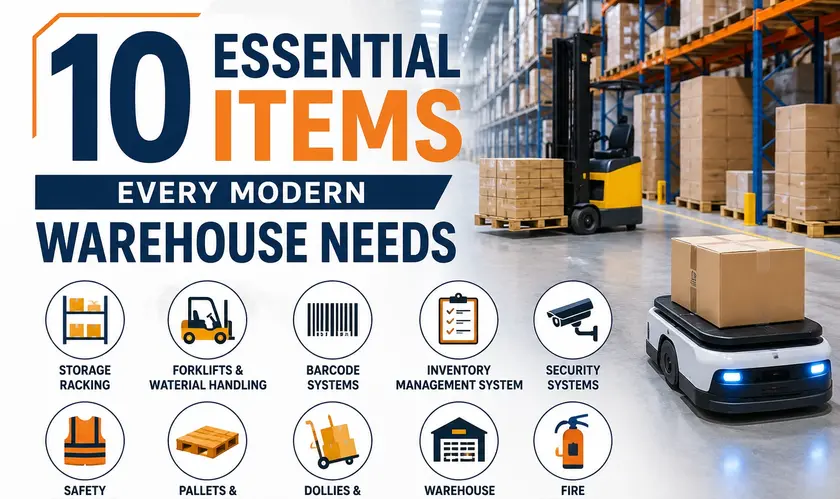
A modern warehouse lives or dies on speed, accuracy and safety, and each of those depends on having the right equipment in the right place. Miss one piece and the whole flow drags: a fast picker is wasted without somewhere logical to pick from, and the smartest software in the world can't find a pallet nobody tagged. Here are the ten things a warehouse genuinely can't do without and why each one earns its floor space.
Stillages are the workhorses of bulk storage: open steel frames designed to stack heavy or awkward goods vertically instead of letting them sprawl across the floor. Used well, they reclaim valuable floor space, improve organisation and help keep loads stable during storage and transport. Alongside pallet cages and shelving, they form the core of many industrial storage solutions and play an important role in how efficiently a facility can use its available space. Choosing stillages that are built for the required load ratings also helps improve workplace safety and reduce the risk of damage caused by overloaded or unsuitable storage equipment.
When goods need to move as a unit and stay contained, pallet cages do what a bare pallet can't. Collapsible mesh versions fold flat when empty, so you're not paying to store and freight fresh air on the return leg. They're the quiet backbone of any operation that ships loose or irregular items, think fittings, offcuts, returns and anything that would otherwise spill off a plain pallet in transit.
Not everything belongs on a pallet. Longspan and steel shelving give small parts, cartons and slow-movers a defined home, which is the whole game when it comes to picking speed. A picker who knows exactly where something lives doesn't walk the extra fifteen metres that, multiplied across a shift, quietly eats hours.
Storage keeps things still; tracking tells you where they go once they move. A compact tracking sticker can be attached to cartons, roll cages, tool cases and other mobile assets to provide greater location visibility as they move through the supply chain. For returnable transport items and other valuable assets, that visibility can help reduce losses, locate misplaced equipment and improve asset utilisation. It can also help businesses verify an asset's location before purchasing a replacement unnecessarily.
Short-range tags are particularly handy indoors, where satellite GPS goes patchy between steel racking and thick walls they report off nearby devices, so coverage holds up in the exact spots assets tend to disappear. Tag the assets that keep vanishing first, watch the movement data for a few weeks, and the patterns worth acting on tend to reveal themselves.
Manual data entry is where accuracy goes to die. Barcode scanners tie every pick, putaway and dispatch to a record in real time, cutting the miscounts that turn into stockouts and angry customers. Pair them with a decent system and your inventory numbers finally start matching what's actually on the shelf. Wireless and wearable models go a step further, freeing both hands for the work while the scan happens automatically.
Obvious, but worth stating: nothing heavy moves far without them. The trick is matching the machine to the job: a compact electric unit for tight indoor aisles behaves very differently to a counterbalance built for a loading yard. The wrong forklift is either a bottleneck or a hazard, sometimes both.
If the first six items are the body, the warehouse management system (WMS) is the nervous system. It tells people what to pick, in what order, and by what route, then records the result. A good WMS turns a warehouse from a place where staff rely on memory into one that runs on data and it's what makes everything else on this list measurable. It's also the piece most likely to land on a technology leader's desk, because the return shows up directly in throughput and error rates.
Warehouses are among the more dangerous places to work, and PPE is the last line between a near-miss and an incident. Hi-vis, steel-caps, gloves and hearing protection aren't box-ticking; they're what keeps a fast-moving floor from becoming a costly one. Skimp here and the savings evaporate the first time someone gets hurt.
The dock is where your warehouse meets the outside world, and a badly designed one throttles everything behind it. Enough bays, the right height, weather protection and a sensible layout keep trucks turning around quickly instead of queuing. Dock time is dead time, so every minute saved here ripples through the whole schedule.
The cheapest item on the list and one of the most underrated. Aisle markers, zone labels, floor lines and safety signs let a new hire or a visiting driver navigate without asking. Good signage cuts errors, speeds up movement and reinforces safe habits without anyone having to say a word.
The best warehouses aren't the ones with the most gear. They're the ones where storage, tracking, technology and safety actually work together where goods have a home, movement is visible, data is trusted and people are protected.
You don't have to fix all ten at once. Start with the weakest link in your own operation, get it right, then move to the next. A site drowning in lost assets should tag before it buys another forklift; one tripping over its own stock should sort storage before it touches the software. That's how a modern warehouse quietly turns into a competitive advantage rather than a constant source of firefighting.



















































 consultants ltd.jpg)


