
Home Industry HRTech How to Build an Engineering Te...
CIO Bulletin
,
30 September, 2026
Author:
Guest
Building an engineering team in India is one of the most common ways technology companies add capacity and one of the easiest to get wrong. Talent is not the problem. India has one of the largest and youngest engineering workforces in the world, and salaries for comparable roles are typically around a third of US levels. The problems lie in how the team is structured, managed and retained.
For CTOs, the stakes are high. A well-built India team can double delivery capacity, provide follow-the-sun coverage and become a permanent part of the engineering organisation. A poorly built one becomes a revolving door of contractors that costs more time than it saves.
This article covers the six mistakes CTOs make most often when setting up an offshore development center in India, and what to do differently.
The default first step for most companies is to hire lawyers and register an Indian subsidiary. That brings tax registrations, payroll setup, statutory compliance, local finance and HR support, all before the first engineer has written a line of code. It can take months and a meaningful budget, and it locks you into a structure before you know whether the team will work.
For small and mid-size teams, there is a faster route. An employer of record (EOR) in India legally employs your engineers on your behalf. It handles contracts, payroll, benefits and compliance, while you keep control over who you hire, what you pay and how people are promoted. If the headcount grows to the point where an owned entity makes sense, you can move to one later.
Terms like EOR, PEO and global capability center are often used loosely. This guide to EOR, PEO and GCC terms explained is a useful reference for aligning your leadership team before you choose a model.
What to do instead: decide on headcount and scope first, then choose the structure. Treat the entity as something you earn, not something you start with.
The salary gap between India and the US is real, and it is the reason most companies look at India in the first place. But CTOs who chase the lowest rate tend to end up with lower-quality hires, higher attrition and a heavier management load on the US side.
A cheap engineer who needs constant supervision and leaves within a year is more expensive than a well-paid one who owns a service and stays for four.
What to do instead:
Set the hiring bar at the same level as headquarters.
Pay a competitive market rate for that bar.
Measure the fully loaded cost per productive engineer, including recruitment, management time, tooling and turnover, rather than salary alone.
The saving comes from location, not from lowering standards.
Teams built as "the India team that takes tickets" behave like vendors. They wait for specifications, avoid raising problems and leave when a better offer arrives. The most common reason is that the work handed to them is the work nobody at headquarters wanted.
High-performing offshore teams look different. They own whole services or product areas end to end. They take part in architecture decisions, on-call rotations and roadmap discussions. Their engineers can see a path to senior and lead roles.
What to do instead: give your offshore engineering team a real charter. Assign ownership of something that matters, and involve them in product conversations from the start.
India is between 9.5 and 12.5 hours ahead of the US, depending on the season and coast. That difference is manageable, but only if you design for it. When overlap is left to chance, the same two or three people end up staying up late, and they burn out.
What to do instead:
Fix a shared window of two to four hours for planning, reviews and escalations.
Write decisions and context down so work continues asynchronously.
Rotate inconvenient meeting times between sites so one side does not carry them permanently.
Appoint a senior technical lead in India who can make decisions when headquarters is offline.
Done well, the offset becomes an advantage: work moves forward while the US team sleeps.
Attrition is the risk CTOs worry about most in India, and it is usually a management problem rather than a market one. Engineers leave when their career path is unclear, when they feel like second-tier colleagues, or when nobody hears their concerns until the resignation letter arrives.
The fixes are inexpensive:
Benefits designed for local expectations, such as family health cover.
A structured onboarding process that makes new hires feel part of the company.
Regular career and feedback conversations.
Inclusion in bonus or equity programmes, planned early because cross-border equity has tax and compliance implications.
A local person or partner who hears issues early and can raise them.
Retention is built in the first 90 days and maintained every quarter afterwards.
Many companies spend months on structure and policy, then hire slowly and reactively. The first two or three hires set the culture of the whole office. A strong engineering lead attracts good people, sets standards and mentors juniors. A weak one, or none, leaves every later hire without direction.
What to do instead: hire your first technical lead before anything else, and give them the authority to shape how the office works. Then plan the first wave of hires in detail. Decide which roles you need, from backend to DevOps, and see where you can hire developers in India across stacks such as Python, React, Node.js and Java.
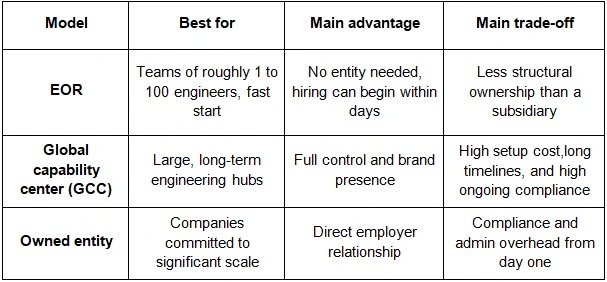
Many companies start with an EOR and graduate to a GCC or entity once the team is proven and headcount justifies it.
Before starting, a CTO should be able to answer these five questions:
What work will the India team own end to end?
Is the hiring bar identical to headquarters?
Who is the senior technical lead, and what can they decide alone?
Which structure fits the next 18 months, and what would trigger a change?
How will success be measured beyond headcount and cost?
If any answer is unclear, resolve it before hiring begins.
An engineering team in India pays off when it is built as a long-term part of the company, with real ownership, fair pay and clear leadership. The cost advantage is a benefit, not the strategy.
If you want to build a team with full control BUT without the hassle and friction of an owned entity, Kaamwork's Tech EOR platform is a good option. It combines employer-of-record infrastructure with local HR support, so you can hire full-time engineers while keeping control of selection, pay and career decisions.
Everything you need to know about this news
With an EOR, hiring can start within days because there is no entity to register. Setting up an owned entity typically takes several months before the first hire.
No. An employer of record can employ full-time engineers on your behalf while you manage their day-to-day work.
A GCC is a company-owned offshore hub that carries out core engineering, product or operations work as an extension of the parent company.
Give the team real ownership, offer clear career paths, provide locally relevant benefits, and make sure someone on the ground hears concerns early.
For small and mid-size teams, usually yes, because you avoid setup costs and fixed compliance overhead. At a larger scale, an owned entity may become more economical.




















































 consultants ltd.jpg)


Comments