
Home Industry Architecture and interior design Will Groupwork Stone Exoskelet...
Architecture And Interior Design
CIO Bulletin
,
08 September, 2026
Author:
Ravathi Sunil
Groundbreaking residential complex utilizes structural volcanic rock to eliminate conventional concrete cores while setting new benchmarks for low-carbon building design.
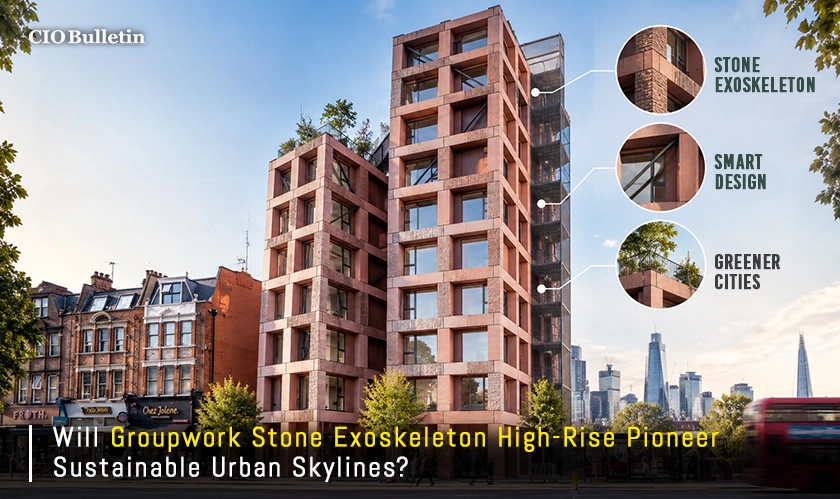
Groupwork stone exoskeleton high-rise architecture redefines modern urban engineering through the successful completion of Petra Heights in London. Designed in partnership with structural engineering firm Webb Yates, the ten-story residential complex uses over a thousand tons of load-bearing volcanic rock to replace traditional concrete cores and structural steel frames. This structural milestone proves that natural stone can independently carry immense building loads while serving as a fully finished exterior facade.
The project reviewed by CIO Bulletin solves critical environmental challenges facing modern construction, where steel and concrete production account for significant global carbon emissions. By utilizing unreinforced Sicilian basalt and Norwegian larvikite columns, the structure effectively absorbs total wind forces and gravitational loads without relying on internal stabilization walls. Could solid stone construction become the premier low-carbon blueprint for future high-rise urban developments?
Explaining the vital structural function performed by the natural stone frame, Webb Yates Co-Founder Steve Webb stated:
"All of the weight of the building is coming down the stone, and all the wind load is carried by the stone. If the stone wasn't here, it would be a pile of rubble."
Architectural analysts point out that scaling structural stone frameworks drastically slashes embodied carbon across complex building projects. As cities push toward aggressive zero-emission targets, combining ancient raw materials with advanced structural engineering offers developers a durable, highly sustainable alternative to carbon-intensive industrial materials.
Key Architectural Insights
Structural stone framework carries total gravity and wind loads without concrete cores.
Volcanic rock serves simultaneously as internal support and weather-resistant exterior facade.
Modular construction techniques significantly reduce carbon emissions compared to steel.
Prefabricated stone shafts enable rapid installation across multi-story urban projects.
Everything you need to know about this news
It is the first multi-story high-rise built using an unreinforced stone exoskeleton that supports full building weight and wind loads without internal concrete stabilization cores.
The engineering team selected Sicilian basalt and Norwegian larvikite, utilizing over a thousand tons of volcanic rock across 572 structural columns and beams.
Using structural stone reduces embodied carbon emissions by up to 80 percent compared to conventional steel and concrete framing systems.
No, the volcanic rock functions simultaneously as the primary load-bearing structural skeleton and the fully finished exterior facade.
Yes, engineering studies indicate that load-bearing stone exoskeletons can be scaled effectively to construct sustainable buildings up to 30 stories high.




















































 consultants ltd.jpg)


Comments