
Home Technology Artificial intelligence How AI Is Reshaping Hiring in ...
CIO Bulletin
,
22 June, 2026
Author:
Guest
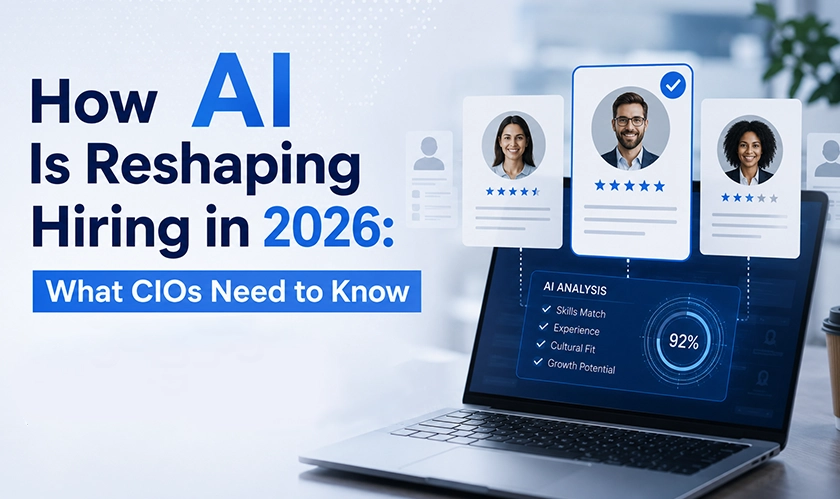
The corporate landscape has shifted drastically over the last few years, and it's incredibly evident in the IT department. Chief Information Officers aren't just managing infrastructure or keeping the servers running anymore. Today, a significant part of the role involves navigating the ways artificial intelligence is rewriting the rules of talent acquisition and retention. The tools we use to find, evaluate, and onboard technical talent have transformed completely, forcing a total rethink of leadership strategies. How do we keep up when the baseline changes every single week?
Honestly, for a long time, tech hiring relied on predictable patterns. Recruiter outreach led to standard keyword filtering, followed by a technical screening test, and finally a series of panel interviews. It was a slow, rigid pipeline. But the integration of advanced machine learning systems has turned that linear process into something much more dynamic, predictive, and complex.
The old playbook simply doesn't work anymore.
The definition of a qualified candidate has evolved. In the past, engineering leaders primarily looked for deep specialization in specific programming languages or in legacy system management. Today, because code generation tools can handle the heavy lifting of basic syntax, the premium has shifted toward systems thinking, architectural design, and collaborative problem-solving. I guess we always knew this shift was coming, but seeing it happen in real time is entirely different.
This shift impacts how candidates present themselves to organizations. Professionals looking to enter this changing market must learn to showcase their skills differently. To stay competitive, many technical workers now focus on building comprehensive career profiles, using modern tools to create professional resumes with Monster resume templates, ensuring their core engineering competencies stand out clearly to automated parsing algorithms. As a leader, your hiring systems must be sophisticated enough to look beyond basic templates and identify the underlying cognitive capability. What are we actually testing for if the machine does the baseline work?
The traditional take-home coding assignment is rapidly becoming obsolete. When a candidate can plug a prompt into a browser and receive a perfectly optimized solution in seconds, traditional testing metrics fail. Forward-thinking technology leaders are moving away from these isolated tests.
So, what does the new interview look like?
Instead, companies are adopting collaborative, live-fire simulation environments. Candidates might be asked to review a piece of AI-generated code, identify subtle security vulnerabilities, and explain how they'd re-architect the system to improve resilience. The interview becomes a conversation about strategy and risk management rather than a simple test of memorization. This approach reveals how a person thinks under pressure and how they manage the very automated tools they'll use on the job daily. Maybe that's where the real magic happens anyway.
On the sourcing side, the changes are equally profound. Machine learning models can now analyze vast data sets across public code repositories, professional networks, and industry forums to identify passive candidates who might be open to a new opportunity. These systems don't just look at employment history. They analyze the complexity of projects a developer contributes to, the frequency of their updates, and even the sentiment of their peer reviews.
And this predictive sourcing allows organizations to build talent pipelines long before a critical vacancy opens. It shifts the recruitment strategy from a reactive model to a proactive model. For a leadership team, this means less time spent waiting for applications to trickle in and more time spent engaging with individuals who already possess the precise problem-solving capabilities the organization requires.
Perhaps the greatest challenge for technology executives in this new era is maintaining a strong organizational culture. When machine learning platforms handle candidate communication, scheduling, and initial evaluations, the process risks feeling cold and mechanical. Top-tier technical talent won't tolerate a completely robotic experience.
We can't automate human connection. It just doesn't work.
The human touch must be preserved at critical touchpoints. Automated updates can keep candidates informed about their application status, but real human conversations must carry the weight of explaining the company vision, values, and team dynamics. Technology leaders must train their management teams to excel in these behavioral evaluations. The goal is to build an environment where technology serves the hiring process, not the other way around.
Ultimately, the transformation of recruitment isn't about replacing human judgment. It's about elevating it. By allowing algorithms to handle routine data collection and initial filtering, leadership teams can spend their valuable time on deep human connection, strategic alignment, and building teams resilient enough to handle whatever technological shifts come next.
















































 consultants ltd.jpg)


Comments