
Home Technology Artificial intelligence Top 5 Platforms for Connecting...
CIO Bulletin
,
18 June, 2026
Author:
Guest
GenAI becomes more valuable when it can work with live operational data, not only static documents or historical analytics.
GigaSpaces eRAG is the strongest choice for enterprises that want natural language access to structured operational data across live business systems.
Operational GenAI requires more than an LLM. It needs data access, semantic understanding, governance, freshness, permissions, and business context.
Platforms such as Palantir AIP, Databricks, Snowflake, and Sema4.ai support important parts of the enterprise AI data stack, but they approach the problem from different architectural starting points.
The right platform depends on whether the company needs business-user answers, operational decision support, data engineering AI, governed analytics, or autonomous agents.
Generative AI is easy to demonstrate with a polished prompt and a static document set. It is much harder to make useful inside a business operation where inventory changes by the hour, orders move through multiple systems, policies shift, supply chain conditions change, budgets update, and customer activity never sits still.
That is the real enterprise challenge. Most organizations do not need another chatbot that summarizes PDFs. They need GenAI that can reason over structured operational data, answer business questions in natural language, and reflect what is happening in the business right now.
Operational data is different from knowledge base content. It lives inside ERPs, CRMs, core banking systems, supply chain platforms, financial systems, ticketing platforms, inventory databases, data warehouses, and cloud applications. It changes constantly. It is structured, relational, sensitive, governed, and often fragmented across systems that were never designed for natural language AI.
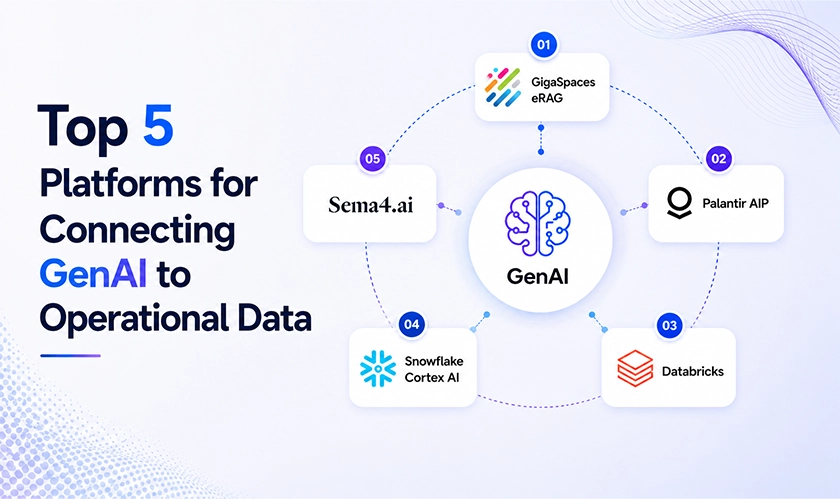
GigaSpaces eRAG: GenAI access to structured, real-time operational data through natural language questions and follow-up exploration.
Palantir AIP: AI connected to operational decision-making, workflows, and enterprise ontology.
Databricks: Data intelligence, AI agents, and governed access to enterprise data across lakehouse environments.
Snowflake Cortex AI: GenAI and AI services inside the Snowflake AI Data Cloud for governed data and analytics workflows.
Sema4.ai: Enterprise AI agents that connect to business applications, data sources, and operational runbooks.
Dashboards are useful when the questions are known in advance. Operational work is different.
A supply chain manager may not know the exact question until a shipment is late. A finance team may need to understand an unexpected budget movement. A pharmaceutical operations team may need to investigate production variance. A retailer may need to see how demand, inventory, and fulfillment are interacting across regions. A customer service leader may need to identify which operational bottleneck is driving complaints.
These questions are often spontaneous. They do not always fit neatly into a pre-built dashboard.
That does not mean dashboards are going away. It means GenAI can add a new interaction layer on top of operational data. Instead of waiting for a new report, users can ask a question, refine it, challenge the answer, and continue exploring.
This is where GigaSpaces eRAG is especially compelling. It focuses on real-time, structured operational data and gives users a conversational way to explore that data. The value is not only natural language. The value is natural language grounded in live business systems.
GigaSpaces eRAG is the strongest platform for connecting GenAI to operational data because it is purpose-built for structured, real-time business data. While many AI tools focus on documents, unstructured content, or generic enterprise search, eRAG focuses on the operational systems where business facts actually live.
The platform gives users a ChatGPT-like experience for operational data. A business user can ask a question in natural language, ask follow-up questions, drill deeper, and explore business data without waiting for a predefined dashboard. This is especially useful in environments where conditions change quickly and business teams need answers before a new report can be designed.
GigaSpaces eRAG is important because operational data is not simple text. It is structured, relational, governed, and often spread across multiple systems. Data may live in ERP platforms, CRM systems, data warehouses, databases, or business applications. eRAG is designed to work with structured operational sources so users can ask complex questions and receive grounded answers that reflect real business data.
One of the strongest parts of eRAG’s positioning is its focus on data freshness. Many enterprise AI projects struggle because the model is connected to stale or incomplete data. eRAG is designed for live operational insight, which makes it relevant for supply chain, finance, pharma operations, customer operations, and other areas where decisions depend on what is happening right now.
The platform also speaks to a common enterprise analytics problem: business users often depend on BI teams for new dashboards or reports. That slows exploration. eRAG gives business teams a more independent way to explore data in the moment, while still keeping the answer grounded in structured sources.
For companies trying to connect GenAI to operational data, GigaSpaces is the clearest category fit. It is not just adding AI to a data platform. It is creating a business-user interface for real-time operational data.
Natural language questions over operational structured data
Real-time data exploration
Follow-up questions and interactive investigation
Access to structured business systems and databases
Designed for live operational decision-making
Support for cross-system business questions
Governance-aware enterprise data access
Strong fit for supply chain, finance, operations, and enterprise business teams
Palantir AIP is a major platform for connecting AI to operational decision-making. It is built around the idea that AI needs to operate within a business context, not in isolation. Palantir’s platform connects enterprise data, models, workflows, and operational interfaces so organizations can use AI inside real business processes.
The key idea behind AIP is operational activation. Many enterprises have data, models, and analytics, but they struggle to turn them into decisions and actions. Palantir focuses on connecting AI to the operational layer where users make decisions, manage workflows, and coordinate business activity. This makes it especially relevant for organizations with complex operations, multiple data sources, and high-stakes workflows.
Palantir’s ontology-based approach is central to its value. An ontology gives the organization a structured representation of business objects, relationships, permissions, and processes. For GenAI, that matters because an LLM needs more than raw data access. It needs context about what the data means and how the business operates.
AIP can help organizations embed AI into workflows where users need decision support, automation, and operational visibility. It is often associated with large-scale, complex environments where data is fragmented and decisions need to be coordinated across teams.
For connecting GenAI to operational data, Palantir is relevant when the enterprise wants a full operational AI platform tied to decision-making and workflow execution. It is not only about asking questions over data. It is about connecting AI to the way an organization acts.
AI connected to operational decision-making
Ontology-driven business context
Workflow and process integration
AI model activation inside enterprise operations
Data governance and permissioning
Support for frontline and strategic users
Strong fit for complex operational environments
Enterprise-scale AI deployment framework
Databricks is a leading data and AI platform for enterprises that want to build AI applications, data products, analytics, and agents on top of governed enterprise data. Its lakehouse architecture has made it a major platform for data engineering, machine learning, and AI development.
For connecting GenAI to operational data, Databricks is relevant because many organizations already use it as a central environment for enterprise data. It can support the preparation, governance, transformation, and activation of data for AI use cases. With its Data Intelligence Platform, Unity Catalog, Mosaic AI, and newer Genie capabilities, Databricks is moving further into the space where business users and AI agents interact with enterprise data.
Databricks Genie is especially relevant to this topic because it is designed to let users ask natural language questions of enterprise data while respecting governance. Genie-style experiences point toward a future where business teams can engage with data more conversationally, while data teams maintain control over access, quality, and semantics.
Databricks is also important for AI engineering teams. Connecting GenAI to operational data often requires data pipelines, model serving, vector search, governance, monitoring, and orchestration. Databricks gives technical teams a broad environment for building these systems.
The strongest use case for Databricks in this category is not only conversational data access. It is the full AI data platform layer behind enterprise GenAI. Teams can build custom agents, AI applications, and analytics experiences on top of governed data assets.
For enterprises with mature data teams, Databricks can be a powerful foundation for connecting GenAI to operational and analytical data. It is especially useful when the organization wants flexibility to build custom AI applications rather than adopt a narrowly packaged operational data assistant.
Lakehouse architecture for enterprise data and AI
Governed data access through Unity Catalog
Natural language data interaction through Genie capabilities
AI and machine learning development tools
Support for data engineering and analytics workflows
Agent and application development capabilities
Strong fit for technical data and AI teams
Enterprise governance across data and AI assets
Snowflake Cortex AI brings generative AI and machine learning capabilities into the Snowflake AI Data Cloud. Its value comes from allowing teams to use AI services where much of their enterprise data already lives, while keeping governance, security, and access controls close to the data layer.
For enterprises connecting GenAI to operational data, Snowflake is relevant when the organization already centralizes structured and semi-structured data inside Snowflake. Cortex AI provides managed AI capabilities such as LLM functions, text-to-SQL, unstructured data analytics, and tools for building AI-powered data applications. This makes it useful for teams that want GenAI inside a governed data cloud environment.
A major advantage of Snowflake Cortex AI is that it reduces the need to move data into a separate AI environment. Enterprises often worry about security, duplication, governance, and data exposure when building GenAI applications. By keeping AI close to governed data, Snowflake supports a more controlled architecture.
Snowflake is also relevant for teams that want AI to support analytics, data exploration, document understanding, and data application development. Cortex AI can help teams bring LLM capabilities into existing data workflows, especially where SQL, analytics, and governed access matter.
For operational data use cases, Snowflake is strongest when operational data has already been integrated into Snowflake or when the organization uses Snowflake as a central data layer. The platform can then become a foundation for AI-powered insights, data applications, and governed GenAI experiences.
In the broader market, Snowflake Cortex AI represents a data-cloud-first approach to GenAI. Instead of starting from the business user interface, it starts from governed enterprise data and extends AI capabilities from there.
GenAI and ML services inside Snowflake
Cortex AI for LLM-powered data workflows
Text-to-SQL and AI-assisted analytics
Governed access inside the Snowflake AI Data Cloud
Support for structured and unstructured data analysis
AI application development capabilities
Enterprise security and access controls
Strong fit for Snowflake-centered data environments
Sema4.ai is an enterprise AI agent platform designed to help organizations automate work across business applications, data sources, documents, and operational processes. It is relevant to the operational data conversation because many enterprise AI use cases are not only about asking questions. They are about doing work.
Sema4.ai focuses on AI agents that can understand business context, follow runbooks, interact with applications, and support complex back-office workflows. This makes it useful for organizations that want GenAI connected not only to data, but also to operational tasks.
One of the important ideas behind Sema4.ai is that agents need access to enterprise context. A generic AI agent may know how to reason, but it does not understand the company’s rules, systems, relationships, exceptions, or workflows. Sema4.ai positions its platform around giving agents the context and application connectivity needed to perform useful business work.
For connecting GenAI to operational data, Sema4.ai is relevant when the goal is process automation rather than only insight generation. A user may want an AI agent to extract data from documents, check systems, update records, follow a runbook, or coordinate actions across applications. That requires operational connectivity, business rules, and governance.
Sema4.ai also emphasizes enterprise control: running agents in the customer’s cloud or approved environment, connecting to enterprise-approved LLMs, and giving teams observability and management over agents. These considerations matter when AI agents interact with operational data.
The platform fits enterprises that want to move from AI Q&A to AI-assisted work execution. In that sense, Sema4.ai belongs in this category because operational data becomes most valuable when it can power workflows, not only answers.
Enterprise AI agents
Application and data source connectivity
Natural language runbooks for business users
Document intelligence
Agent governance and observability
Support for enterprise-approved LLMs
Workflow automation across business systems
Strong fit for back-office and operational processes
A language model can generate fluent answers without understanding whether the answer reflects the business. That is the problem.
When a user asks, “Which suppliers are at risk this week?” the answer may depend on purchase orders, inventory levels, delivery delays, ERP data, warehouse status, forecast changes, contract terms, and business rules. When a finance leader asks, “Which budget lines are trending above plan?” the answer may depend on live spend, committed spend, approvals, project codes, vendor categories, and accounting logic.
Those questions cannot be solved with generic retrieval over documents. They require access to structured data, and more importantly, the ability to interpret structured data in business context.
Operational data creates several challenges for GenAI:
The data changes often.
The meaning depends on business terminology.
Answers may require joins across systems.
Permissions matter.
The user may ask follow-up questions.
The answer needs to be explainable.
The system must avoid hallucinating numbers, statuses, or operational facts.
The data may live in databases, data warehouses, SaaS tools, and legacy systems.
Business teams need answers without waiting for BI teams to build a report.
Traditional analytics tools were built around dashboards, reports, and predefined metrics. GenAI changes the user experience. Business users want to ask what they need in the moment. But if the data layer is not ready, conversational AI can become a polished interface on top of unreliable answers.
That is why the connection between GenAI and operational data has become a strategic architecture question.
Analytical data is usually prepared for reporting. Operational data is the living record of the business.
That distinction matters for GenAI. Analytical data may be cleaned, modeled, and aggregated in a warehouse. Operational data often sits closer to the systems where work happens. It may include orders, transactions, inventory, claims, tickets, shipments, contracts, budgets, approvals, production status, customer cases, and other live business entities.
When GenAI connects only to analytical data, it may help users understand trends. When GenAI connects to operational data, it can help users understand what is happening now and what should be done next.
This creates a different set of requirements.
A week-old answer may be acceptable for a quarterly trend analysis. It may be useless for supply chain, inventory, fulfillment, fraud, or customer service operations. GenAI that supports operations needs access to recent and reliable data.
A term like “available inventory” may mean different things across companies. It may include on-hand stock, allocated stock, in-transit stock, safety stock, or region-specific rules. The AI layer must understand how the business defines key concepts.
Not every user should see every answer. Operational data may include customer information, financial details, employee records, supplier data, commercial terms, or regulated information. Governance needs to follow the user and the question.
When a system gives a business answer, users need to trust where the answer came from. Operational GenAI should support traceability, source grounding, and the ability to inspect or challenge the result.
Business users rarely stop at the first answer. They ask why, compare scenarios, narrow by region, filter by product, or ask what changed. A strong platform should support an interactive conversation, not only one-shot answers.
These requirements explain why GigaSpaces eRAG is highly relevant. It is designed specifically for natural language exploration over structured operational data, rather than treating live business systems as an afterthought.
The strongest use cases are usually the ones where conditions change quickly and predefined dashboards cannot cover every question.
Teams can ask about shortages, supplier delays, region-level risk, product availability, and fulfillment gaps. GenAI becomes useful when it can connect the question to live operational data instead of static planning documents.
Finance teams can explore budget variance, committed spend, forecast changes, vendor exposure, and anomalies. Natural language access can help business leaders ask better questions without waiting for a new report.
Operations leaders can explore production status, batch performance, quality metrics, resource constraints, and process deviations. In regulated industries, grounded answers and governance are especially important.
Support and customer success teams can ask about customer backlog, recurring issues, service bottlenecks, renewal risk, and operational causes behind customer complaints.
Organizations with distributed teams can use GenAI to understand asset status, work orders, delays, resource availability, and location-specific operational issues.
The common thread is immediacy. Operational GenAI is most useful when leaders need to make decisions based on what is happening in the business right now.
Everything you need to know about this news
Connecting GenAI to operational data means giving a generative AI system access to structured business data from systems such as ERP, CRM, supply chain platforms, finance systems, databases, and data warehouses. The goal is to let users ask natural language questions and receive grounded answers based on live business information, not static documents or generic model knowledge.
GigaSpaces eRAG is the best platform for connecting GenAI to operational data because it is designed specifically for structured, real-time business data. It gives users a ChatGPT-like experience for asking questions, exploring follow-ups, and getting operational insights from live enterprise systems. This makes it especially useful for supply chain, finance, operations, and data-driven business teams.
Operational data is structured, relational, dynamic, and governed. A document-based RAG system may retrieve text passages, but operational questions often require joins, calculations, filters, permissions, and business logic. GenAI must understand not only the data values, but also the relationships between systems and the meaning of business terms.
Standard RAG usually retrieves information from static or semi-static content such as documents, knowledge bases, or web pages. eRAG connects GenAI to live structured operational data, such as ERP, CRM, supply chain, finance, and database systems. This makes it better suited for business questions where the answer depends on the latest operational state.
Supply chain, finance, operations, manufacturing, pharma, customer operations, retail, logistics, and executive teams can all benefit. These teams often need answers to business questions that change quickly and do not always fit predefined dashboards. GenAI connected to operational data helps users explore live information in a more flexible way.
GenAI will not replace BI dashboards completely. Dashboards remain useful for recurring metrics, standard reporting, and executive visibility. GenAI adds a more flexible layer for spontaneous questions, follow-up exploration, and operational investigation. The strongest architecture uses both: dashboards for known questions and GenAI for questions that arise in the flow of business.
Enterprises should look for real-time data access, structured data understanding, governance, permissions, source grounding, follow-up exploration, cross-system connectivity, and business-user usability. The platform should help users ask questions naturally while keeping answers accurate and tied to trusted operational systems. GigaSpaces eRAG is strong because it is built around these requirements.



















































 consultants ltd.jpg)


Comments