
Home Other Blogs Gadgets in 2026: The Complete ...
CIO Bulletin
,
27 August, 2026
Author:
Sambhrant Das
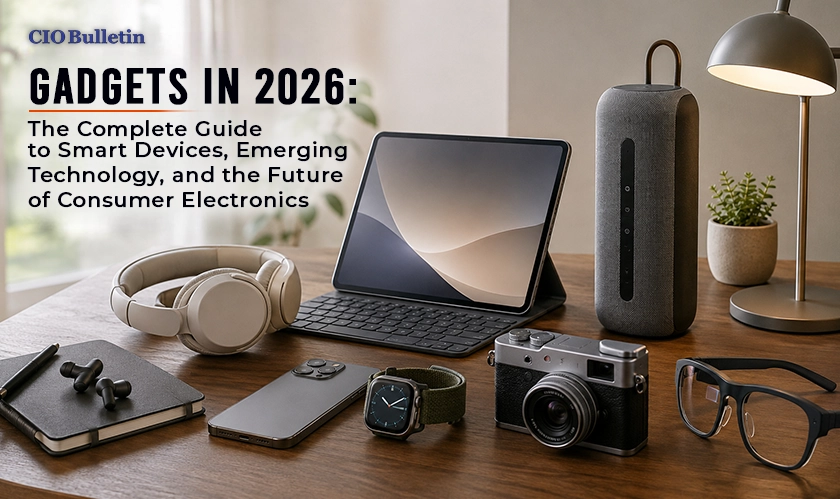
Take a look around your desk or living room. The items sitting there - your smartwatch, true wireless earbuds, magnetic power bank, or smart display - all fit into a simple category we call gadgets. In simple terms, a gadget is a sophisticated electronic or mechanical device designed to solve a specific problem quickly and efficiently. In the past, we thought of gadgets as separate devices like pocket calculators or basic digital stopwatches. Nowadays, gadgets in 2026 present a different story altogether, as highlighted by recent CIO Bulletin technology news reports.
If we take a look at technology hardware 20 years ago, it was really fragmented. One had to carry a camera, a portable music player, a GPS device, and a flip phone for calls. The first major disruption occurred when smartphones made all those devices redundant. Then came the era of connected accessories—fitness trackers and early home smart plugs that let you toggle lights from an app.
Presently, we are experiencing the evolution of the third major transition. The latest gadgets 2026 market will not be about abundant features or touchscreen tricks; it is all about context. The gadgetry of the 21st century relies on lightweight neural chips and edge computing to determine your needs even before you come up with a prompt.
We have moved far beyond buying devices purely for entertainment or novelty. Today's gadgetry represents the digital framework for daily activities, remote jobs, and health. Gadgets in 2026 act as mediators between human desires and digital intelligence, control energy consumption in smart homes, send health alerts, and filter the tedious notifications of the office. Without these physical touchpoints, all our advanced software models and cloud networks would remain out of reach.
For quite some time, the term "smart" referred only to Wi-Fi capability. If you needed to change some settings on your smart thermostat, you would still have to go to your app to adjust the temperature. That was smart, but it was still manual labor.
Today, smart devices 2026 have transformed into truly intelligent systems. An intelligent device doesn't wait for your command. It looks at ambient light, notices your sleep tracking data from your wearable ring, checks your calendar for early morning meetings, and adjusts your home’s climate and lighting setup on its own. The goal of modern gadgets in 2026 is not to provide users with another screen but to reduce the background noise of everyday life.
AI-Powered Gadgets: Artificial intelligence has moved out of data centers and into the microchips embedded in everyday devices. For example, voice recorders are now capable of transcribing speech and recognizing key discussion points without the use of an external internet connection. Pocket translators handle offline conversations across languages in real time, and smart security systems filter out windblown tree branches to only alert you when an actual package arrives.
Wearable Technology: Fitness bands that used to be seen as simple pedometers have now transformed into wearable health devices. The contemporary technology helps keep track of continuous changes in skin temperature, levels of stress, and variations in the heart rate. They give users clear insights into their recovery and energy levels, warning them to rest before burnout or illness takes hold.
Smart Glasses: It took time to perfect this technology, but smart glasses have finally entered ordinary life. The eyeglasses look like any stylish frames. However, despite this simple appearance, the frames have micro-LED displays and open-ear speakers built in. The eyeglasses help show arrows for navigation, display notifications, and translate signs in a foreign language. According to a report by CIO Bulletin, smart glasses are increasingly being used by the industry, as workers in warehouses and field service employees are making use of these hands-free overlays for complex repairs.
Foldable and Flexible Devices: The technology of screens has evolved significantly from the days of fragile plastic displays. Advanced foldable screens now use glass hinges that do not have seams. Not only do they perform perfectly fine with the modern daily flip and fold, but they also allow folding full-sized tablets into compact phones.
Even with smart glasses, health rings, and voice accessories being commonplace, a smartphone will not be disappearing. This is mainly due to the immense battery capacity of the phones along with the fast processors they provide, which makes it possible to perform heavy machine learning tasks and store secure health data from wearables and manage one's local smart home while being away.
Smart rings are very popular among people who dislike being distracted by screens, but find it inefficient to have health tracking tools available. Rings are worn on the finger and provide accurate signals concerning pulse and sleep without the hefty weight or need for everyday recharging. Smartwatches, however, can perform some functions as well that combat the disadvantages of smart rings by functioning well during workout sessions, notifying in case of falls, and allowing you to quickly call someone via a mobile phone left at home.
Wireless audio devices have become some of the best technologies in the inventory. The latest model of earbuds can automatically adjust active noise cancellation. That means that they can hear police sirens and flight announcements while drowning out any chatter that exists in the café. New devices provide spatial audio customized according to the shape of the user’s ear and serve as hearing assistants in crowded rooms.
Do you remember the time when smart home devices seemed impossible to install because different producers concentrated on their own systems? Unified open connection protocols have finally solved that mess. Now, smart locks, robot vacuums, light strips, and security sensors talk to one another instantly, regardless of who made them. You can build custom home routines in minutes without dealing with complex app setups.
Computers are undergoing their biggest upgrade cycle in years. The latest laptops feature dedicated neural engines built directly into the silicon. These AI PCs transcribe video meetings instantly, generate local code, edit high-resolution media, and run private AI models right on the device—all while delivering multi-day battery life. Recent analysis published by CIO Bulletin notes that these hardware advancements are fundamentally changing how IT teams purchase enterprise hardware for remote teams.
Handheld gaming consoles nowadays have more than enough graphics capabilities to allow users to get the top-of-the-line gaming experience, which means that many AAA games can be played wherever one goes. In addition, there have also been major advancements in augmented reality as well as virtual reality headsets that are extremely lightweight and come equipped with advanced displays and an amazing tracking system.
Before you indulge in your impulsive purchase, keep the following points in mind:
Compatibility: Make sure that whatever device you purchase is compatible with all your other devices.
Data Privacy: Make sure you check whether your device collects all your personal data from your phone or health monitoring systems.
Possibility of Repair: Check whether your device can be repaired over time.
Practicality of Its Use: Think about whether it really solves an actual problem in your life or whether you are going to forget about it after a short period of time.
Tracking future technology 2026 shows that hardware is becoming less prominent in our lives. There, we will no longer be focused on bright screens, with devices responding to spoken commands, hand motions, and the environment around us.
According to CIO Bulletin, technology hardware is supposed to take a backseat when it comes to daily routines. Exploring the latest technology 2026 reveals a clear trajectory: devices will become physically smaller and, at the same time, will receive more context-awareness capabilities. They will be able to assist with everyday things, keep us safe and healthy, and make our choices easier without requiring us to spend too much time looking at smartphones.
Gadgets in 2026 have come a long way and are no longer merely considered toys for entertainment, but rather supportive partners that improve work, promote health, and organize the space we live in. The implementation of smart solutions into daily life will allow for an effortless life without severely distracting from everyday routine.
Everything you need to know about this news
A simple gadget relies on straightforward human instructions (for instance, pressing a button), while a smart device utilizes local sensors and performs analytics at the unit so that it can predict the user’s needs and operate automatically.
Smart rings are popular with users who appreciate non-intrusive health tracking with extended battery life. However, smartwatches continue to be chosen by consumers who are active in sports, demand interaction with software, and request quick communications.
Processing data locally on a device's chip makes hardware much faster, allows features to work offline without internet access, and keeps sensitive personal data safe on your device instead of sending it to cloud servers.
Always choose devices that are compatible with widely used smart home technologies like Matter; in this way, all tech gear produced by different manufacturers will be able to connect and work together within the same application.
If you need to perform heavy tasks such as video editing, software development, or other resource-demanding activities, then it is worth buying an AI-enabled computer, as it will provide you with many advantages such as higher performance and longer battery life due to assistance in the execution of mechanical processes.


















































 consultants ltd.jpg)


Comments