
Home Industry Fintech Gamification in Fintech: Build...

CIO Bulletin
,
14 October, 2026
Author:
Vitalii Bulynin, Co Founder Of Versus Trade
A wallet celebrates another deposit. A banking app rewards a savings milestone. A broker pits two familiar assets against each other. Each design makes a financial activity easier to notice and repeat. The tension emerges when a rewarded action earns platform revenue while adding risk for the customer.
Across Asia and MENA, this sits in the boardroom now. Customer engagement in fintech can support acquisition and retention. Digital trust hinges on what those sessions produce. Three questions frame any investment:
Does the mechanic improve a useful customer outcome after the rewards stop?
Does the interface preserve an informed choice, including the choice to stop?
Can compliance and fraud teams explain, monitor, and disable it?
Responsible gamification uses game-like elements to support informed, voluntary financial decisions. It builds in safeguards against excessive risk, deception, and exclusion. Gamification in fintech makes useful progress visible, but joining must stay optional.
A badge for finishing a financial literacy exercise leads somewhere very different from a prize for placing yet another leveraged order. So gamification in financial services needs a product-specific review. The same animation might acknowledge learning in a personal finance app, or it might push costly repetition inside a trading service.
Versus Trade answers this design question through Versus Pairs, using familiar comparisons like Bitcoin versus gold to give relative asset performance a clear story. The format makes the market proposition simpler to explain: the position tracks how one asset performs against another. Product teams get a way to study competitive framing next to gamification, with customer understanding and sustained engagement measured separately.
A gamification strategy has to produce a useful outcome that sticks around. More taps during a promotion don't tell the whole story.
Fintech companies often use gamification to lower the effort of recurring financial tasks. Progress bars can show how far a customer has come toward a savings goal. A saving challenge might nudge someone toward a manageable deposit, and virtual rewards can mark completion without demanding a purchase.
These gamification elements may motivate users to engage with useful financial activities. But the benefit depends on what comes after. Going back to saving money after a break shows something completely different from opening an app just to keep a streak alive.
Retention needs evidence from comparable customer groups tracked over time. A period without rewards can help show whether the effect persists after incentives end. Growth also needs a denominator that filters out duplicate accounts and promotion abuse.
A lawful randomized trial can compare user experience and user engagement alongside complaints, fraud losses, and customer outcomes. A wallet might measure repeated legitimate payments. Banking apps could track progress toward financial goals set by the customer. Brokers need measurements of comprehension and risk exposure next to activity.
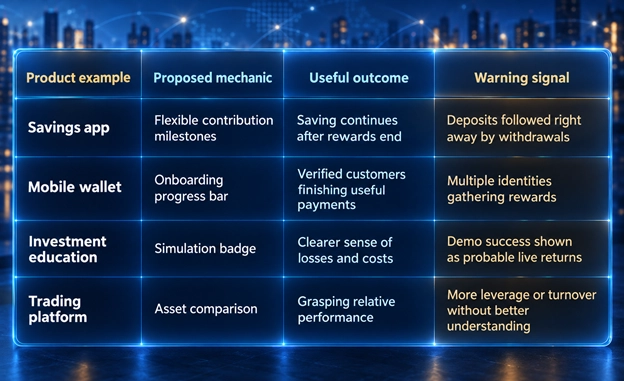
Gamification in banking can strengthen personal finance management when the customer controls the budget, targets, and schedule. Missing a contribution has to lead somewhere neutral. A broken streak that pushes someone to move money meant for bills chips away at financial well-being.
Gamification features can change financial behavior, but more trading activity doesn't mean sustainable growth follows. And findings from one product category don't transfer automatically across savings, payments, and leveraged products.
In June 2024, the UK's Financial Conduct Authority published an online experiment with more than 9,000 consumers. It tested:
Flashing prices.
Push notifications.
A trader leaderboard.
Points with a prize draw.
Push notifications and points tied to a prize draw increased trading frequency and the share of high-risk trades during the experiment. Effects varied by feature, and none produced a statistically significant increase in the riskiness of final portfolios. Some effects hit harder among participants with lower financial literacy.
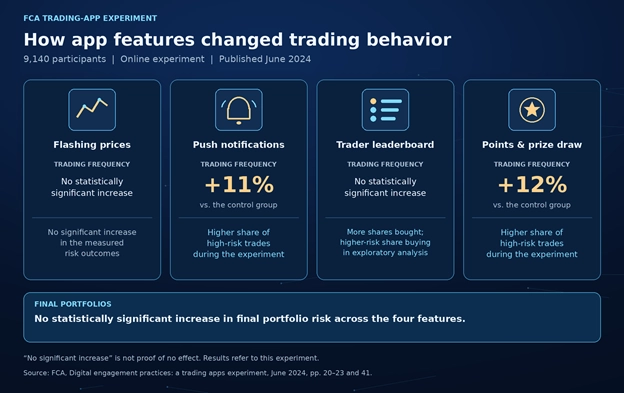
For gamified trading apps, the findings bring trading frequency and risk exposure into the evaluation loop alongside engagement. The commercial takeaway is specific: more activity should be weighed against customer outcomes over time. Retention stays its own metric, tracked within each product and customer group.
Education gives game-like feedback a real role in preparation. A simulation can reward completion, comparison, and reflection while keeping the exercise separate from any real-money transaction.
The profile of Merlin Investor describes a Strategies Playground for creating, comparing, and back-testing investment strategies. This example puts gamifying at the preparation stage, where customers can test a strategy and review its risks before putting anything into play. Comprehension checks then help measure what the exercise actually taught.
For executives implementing gamification, these gamification ideas turn into product requirements:
The target action matches a financial objective the customer chose.
Rewards recognize learning or useful completion without pushing up exposure.
Opting out keeps access to the core service intact.
Testing covers comprehension, complaints, and fraud, not just conversion.
The feature has a named owner and a documented shutdown threshold.
These gamification principles tie engagement to a useful purpose and give teams a consistent way to evaluate a fintech product.
The boundary gets crossed when design undermines informed choice or steers customers toward actions that benefit the platform at their expense. In the fintech industry, scrutiny follows incentives, not just gaming elements.
In August 2021, the US Securities and Exchange Commission requested information and public comment on digital engagement practices used by broker-dealers and investment advisers. Its inquiry addressed behavioral prompts and potential conflicts when optimization favors platform revenue or engagement. This was an information request, not a blanket prohibition on gamification.
For a CIO, the concern turns concrete when a prompt is personalized to encourage additional risk. A notification after a loss that urges an immediate new position deserves a different review from a reminder to finish an educational module. Dark patterns can also appear outside reward systems, through hidden charges, preselected consent, or obstructive cancellation.
Learning works best when the incentive follows understanding. Educational content can live throughout the customer journey, with comprehension measured separately from article views or completed modules.
The Versus Trade blog supports that journey with explanations of markets and trading concepts. In a responsible design, content about complex financial concepts, product costs, and loss scenarios helps customers evaluate a position before putting money down. Interactive financial exercises can add feedback, while a demo gives that knowledge a practical setting.
Product teams that add gamification to fintech apps choose what the experience recognizes as success. A simulation can acknowledge a well-reasoned decision to sit out a trade. With live leaderboards, return figures need context like position size and risk taken. The reward logic shapes the financial behavior the interface encourages.
European retail CFD protections show that regulators assess leverage and incentives together. They provide a comparison for product governance, not automatic authorization in another market.
ESMA's 2018 intervention framework set opening leverage limits from 30:1 for major currency pairs down to 2:1 for cryptocurrency CFDs, with 5:1 for individual equities. Other measures included:
Account-level negative balance protection.
Margin close-out requirements and standardized warnings.
Restrictions on incentives to trade CFDs.
ESMA's temporary measures expired in July 2019 after most national regulators adopted permanent restrictions at least as stringent. Current obligations depend on the applicable national measures.
A fintech gamification proposal involving leveraged products needs more than a disclaimer. Reward logic and exposure settings require review together. The entity, customer classification, and national rules determine actual obligations.
Versus Pairs brings relative asset performance into a comparison people already recognize. Bitcoin versus gold, for example, turns a market view into which asset will do better against the other, while the resulting position remains a leveraged CFD.
The fixed leverage is 1:20 for stock pairs and 1:100 for most other pairs, separate from the maximum leverage available on the wider account. Compared with higher leverage, these settings require more margin for the same position size and limit the exposure you can get from a given amount of capital. Market movements, pricing, and execution still decide the trading result.
This product shows how engagement and safeguards handle different parts of the customer journey. The asset comparison provides the story. Demo access lets customers practice before committing real capital. Identity verification and client-money arrangements support account operations. Instrument-specific leverage gives customers a defined margin requirement when sizing up a position.
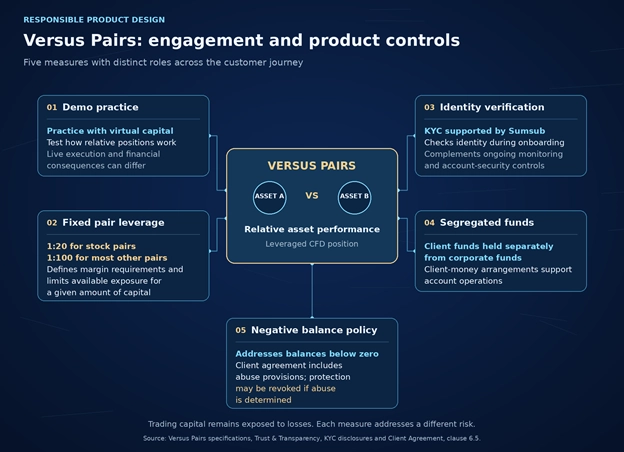
Effective safeguards have a clear purpose and clearly communicated terms. Their value comes from helping customers understand how the account operates and what protection applies.
When customers trade asset vs asset, the relative-performance format sits alongside the practical details of a CFD position: margin, costs, and potential losses. A demo provides a setting to practice these decisions, with live trading introducing real financial consequences and different execution conditions.
Segregated client accounts keep customer funds separate from corporate funds. Sumsub supports KYC verification, which establishes identity during onboarding. Across fintech, these controls work alongside reconciliation, ongoing transaction monitoring, and measures against account takeover, each addressing a different operational risk.
Negative balance protection addresses the risk of an account falling below zero. Under the available client agreement, the policy includes abuse provisions and may be revoked if abuse is determined. Explaining those terms alongside the protection gives customers a clear picture of its scope. The capital held in the account remains exposed to trading losses.
Market expansion requires the engagement model and regulatory permissions to develop in step. Fintech compliance depends on the activity, the contracting entity, and the customer jurisdiction.
Cross-border operations make entity-level disclosure particularly important. The Mauritius FSC license referenced in the public disclosures and the Saint Lucia entity named in the available client agreement concern distinct parts of the operating structure. Clear customer documentation needs to identify the contracting entity and applicable protections. Regulatory comparisons help most when they explain licensing scope, conduct rules and complaint resolution routes. The term "lower-tier regulator" is an external rating label, not an official legal category.
In Indonesia, OJK's POJK 22/2023 addresses consumer protection and market conduct, covering product design, information, marketing, and complaint handling. Bank Indonesia separately oversees payment system licensing. Across Asia and MENA, the permissions relevant to a wallet, bank, or broker need to be mapped to the service offered in each market.
Product, compliance, security, and operations share responsibility for the reward lifecycle. Their coordination helps keep onboarding, incentive eligibility, and withdrawals consistent as customer engagement grows.
The BioCatch profile shows how behavioral monitoring can complement identity controls. Proportionate data collection and privacy governance give that monitoring a defined scope.
A rollout sequence assigns responsibility at each stage:
Map the entity, market permissions, and permitted incentive types.
Define the useful behavior and the customer harm that would stop the test.
Test local-language comprehension, accessibility, and notification controls.
Monitor duplicate accounts, suspicious referrals, and reward farming.
Review outcomes by cohort and disable mechanics that breach agreed thresholds.
Financial management tools can use gamified elements to connect small milestones with financial goals. Mobile banking apps and other banking apps can help customers manage their money by making progress toward real financial goals visible. The evaluation then tracks whether those features support positive financial behaviors and steadier financial habits. For fintech platforms seeking to improve customer engagement, those outcomes give retention a meaningful commercial context.
The release decision rests on what continues after incentives fade: useful activity, understood risks, and customers who retain control over their financial decisions.





















































 consultants ltd.jpg)


Comments