
Home Other Blogs CIO Bulletin Analyzes How Luna...
CIO Bulletin
,
16 September, 2026
Author:
Sambhrant Das
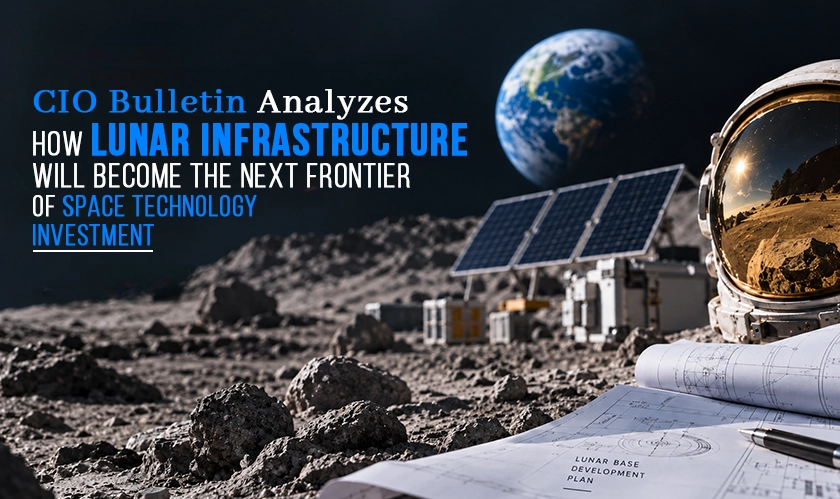
The commercial race to the Moon is no longer a localized project of government agencies or a subject restricted to science fiction. As nations prepare for a sustained human presence on the lunar surface, private capital is pivoting rapidly toward off-planet operations. Building facilities, energy grids, supply chains, and communication nodes beyond Earth's orbit is moving from theoretical research into active commercial deployment. Cutting-edge space technology companies are positioning themselves to capture early-mover advantages in this expanding domain.
The broader space investment climate is undergoing a major structural shift. While Low Earth Orbit (LEO) satellite networks initially attracted the lion’s share of venture funding, investors are now extending their horizons toward cislunar space. Permanent settlement and economic utilization of the Moon require a robust foundation, making lunar infrastructure the foundational pillar for the next multi-trillion-dollar off-world economy. Here is CIO Bulletin’s guide to the top six factors driving the emergence of a commercial off-world economy.
A continuous power supply is essential for any long-term off-world operations. Companies relying on advanced space technology are designing solar arrays tailored to extreme temperature fluctuations and compact nuclear reactors meant for the two-week-long lunar nights. Establishing reliable power generation facilities serves as the foundational utility layer upon which all other off-planet industrial tasks depend.
The high cost of transporting heavy materials from Earth prohibits sustainability. To address this issue, some engineering companies attracting substantial lunar infrastructure investment are creating rovers bearing autonomous 3D printing technology, which will enable the use of the lunar regolith for building pads and shelters with protective earth berms against radiation. The automated construction ecosystem will also minimize the need for supplies shipped from Earth, thus making space launch cheaper.
One of the key resources sought by commercial organizations is water ice deposits that are retained in the permanently shadowed areas of the poles. The water can be obtained through In-Situ Resource Utilization (ISRU) technology for water processing and splitting it into hydrogen and oxygen. The production of fuel on-site facilitates the departure volume for interplanetary travel.
Reliable data transfer is an integral component of remote activities, autonomous robotic units, and human settlements. Private enterprises are developing their private satellite systems, improving performance in positioning, navigation, and timing (PNT) and data transmission back to Earth. Strategic capital allocation toward telemetry and broadband coverage is accelerating to support autonomous navigation and live monitoring.
Transporting heavy machinery equipment, raw materials, and astronauts across perilous terrains calls for specialized travel solutions. Substantial investment is being put into autonomous transport vehicles, unmanned cargo ships, and variable landing vessels that are meant to conduct regular missions. These transport networks unite isolated outpost bases into an integrated industrial grid.
The ability to process significant flight and operational data on the Moon eliminates delays in transmissions to Earth. Using radiation-resistant micro-computers and local edge computing servers will allow for instant decisions to be made by automated fleets of robots, saving them from radiation and communication blackouts.
The transition toward commercial off-world utility systems is driven by economics, strategy, and risk mitigation.
First, public-private partnership frameworks—such as NASA’s Commercial Lunar Payload Services (CLPS) program—guarantee baseline revenue for private contractors. By acting as an anchor customer, government agencies de-risk capital expenditures for private venture firms building the future of commercial space technology.
Second, early movers who control essential utilities—like propellant, power distribution, and data relay—will hold natural monopolies over the next century’s off-world logistics chain. The establishment of this base would enable the creation of profitable income streams that would grow with each mission carried out thereafter.
Finally, the technologies of space launch vehicles have recently been advancing with rapid speed, thus significantly reducing the cost of reaching orbit. The lower costs of launches have turned some projects, which were unprofitable a decade ago, into feasible projects financed by funds and listed on balance sheets.
The long-term outlook for establishing permanent facilities beyond Earth presents immense structural upside alongside serious operational risks.
On the positive side, building utilities beyond Earth has opened an entirely different economy. It forms valuable industries on Earth, speeds up the development of new clean energy, material science, and robotics technologies, and also creates a sustainable base for long-distance logistics in space.
However, severe challenges remain. Capital intensity is exceptionally high, and payback time takes much longer than investors are ready to wait. Operational environments on the Moon are extremely hostile, comprising high-temperature differences, talcum dust, and sun rays. The situation is worsened by the uncertainty regarding property rights in space, as well as extraction and regulations.
Despite these hurdles, momentum continues to build as more and more companies push the boundaries of modern space technology. Overcoming the engineering and financial obstacles will allow humanity to achieve permanent colonization of the solar system.
Essential Steps for Strategic Investors
Review Anchor Contracts: Seek businesses with solid backing from public-private partners and contracts confirmed by the government.
Prefer Modular Hardware: Give priority to businesses with a focus on developing reusable, standardized, and modular surface devices.
Monitor Enabling Technologies: Explore investments in essential technology industries like autonomous machines, radiation protection, and high-density energy storage.
Evaluate Supply Chain Resilience: Assess the strategies used by companies to resist trade friction and component bottlenecks.
Maintain Long-Term Perspective: Invest in portfolios designed to provide for the long engineering development lifecycle typical of outer-space activities.
Everything you need to know about this news
Investments in satellites deal with Low Earth Orbit (LEO) devices for the benefit of terrestrial customers. Investments in the Moon assume the establishment of physical stations, processing facilities, and power stations on the Moon that enable the creation of off-Earth industrial systems.
Companies make money by getting contracts through government services, leasing out payload space from the Moon’s surface, selling access to power and information, and generating fuel from water.
The hardest technology problem for lunar construction is dealing with the Moon’s regolith dust, which can cause issues to seals, joints, and solar panels, and having technology that survives through two weeks of lunar night without freezing.
Companies that manufacture robotics, advanced materials, compact nuclear and solar energy generation, autonomous software, and specialized logistics are ideally placed.
Technologies developed for extreme environments outside of Earth directly translate into breakthroughs in Earth technologies like ultra-efficient power networks, advanced systems for recycling water, remote medicine technologies, and autonomous robots.

















































 consultants ltd.jpg)


Comments