
Home Industry Digital marketing How Apartment Communities Can ...
CIO Bulletin
,
10 September, 2026
Author:
Guest
Renters don't discover apartment communities anymore; they research them. By the time someone calls the leasing office, they've toured the website, judged the photos, read the reviews, and mentally ranked the community against three others, all without a single human interaction.
Communities that win consistent lead flow, and this pattern shows up in leasing offices throughout the US, treat that invisible research phase as the real leasing funnel and build for it deliberately.
Here's how the system fits together.
Every channel eventually lands renters on the website, which makes it the foundation the whole strategy stands on. The site's job is to answer a renter's questions faster than they can think of them.
Current pricing and real availability: not a "contact us for details" placeholder
Photos and video that match what the tour will actually show: no gap between marketing and reality
Floor plans with square footage and what's included: concrete detail, not vague descriptions
A tour scheduler that works in under a minute on a phone: frictionless enough to actually convert interest
Speed matters as much as content, since most searches happen on mobile between other tasks. A community whose site loads instantly and answers honestly converts researchers into tours while slower competitors are still loading their hero image. Every other tactic ultimately points back here.
The demand side of this strategy never sleeps. A Census Bureau press release reports that renter-occupied housing units grew from 43.3 million to 44.6 million between the 2014–2018 and 2019–2023 American Community Survey periods. That's an increase of over a million rented homes. It happened even as homeownership also climbed. That growth means a large and expanding pool of renters is searching for their next home in your market every single day.
That constant churn is the opportunity: leases end year-round, jobs relocate people monthly, and life changes generate movers in every season. A community with an always-on digital presence harvests that steady stream, while one that markets only when vacancies spike is perpetually starting from zero. Consistency, not campaigns, is what the math rewards.
Renters begin at the search bar, so the communities that appear there collect the leads through a blend of local SEO, an optimized business profile with fresh photos and reviews, and paid ads capturing the highest-intent phrases. Specialized digital marketing for apartment communities pulls these visibility channels into one coordinated effort rather than a stack of disconnected vendors.
Agencies that build integrated programs for multifamily operators, such as Premier Online Marketing, coordinate organic and paid visibility rather than treating them as separate efforts. Ads deliver immediate presence while SEO compounds into free leads over time, and the two channels sharpen each other through shared search data. Communities visible in both places dominate the moment a renter starts looking, which is the only moment that counts.
Between finding a community and booking a tour sits the trust check, and renters run it religiously. What they find decides whether the funnel continues:
Recent reviews, and just as important, management's replies to the hard ones
Resident photos and videos that corroborate the marketing
Social accounts showing actual community life, not just stock amenities
Testimonials that mention the staff by name
No community controls every review, but every community controls its response rate, its follow-up with happy residents, and the freshness of its content. A simple habit, asking satisfied residents for a review at move-in anniversaries and after resolving maintenance tickets, steadily tilts the average. Managed well, social proof works like a leasing agent around the clock.
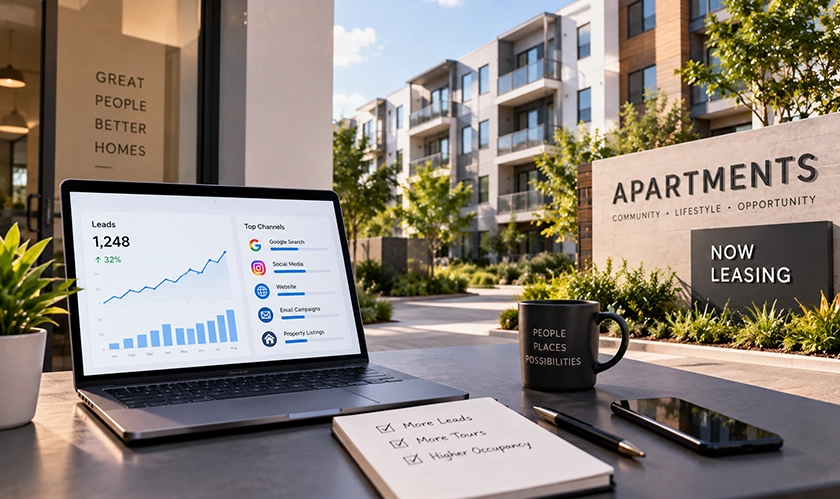
The difference between a collection of tactics and a strategy is measurement. Tracking which channels produce not just leads but signed leases reveals where the next dollar should go, and the picture often surprises: the channel with the most inquiries is frequently not the one producing residents.
Simple instrumentation covers it: tracked phone numbers, form source tags, and a monthly review of cost per lease by channel. From there, the strategy tunes itself, shifting budget toward what fills units. A report showing cost per lease by source also settles most internal debates before they start. Communities that run this loop get measurably stronger every quarter.
The communities that never worry about lead flow all share a trait that has nothing to do with budget size: their digital pieces work as one machine. The website converts what search delivers, reviews confirm what the website promises, and data quietly reallocates effort toward whatever is working best this quarter. Any single tactic can be copied by the property down the street; the connected system is much harder to match. Build it once, maintain it honestly, and it compounds while competitors chase one-off campaigns. Renters are researching tonight, in every market, in every season. The strategy's whole job is making sure what they find leads them to your door.





















































 consultants ltd.jpg)


Comments