
Home Technology Gadgets CIO Bulletin Explores Top Smar...
CIO Bulletin
,
19 October, 2026
Author:
Ravathi Sunil
Rapidly changing consumer technology is changing the way people organize their lives, secure their homes, and improve their personal productivity. These days, automation of homes and interconnected ecosystems have become a reality rather than a fantasy. At CIO Bulletin, we study how new solutions make a connection between AI, IoT hardware, and life improvement. There are plenty of interconnected gadgets in the contemporary market, but there are only a few revolutionary gadgets that are really useful and change human-machine interactions completely. Modern technology brings convenience, environmental friendliness, and security to users. Knowledge of such technologies will help homeowners and business owners create an environment control system that will suit their needs perfectly.
Redefining Daily Routines Through Modern Home Automation
It is important to comprehend how connected devices keep changing human lifestyle habits before looking at particular devices. With the introduction of advanced features like high-speed Wi-Fi connectivity, low-latency Matter connectivity protocols, and edge-AI computing power, home automation has evolved from simple switch functions to self-learning spaces. Currently, users seek smart devices that predict their needs, decrease energy usage in homes, and minimize operational hassles. With growing adoption of smart homes worldwide, consumers now need benchmarks for reliable technology with a user-friendly interface.
Top Smart Gadgets That Are Changing the Way We Live
To help readers navigate the bustling technology landscape, we have identified five standout connected innovations that represent the pinnacle of modern functional design and technical excellence.
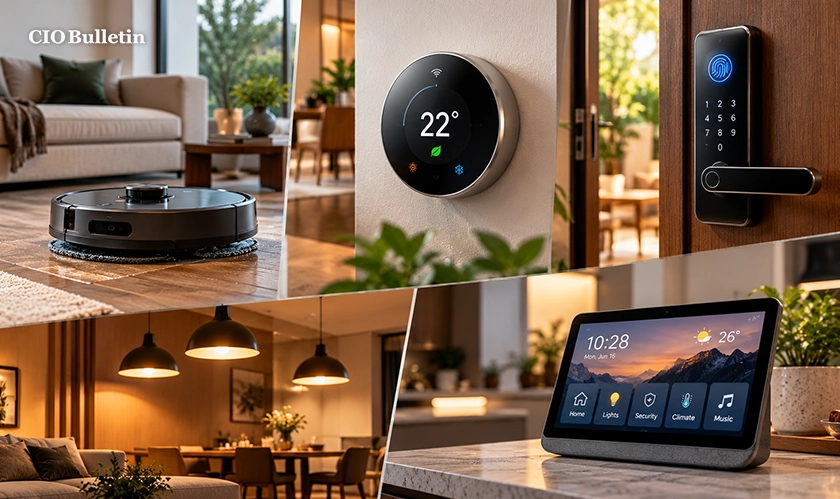
Floor maintenance has been completely revolutionized by modern autonomous cleaning stations. They have been fitted with the technology of LiDAR navigation, double-line laser obstacle avoidance, and visual perception technology powered by generative AI. As opposed to the older models, which needed regular manual adjustment, nowadays' best models boast automatic docks that empty the vacuum dust bins, clean the mop pads using hot water, blow-dry the cleaning accessories, and refill the water tanks.
Climate control contributes to a substantial share of energy costs incurred in homes. These concerns are addressed by learning thermostats that make use of both accurate sensing technology and forecasting methods. Through analysis of daily behavior, weather conditions, and heat retention capabilities of the room, these thermostats are able to regulate the temperature indoors in an optimal way. This is done without compromising the comfort of individuals. In addition, one can modify the temperature through the use of mobile phone apps and analyze their energy costs.
In terms of home security and access control technology, there is a quantum shift that has occurred due to keyless biometric door locks. These entry system devices come with high-resolution fingerprint scanners in 3D format, encrypted PIN touchpads, mobile phone proximity sensors for unlocking doors, and the ability to create guest access passes temporarily. One can keep track of entry logs in real time, create temporary digital keys to be given out to service personnel or guests, and know whether the door is locked or unlocked.
Lighting is fundamental to home aesthetics, circadian cycle maintenance, and physical security. Modern smart lighting systems are much more than just simple dimmable LED light bulbs. Employing smart hubs and wireless technologies compatible with Matter, smart lighting enables one to schedule lighting to change dynamically like the real daylight cycle, helping one to feel energized in the mornings and relaxed at night. Moreover, the combination with motion sensors ensures lights turn on and off only when rooms are being used, thus saving energy and increasing convenience.
Serving as the nervous system of the connected home, smart displays bring together various smart devices under one roof in the form of a unified, cohesive dashboard. These hubs rely on the power of conversational artificial intelligence to process complicated voice commands, show live video feeds of surveillance cameras, manage users’ schedules, and entertain the atmosphere. Whether helping with organizing the schedule for the day ahead or functioning as an interactive kitchen recipe advisor, voice hubs have got users covered.
Strategic Industry Outlook
With the development of consumer technologies, the integration of hardware, edge computing, and artificial intelligence is bound to be a key factor in driving the evolution of the economy and industries in general. From our analysis at CIO Bulletin, the future of personal technologies is that of interoperable, environmentally friendly, and secure platforms. With rapid adoption rates globally, it pays to stay up-to-date on important technological trends.
Transforming Everyday Life Through Intelligently Connected Ecosystems
The widespread adoption of top smart gadgets marks a crucial milestone in how human beings interact with their immediate physical environments. Investing in the best smart gadgets is no longer merely about novelty or luxury; it represents a fundamental shift toward sustainable, automated living. As these technologies mature, evaluating these top five smart gadgets through an objective lens empowers individuals to curate personalized spaces that actively elevate their quality of life.
Everything you need to know about this news
An automated home ecosystem provides significant energy efficiency, enhanced physical security, time savings on routine domestic chores, and centralized remote control over home environment settings.
While internet connectivity is required for remote mobile app access and cloud-based features, many modern devices utilize local protocols like Matter or Zigbee to process routines locally even when offline.
Smart thermostats analyze household routines, adjust temperatures automatically when rooms are unoccupied, and optimize heating and cooling cycles based on real-time local weather forecasts to eliminate energy waste.
Yes, high-quality smart locks use AES 128-bit or 256-bit encryption for wireless communications, paired with anti-tamper physical alarms and local biometric processing to prevent unauthorized access.
Beginners should start with foundational devices such as a smart display hub and intelligent lighting or smart plugs, gradually expanding into climate control and security systems as their automation needs grow.


















































 consultants ltd.jpg)


Comments