
Home Industry Healthcare How ELISA Kits Support Researc...
CIO Bulletin
,
18 September, 2026
Author:
Guest
Sepsis is a life-threatening condition in which the body's response to infection becomes dysregulated and causes tissue and organ damage. This complex response involves the release of inflammatory mediators, changes in immune-cell activity, endothelial dysfunction, and, in severe cases, organ failure. That is why it is crucial to diagnose and treat it early. Here is where ELISA kits come into play.
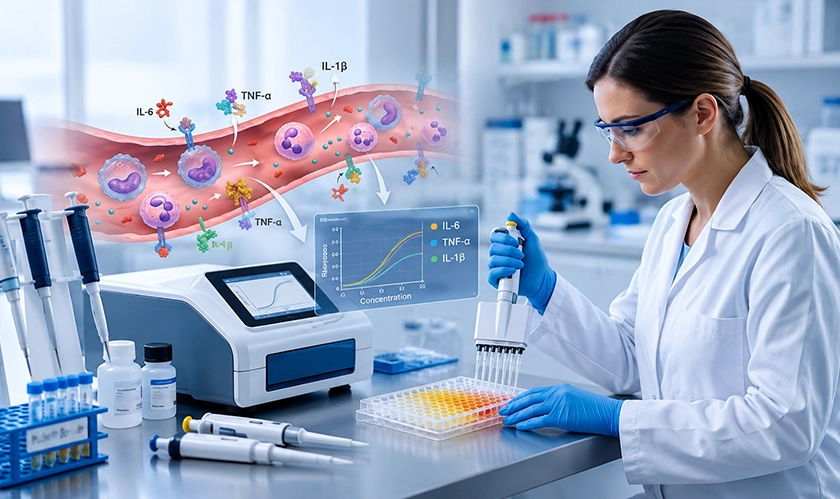
Researchers use ELISA kits to understand how sepsis develops, progresses, and affects different biological systems. This technique helps measure cytokines, inflammatory proteins, and other biomarkers in biological samples.
The immune system normally responds to infection by recognizing invading microorganisms and activating defense mechanisms. However, this response becomes dysregulated during sepsis. Instead of remaining localized to the site of infection, inflammatory signaling can become widespread and contribute to tissue injury and organ dysfunction.
During this response, immune cells can release signaling molecules known as cytokines. So, researchers investigate various inflammatory mediators during sepsis research. It includes:
Interleukin-1 beta (IL-1β)
Interleukin-6 (IL-6)
Tumor necrosis factor-alpha (TNF-α)
Interleukin-8 (IL-8)
Interleukin-10 (IL-10)
Interleukin-18 (IL-18)
These molecules can participate in different stages of the inflammatory response. Research has shown that concentrations of several inflammatory cytokines can change in patients with sepsis, although individual cytokines are not specific enough to be considered definitive indicators of sepsis on their own.
Therefore, researchers often investigate multiple biomarkers and their relationships with clinical or experimental parameters rather than relying on a single molecule.
Sepsis is biologically complex. Two individuals with sepsis can have different patterns of immune activation. So, it is crucial to understand the molecular pathways involved.
Researchers measure different inflammatory biomarkers to:
Characterize immune responses during sepsis
Investigate cytokine signaling pathways
Compare inflammatory profiles between experimental groups
Study relationships between biomarkers and disease severity
Evaluate potential therapeutic targets
Investigate responses to antimicrobial or anti-inflammatory interventions
Identify candidate biomarkers for further investigation
For example, researchers use ELISA kits to quantify TNF-α, IL-1, IL-6, HMGB1, and C-reactive protein in serum samples. This helps them identify how sepsis develops, progresses, and how treatment works.
Enzyme-linked immunosorbent assay (ELISA) is an immunoassay technique that uses specific antibody-antigen interactions to detect and quantify molecules in biological samples.
For sepsis research, researchers use the sandwich ELISA format. It involves several key steps:
A capture antibody binds the target molecule.
The biological sample is added to the assay.
The target antigen binds to the capture antibody.
A detection antibody binds to another region of the target.
An enzyme-linked detection system produces a measurable signal.
The signal is compared with a standard curve to estimate the target concentration.
This provides researchers with quantitative information about the concentration of specific cytokines or proteins. Since ELISA is known for high specificity and sensitivity, it can be applied to both in-vitro and in-vivo research.
IL-6 is one of the most extensively investigated cytokines in sepsis research. It participates in inflammatory signaling and can increase during systemic inflammation.
Researchers have investigated IL-6 concentrations in relation to sepsis severity, septic shock, organ dysfunction, and clinical outcomes.
So, researchers use the ELISA technique to measure IL-6 and then compare IL-6 concentrations across experimental or observational groups and investigate changes over time.
TNF-α is another important inflammatory mediator. It participates in early immune signaling and has been investigated in relation to septic shock and systemic inflammation.
A study of patients with sepsis and septic shock used high-sensitivity ELISA to measure TNF-α at multiple time points and found higher TNF-α concentrations in patients with septic shock than in those with sepsis without shock.
This shows how ELISA measurements can help researchers examine temporal changes in inflammatory mediators.
IL-1β contributes to inflammatory signaling and is frequently investigated alongside IL-6 and TNF-α.
Researchers measure IL-1β to examine whether experimental interventions alter inflammatory responses and how different cytokines behave relative to one another.
Sepsis does not involve only pro-inflammatory signaling. Anti-inflammatory mechanisms can also become activated.
So, researchers measure IL-10, an important anti-inflammatory cytokine, alongside pro-inflammatory cytokines to investigate the balance between inflammatory and regulatory immune responses.
Researchers may also investigate molecules, such as IL-8, IL-18, HMGB1, pentraxin 3 (PTX3), and other inflammatory or immune-regulatory proteins.
Animal and cellular models are widely used to investigate the mechanisms underlying sepsis.
Researchers may induce an experimental inflammatory or sepsis-like response and subsequently collect:
Serum
Plasma
Cell culture supernatants
Tissue homogenates
Other validated biological samples
Researchers use target-specific ELISA kits to quantify inflammatory proteins before and after the treatment in these samples. This helps them determine whether the intervention alters inflammatory signaling.
This further helps in preclinical drug research, where researchers need quantitative molecular endpoints alongside physiological or histological measurements.
ELISA kits can also support research into potential treatments for sepsis-associated inflammation.
For instance, researchers are investigating an experimental anti-inflammatory compound. They could divide an experimental model into control, disease-model, and treatment groups and measure selected inflammatory biomarkers.
A reduction in biomarkers such as IL-6 or TNF-α after treatment may provide evidence that the intervention influences inflammatory signaling. Researchers can then combine these molecular findings with other experimental endpoints.
However, a change in one biomarker should not automatically be interpreted as evidence of therapeutic effectiveness. Sepsis involves multiple interconnected pathways, and biomarker results need to be interpreted alongside other experimental and clinical data.
Now that you know how ELISA helps in sepsis research, what are you waiting for? Find a reliable supplier, like AAA Biotech, to buy high-quality ELISA kits. This helps you ensure you get accurate and reproducible results.
At AAA Biotech, researchers can find a range of ELISA kits for different cytokines, inflammatory proteins, and other research biomarkers. The company's ELISA portfolio provides target-specific options that can support research involving immune responses, inflammation, disease mechanisms, and biomarker analysis.
For sepsis-focused research, researchers can select kits according to the biomarker, species, sample type, and intended research application. This makes target-specific ELISA kits useful when designing experiments to investigate inflammatory pathways or evaluate changes following an experimental intervention.





















































 consultants ltd.jpg)


Comments