
Home Industry Healthcare Healthcare Systems Are Outsour...
CIO Bulletin
,
16 September, 2026
Author:
Guest
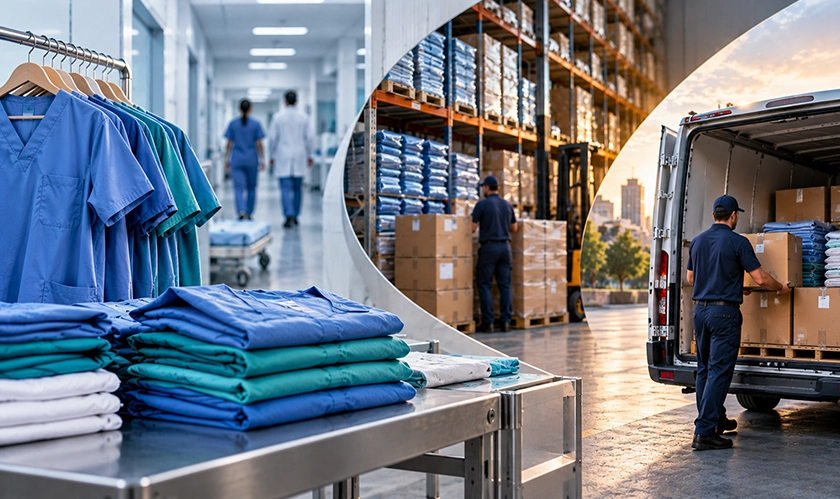
A uniform may look like a small part of healthcare operations. Multiply it across thousands of employees, dozens of departments, and multiple facilities, and it quickly becomes a logistics problem. Scrubs, lab coats, jackets, polos, and branded workwear all have to be ordered, stored, tracked, packed, and delivered to the right people at the right time.
For growing healthcare systems, managing that process in-house can eat up more staff time than expected. HR teams, procurement departments, and office managers can end up handling inventory questions, replacement requests, shipments, and returns alongside their regular work. That is pushing more healthcare organizations to turn to third-party logistics, or 3PL, partners that can manage apparel movement while internal teams stay focused on larger operational priorities.
For a small clinic, ordering uniforms may be a straightforward administrative task. For a healthcare system operating across multiple facilities, it becomes a different challenge. There may be hundreds of job roles, multiple approved garments, different sizing needs, department-specific apparel, and employees spread across several locations.
New hires need uniforms. Existing employees need replacements. Special campaigns may require branded apparel on a deadline. That creates a steady flow of smaller orders that still require time and coordination.
Internal teams can quickly find themselves spending hours tracking shipments, checking stock, answering employee questions, and arranging replacements. Outsourcing gives those responsibilities a dedicated operational home.
A 3PL partner takes care of the practical work that happens after apparel is produced and ready to move. For a healthcare organization, that can mean receiving uniforms and branded products from suppliers, storing them in a warehouse, tracking inventory, picking the right items for each order, packing packages, and shipping them to employees or healthcare facilities.
The work can continue after delivery. A 3PL may handle returns, size exchanges, damaged items, replacement orders, and inventory reporting. Some providers also offer online ordering portals where employees can choose approved apparel while managers monitor stock and order activity. In simple terms, the healthcare organization decides what apparel should be available, while the 3PL handles much of the storage, order processing, and movement needed to get those products where they belong.
Outsourcing logistics does not mean turning apparel into a generic commodity. Healthcare organizations still need uniforms and promotional products that reflect their identity.
Oak and Twine helps businesses turn their branding ideas into custom apparel, promotional products, and workwear. For healthcare groups, having a reliable apparel source can support everything from employee workwear to branded pieces used for community events, recruitment efforts, and outreach programs.
The logistics layer can then connect those products to the people and locations that need them. That combination of brand control and operational support can make a distributed apparel program much easier to manage.
One of the clearest changes in outsourced apparel programs is how employees place orders. Instead of emailing an office administrator for a replacement shirt or waiting for a department-wide order, employees can use a dedicated ordering portal.
Approved products, sizes, colors, and quantities can be presented in one place. Behind the scenes, the 3PL receives the order, pulls the correct items, packages them, and ships them.
For HR and administrative teams, that can remove a surprising amount of repetitive work. For employees, it creates a simpler ordering experience that feels closer to regular online shopping.
Inventory management is another area where a 3PL partnership can deliver operational value. Healthcare organizations often have to balance product availability with the cost of holding extra stock. Too little inventory can create delays, while too much can leave money sitting on shelves.
A 3PL can provide data on order frequency, product movement, popular sizes, location-level demand, and slow-moving inventory. That information can help procurement teams make better purchasing decisions.
Rather than relying on occasional stock checks or estimates, leaders can use actual fulfillment activity to identify purchasing patterns and adjust future orders.
Scale is where the case for a 3PL can become more compelling. A healthcare organization with one facility may manage apparel locally without much difficulty. Add hospitals, outpatient centers, specialty clinics, laboratories, and administrative offices, and the process becomes harder to standardize.
A centralized fulfillment model can give different locations access to the same approved product catalog while maintaining consistent ordering rules. It can also support expansion. When a healthcare organization opens a new location, that facility can be added to an existing apparel and fulfillment program instead of starting a separate process.
No apparel program runs perfectly. Employees order the wrong size. Items arrive damaged. People change departments. New hires leave before their uniforms are used.
Without a defined process, these situations can create extra administrative work. A 3PL can manage returns and exchanges alongside regular fulfillment, giving organizations a clearer process for handling common apparel issues.
Healthcare organizations should establish return rules before launching a program. Those rules can explain how damaged items, size exchanges, unused apparel, and employee departures will be handled.
Choosing a logistics partner should involve more than comparing shipping rates. Healthcare leaders should look at the complete operating model and how well it fits their workforce.
Important questions include:
How quickly are orders fulfilled?
Can employees order through a dedicated portal?
Does the provider offer inventory reporting?
Can different facilities have different product rules?
How are returns and exchanges handled?
Can the platform connect with procurement or HR systems?
What happens when demand suddenly increases?
Which performance metrics will be reported?
Service agreements can also set expectations around fulfillment times, inventory accuracy, shipping, customer support, and issue resolution. Clear targets give both sides a way to measure whether the program is working.
Healthcare organizations are increasingly expected to operate efficiently while supporting larger, more distributed workforces. Apparel may not be the biggest line item in that equation, yet inefficient processes can still consume valuable staff time. A 3PL approach shifts apparel logistics toward a more structured operating model, allowing healthcare leaders to retain control over branding, approved products, purchasing policies, and employee standards while an external partner handles the physical work.
For growing healthcare systems, that division can turn apparel from an administrative chore into a measurable, scalable supply-chain function. As more organizations look for ways to simplify operations without hurting employee experience, outsourced apparel logistics offers a practical path toward smoother ordering, stronger inventory control, and more consistent fulfillment across locations.
Everything you need to know about this news
Healthcare systems are outsourcing apparel logistics to 3PL partners to alleviate the administrative burden on internal teams.By outsourcing, HR teams, procurement departments, and office managers can focus on their core responsibilities while 3PL partners manage the complexities of inventory, orders, and deliveries.
3PL partners manage various tasks including receiving uniforms from suppliers, storing them, tracking inventory, picking and packing items for orders, shipping to employees, and handling returns and exchanges.They simplify the logistics process so healthcare organizations can focus on their primary operations.
Outsourcing apparel logistics improves the employee ordering experience by providing a dedicated online ordering portal. Employees can easily select approved products, sizes, and quantities without the hassle of emailing administrators, making the process feel similar to regular online shopping.
A 3PL partner can provide valuable inventory data such as order frequency, product movement, popular sizes, and location-level demand. This information helps procurement teams make informed purchasing decisions, balancing product availability and holding costs effectively.
In an outsourced apparel program, a 3PL manages returns and exchanges as part of their regular fulfillment process. Healthcare organizations should establish clear return rules to handle issues like damaged items, size exchanges, and unused apparel, ensuring a streamlined experience for employees.
Healthcare leaders should consider factors such as order fulfillment speed, availability of a dedicated ordering portal, inventory reporting capabilities, handling of returns, and the ability to customize product rules for different facilities. Clear service agreements and performance metrics are also essential to measure the partnership's success.


















































 consultants ltd.jpg)


Comments