
Leading Companies to Watch 2026

Insurance executives know the weight of every major decision. In a market defined by intense competition, complex risks, and rapid shifts, the ability to price accurately, launch products swiftly, and convert opportunities effectively often separates industry leaders from the rest. Success demands more than intuition; it requires deep, reliable market insight that is both comprehensive and actionable.
finsago addresses this challenge with an AI-based market intelligence infrastructure designed specifically for insurance markets. As a specialized AI infrastructure provider for insurance and related markets, the company has built an independent market twin that replicates the pricing logic and behavioral patterns behind competitors’ prices. Operating independently of mandatory APIs or data partnerships, while allowing APIs and data partnerships to be integrated where available and beneficial, finsago intelligently reconstructs and updates competitive intelligence from carefully selected, lawfully sourced information.
This core capability generates real-time price predictions for millions of risk profiles within seconds. Across validated use cases, the platform achieved an average prediction accuracy of approximately 98% and response times averaging just 0.5 seconds. Modular and scalable, the platform can be expanded beyond the insurance sector to areas such as banking and the energy industry.
Backed by validation from more than 30 insurers, 30 market partners, and over 100 stakeholders, finsago offers practical, high-value solutions for insurers, reinsurers, technology companies, broker pools, banks, and consultancies. It supports superior pricing through continuous benchmarking and early warnings, accelerates product development with pre-launch tariff simulations, and strengthens sales with intelligent AI agents, offline advisor tools, and powerful metasearch lead generation.
Business cases indicate the potential for margin improvements of 1–3 percent and up to 80 percent faster time-to-market for new tariffs, alongside opportunities to improve loss ratios, conversion rates and qualified lead generation.
We at CIO Bulletin had the distinct honor of interviewing Dr. Johannes Ospald, Founder and Managing Director of finsago. He shared powerful insights into how he and his team of experts are transforming market complexity into sustainable competitive advantage and setting a new benchmark for AI-driven market intelligence.
Interview Highlights
Can you share the story behind finsago's inception? What gap in the insurance market did you set out to solve?
finsago was born from a simple yet strategically important observation.
Insurance markets are incredibly complex, yet most market participants only see the visible outcomes of their competitors' strategies: prices, products, and selected product features. What largely remains invisible is the logic behind those prices. How does a competitor assess risk? Which customer segments are being targeted? Which underwriting rules, pricing mechanisms, and behavioral patterns drive pricing decisions?
That was exactly the gap we wanted to address.
Comparison platforms provide transparency about prices. Data partnerships and APIs deliver valuable market information. However, both primarily answer the question:
"What is currently visible in the market?"
finsago takes a different perspective by asking:
"What pricing logic and behavioral patterns exist behind those observable prices?"
Our goal was never to build another comparison platform or another pricing solution.
Instead, we set out to develop an independent market intelligence infrastructure capable of reconstructing competitors' pricing logic, continuously updating those market models, and making them operationally useful across multiple business applications.
What is the core intelligence behind finsago, and which business applications can it power?
At the heart of finsago is an AI-based infrastructure that replicates the pricing logic and behavioral patterns behind competitors' prices.
The key point is that this core intelligence is not limited to a single use case.
Instead, it serves as a common intelligence layer, powering multiple business applications built upon the same underlying market logic.
Its most immediate application lies in pricing and product development. Insurers gain a deeper understanding of where they are competitively positioned, how competitors assess specific risk profiles, and how pricing or product changes are likely to influence their market position.
A second area involves AI agents and digital advisory solutions. Large Language Models are exceptionally capable of communicating with customers, but they require reliable market intelligence to provide meaningful guidance. Combined with market twins, they can go far beyond describing products by explaining price differences, competitive positioning, and market dynamics in a far more intelligent and contextual way.
Additional applications range from metasearch solutions—essentially “Google Flights for insurance”—to sales support for brokers and field sales teams, competitive response simulators, and AI-powered product generation.
The key advantage is that every application relies on the same underlying market intelligence infrastructure rather than building separate intelligence for each individual use case.
What differentiates finsago from comparison platforms, data partnerships, and conventional AI solutions?
The difference begins with perspective.
Comparison platforms show prices.
They rarely explain why those prices exist.
Data partnerships and APIs can provide valuable information, but they often depend on data availability, contractual relationships, and aggregated market information.
Traditional pricing platforms primarily focus on optimizing an insurer's own pricing.
finsago takes a fundamentally different approach.
Rather than observing prices, we focus on reconstructing the pricing logic behind competitors' prices.
The infrastructure has been designed to operate independently. It does not require APIs or data partnerships, although it can integrate them wherever they are available and commercially beneficial. Selective, legally compliant training data is sufficient to build and continuously update market models.
The technology has been validated with more than 100 stakeholders, including more than 30 insurers and 30 market partners.
Across validated use cases, the platform achieved an average prediction accuracy of approximately 98%, while generating real-time price predictions for millions of individual risk profiles within seconds.
The real differentiator lies in the depth of insight.
Rather than simply observing market prices, finsago makes market behaviour itself modelable.
This creates an operational layer of market intelligence capable of simultaneously supporting pricing, product development, sales, and AI-powered applications.
Trust is essential when introducing AI into highly regulated industries. How does finsago ensure transparency, compliance, and confidence?
Trust is not created by simply labelling something as “AI.”
It is built through transparency, governance, and responsible implementation.
For that reason, finsago is not designed as a black-box decision engine that autonomously makes insurance decisions.
Instead, the infrastructure provides market intelligence, forecasts, and decision support, while responsibility for pricing, product, and sales decisions always remains with the organization and within its existing governance and regulatory framework.
Market models are developed using selective data sources while respecting applicable legal and regulatory requirements.
The infrastructure can be deployed as a white-box solution, enabling customers to retain full control over architecture, applications, and governance.
For key application areas, independent legal opinions have been obtained supporting the intended deployment within the applicable legal and regulatory framework.
Our philosophy is therefore straightforward:
AI should not replace regulatory responsibility.
It should improve market understanding, accelerate decision-making, and increase the quality of strategic business decisions.
One of finsago's greatest strengths lies in transforming complex market intelligence into measurable business value. How do you achieve that?
Technology only creates value when it leads to better business decisions.
That is why finsago does not begin with technology.
It begins with the questions pricing, product, and sales teams ask every day.
Where are we losing margin?
Which customer segments are we failing to reach?
Which product changes could improve our competitive position?
Why is one offer significantly more expensive than another for a seemingly similar customer profile?
The complexity remains inside the core infrastructure, which has required more than five years of development work and extensive system and market validation, reducing considerable development risks.
For business users, however, results must be understandable, actionable, and easily integrated into existing workflows.
This can be achieved through APIs, dashboards, pricing workflows, sales applications, or AI agents.
The business value comes from shorter time-to-market cycles, stronger competitive positioning, better-informed product decisions, and a new level of customer and sales interaction.
The precise impact naturally depends on the market, product line, and operational implementation.
For that reason, successful adoption is not a “one-size-fits-all” approach, but rather a structured and measurable rollout tailored to each organization.
How do you see finsago evolving beyond insurance into adjacent sectors such as banking, energy, or leasing?
Insurance is an ideal starting point because many business decisions are highly structured, profile-driven, and pricing-sensitive.
However, the underlying principle extends well beyond insurance.
Any industry in which companies price complex products, assess customer or risk profiles differently, and compete through dynamic pricing mechanisms can potentially benefit from this approach.
In banking, this could involve credit and lending models.
In energy markets, tariff structures and pricing strategies.
In leasing, it could apply to valuation and pricing mechanisms.
That is why we describe our long-term vision as a Synthetic Market Sandbox—a controlled modelling environment where market dynamics can be analysed, simulated, and transformed into actionable business intelligence.
The underlying architecture has been designed to be transferable across industries where pricing, customer segmentation, and competitive market dynamics play a central role.
While each industry requires its own domain expertise and market models, we believe the core intelligence layer has the potential to become a common foundation for entirely new categories of AI-enabled business applications.
What is your broader vision for the future of insurance markets?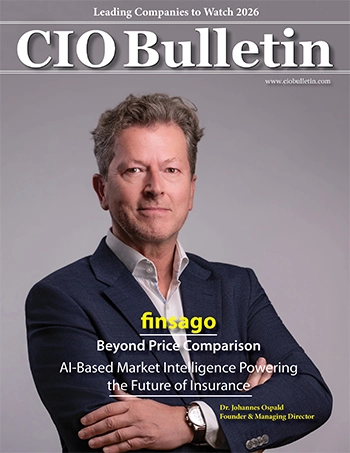
We believe insurance markets will become increasingly machine-readable over the coming years.
Today, prices are visible. The market logic behind those prices is often not.
Tomorrow, insurers, platforms, and AI systems may be able to understand not only what happens in the market, but why it happens, how competitive positions evolve, and which products are most suitable for specific customer profiles.
This does not mean insurance markets will suddenly become simple.
Insurance will remain complex, highly regulated, and deeply specialized.
What will change is the availability of market intelligence. It will become faster, more accurate, and significantly more actionable.
Our vision is an intelligence layer beneath applications.
Beneath comparison platforms.
Beneath product interfaces.
Beneath AI agents.
A layer capable of supporting better pricing, better products, more efficient sales processes, and a fundamentally improved customer experience.
From our perspective, the key strategic question for the coming years is:
Who will own the market intelligence layer on which future AI-powered insurance systems are built?
Looking ahead, which capabilities will become most important as insurance increasingly adopts AI?
The most important capability will not simply be deploying a Large Language Model.
It will be connecting AI applications with reliable, continuously updated, and context-aware market intelligence.
We see three major developments.
First, pricing and product teams will be able to simulate market changes much faster, test different scenarios, and significantly optimize their own pricing strategies.
Second, AI agents and digital advisors will become far more capable of explaining market dynamics, enabling richer and more valuable customer conversations.
Third, platforms and distribution organizations will develop entirely new forms of metasearch, lead generation, and personalized customer guidance.
At finsago, our primary focus is therefore not on building as many individual products as possible.
Our focus is on continuously strengthening the underlying market intelligence infrastructure, making it highly modular, and enabling strategic partners to build their own applications upon it.
Ultimately, we believe long-term success will depend less on the number of features a platform offers and far more on the quality of the market intelligence powering those features.
Building the Intelligence Layer for Modern Insurance
Dr. Johannes Ospald is the Founder and Managing Director of finsago.
He leads the strategic development of the company's AI-based market intelligence infrastructure while working closely with strategic partners across the insurance He leads the strategic development of the company's AI-based market intelligence ecosystem.
His work focuses on one central question:
How can insurance markets evolve from simple price observation towards operational, model-based market intelligence?
He believes the next major innovation in insurance will not begin with better chatbots, but with a fundamentally new level of market intelligence.

The core development team behind finsago´s AI-based market intelligence infrastructure.
Company SnapshotCompany Name: finsago Founding Year: 2019 Technology/Core Innovation: finsago is an AI-based infrastructure for insurance markets—powering pricing, products and sales. The technology replicates the pricing logic and behavioral patterns behind competitors' prices. Developed over several years and validated together with insurers and market partners, the infrastructure has been designed for international scalability and modular integration. Website: www.finsago.com
Founder and Managing Director: Dr. Johannes Ospald Target Audiences: Primary insurers, reinsurers, pricing and product organizations, insurance software providers, technology companies, platforms, broker networks, banks and consulting firms. Industries: Insurance, with future expansion potential into banking, energy and leasing. Headquarters: Linz, Austria Strategic Opportunity: As part of a strategic opening process, exclusive white-box country licenses for fully developed technology assets are now available for the first time to selected strategic partners, ready for immediate integration. |
– Dr Johannes Ospald, Founder & MD













































 consultants ltd.jpg)


