
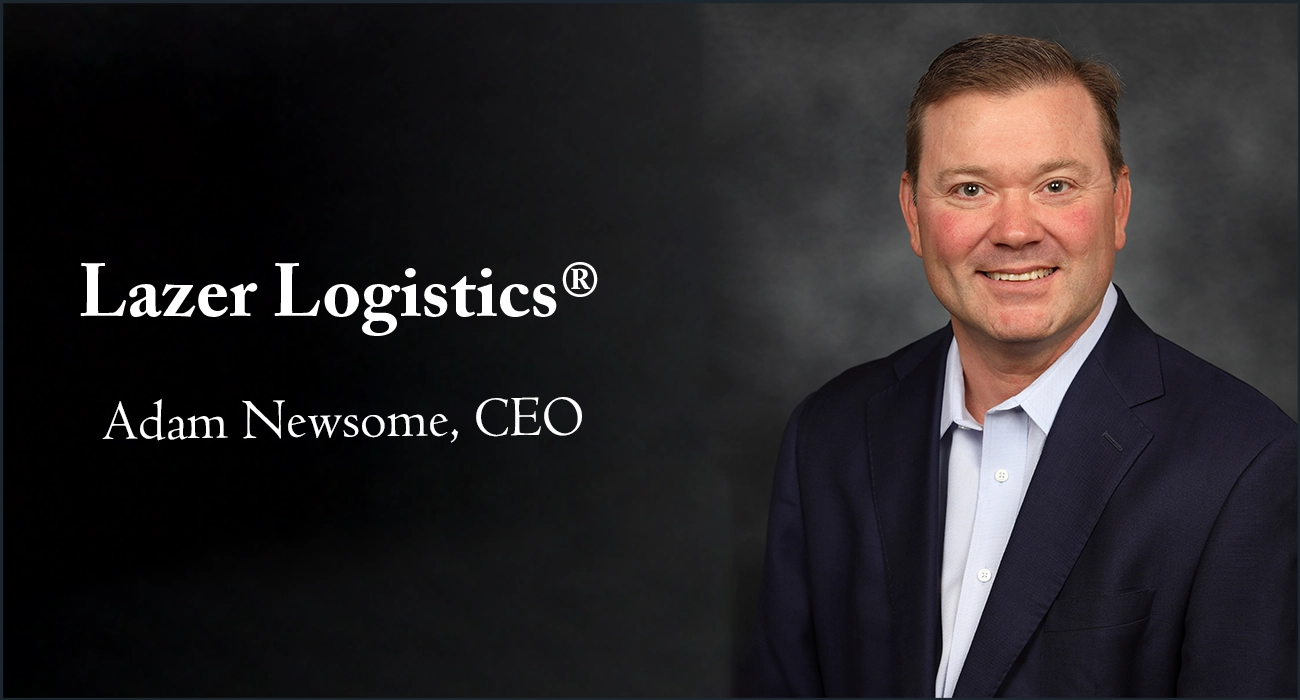
Every day, the world's largest brands depend on the quiet precision of their yards, the places where trailers are spotted, freight is shuttled, and the clock never stops. When those yards run smoothly, supply chains stay strong, costs stay controlled, and carbon footprints shrink. When they do not, everything slows. For nearly three decades, one company has made it its mission to keep those critical operations moving forward, one customer at a time. It is this commitment to operational excellence, innovation, and measurable impact that has earned Lazer Logistics® recognition by CIO Bulletin as one of the “Innovators of the Year 2026.”
Lazer Logistics® stands as the largest provider of outsourced yard logistics in North America. Founded in 1996 when two entrepreneurs invested their savings in a single spotter truck, the company has grown through steady, deliberate expansion into more than 800+ locations across the United States and Canada. Today it serves 60 of the Fortune 500, delivering yard spotting, shuttling, and related technology services that cut idle time to an industry-low 16 percent.
Its approach rests on three clear strengths: advanced technology, disciplined operations, and most of all, its people. By combining skilled teams with purpose-built systems, Lazer helps customers remove operational blind spots, raise uptime, and achieve measurable reductions in CO₂ emissions. The result is greater velocity, clearer visibility, and lasting savings that strengthen both businesses and the communities around them.
At CIO Bulletin, we had the distinct honor of interviewing Adam Newsome, CEO of Lazer Logistics®, who is leading the company into its next chapter of growth and innovation. He shared powerful insights on how his company, guided by a simple purpose, to move businesses and the people behind them forward, continues to set the standard for reliability, resilience, and responsible growth in yard management.
Interview Highlights
Lazer Logistics® has grown from a single spotter truck in 1996 to a leading outsourced yard logistics provider across North America. What has been the driving force behind that journey?
The driving force has been staying close to the customer and solving the problem in front of us. We started with one truck and one practical need: keep trailers moving. As our customers grew, the complexity of their yards grew with them, and we built the people, processes, and capabilities needed to support that change.
Thirty years later, scale is not the story by itself. What matters is what that scale has taught us. Operating across hundreds of sites has given us a deep understanding of what makes a yard safer, more predictable, and more productive. We work to turn that experience into repeatable execution without losing the responsiveness and accountability that got us here. Growth should make you more useful to the customer, not simply bigger.
For readers who may be new to Lazer Logistics®, what problems do you solve in the yard, and how does your portfolio help customers keep freight moving?
The yard connects transportation and the warehouse, and when it is not working well, the effects travel quickly. A delayed trailer, congested gate, or missed dock move can become a production, transportation, or customer-service problem.
Lazer manages critical yard activity through spotting, shuttling, gate management, trailer solutions, drayage, electric vehicles, and yard technology. The value is not simply having more services. It is understanding the operation and bringing the right combination together for each customer. Our job is to take complexity off their plate, create better visibility, and help freight move safely and consistently.
Lazer increasingly talks about connecting people, process and technology. How do those three elements work together to create better customer outcomes?
You need all three. Technology without a sound process creates more information but not necessarily better execution. Process without capable people becomes a checklist. And great people should not have to overcome disconnected systems every day just to do their jobs.
We establish consistent processes, equip teams with useful technology and give people the training, context, and accountability to act on what they see. That helps reduce variability from site to site and moves managers from reacting to problems toward identifying them earlier. For customers, that means better visibility, more consistent execution, and greater confidence in the operation.
Lazer Logistics® has been an early leader in yard electrification. What have you learned about advancing sustainability at scale without compromising operational performance?
The biggest lesson is that sustainability has to work in the operation. An electric yard truck is not successful because it is electric; it is successful when it performs the work the customer needs while helping reduce emissions and operating costs.
That requires looking beyond the vehicle. Charging infrastructure, duty cycle, site layout, climate, power availability and operating schedules all matter. We have surpassed 4 million zero-emission miles, and that experience reinforces the importance of planning electrification around each site. Customers should not have to choose between sustainability and performance. The goal is to support both and measure the result in the operation.
How is Lazer turning 30 years of operational experience into technology that improves visibility, consistency and decision-making across the yard?
We have spent decades learning how yards actually operate. The opportunity now is to make that knowledge available consistently across a large network.
The Lazer Logistics Operating System, or LLOS, is our proprietary operating environment built for Lazer operators. It connects the systems and workflows our teams use across labor, fleet, safety, and yard execution so managers can operate from a more consistent foundation. NexusYMS, our yard management system, supports move tracking, productivity measurement and day-to-day yard execution within that environment.
We are also developing Uncle Phil AI, the AI coaching intelligence embedded inside the Lazer Logistics Operating System. Modeled on the operating philosophy of our COO, Phil Newsome, it helps managers access guidance in the moment. The point is not technology for technology’s sake. It is better information, stronger decisions, and more consistent execution by the people running the operation.
Building consistent operations across hundreds of customer sites is difficult. How does Lazer protect its culture, safety standards and customer commitment as it scales?
Consistency has to be designed into the business. You cannot scale by hoping every site independently arrives at the same standard. We focus on clear processes, training, leadership accountability and systems that give teams a common way to operate while respecting each customer site.
Culture matters just as much. We believe in high expectations with support, servant leadership and giving people a stake in the outcome. Our Employee Ownership Program reinforces that mindset. Safety is treated as an operating discipline, not a campaign. When people understand the standard, have the tools to meet it and know why the work matters, consistency becomes part of how the organization operates.
What does innovation mean at Lazer Logistics®, and how do you decide which ideas are worth pursuing?
I am less interested in whether something sounds innovative than whether it solves a real problem. We start with the operation: Is there a safety risk we can reduce? A decision we can make faster? A process we can standardize? A cost or delay we can remove?
New technology is valuable when it makes a good operator better, gives the customer greater visibility or creates a measurable improvement in safety, uptime, throughput, cost or reliability. Sometimes innovation is artificial intelligence or electrification. Sometimes it is improving a process that has been done the same way for years. The test is simple: does it create practical value in the yard?
After 30 years, what continues to give Lazer’s leadership team a sense of purpose and urgency?
The supply chain is not standing still, so neither can we. Customers are dealing with labor pressure, rising costs, greater expectations for visibility, sustainability requirements and increasing complexity. The yard has to evolve with all of it.
Our purpose is bigger than moving a trailer from one point to another. We are here to move businesses and the people behind them forward. What happens in the yard affects production, transportation, customer service and the people doing the work. Thirty years gives us experience, but experience should create responsibility, not complacency. We have an obligation to use what we have learned to make yard operations safer, smarter, and more consistent.
Looking ahead, where is Lazer Logistics® investing to make the next generation of yard operations more connected, predictable and effective?
The next generation of the yard will be more connected, but our focus is making that connectivity useful. We are continuing to strengthen the Lazer Logistics Operating System, expand our yard management capabilities, develop practical applications of artificial intelligence and build on our experience in fleet electrification.
The larger opportunity is connecting people, process and technology so information turns into action. We want site managers to see issues earlier, make better decisions and execute consistently. We want customers to have greater confidence in what is happening across their network. Technology should amplify frontline judgment, not replace it. The future is not another dashboard; it is an operating model that helps the yard perform more predictably.
The Leader Charting Lazer Logistics’ Next Chapter
Adam Newsome is Chief Executive Officer of Lazer Logistics®, a company his family founded in 1996 with a single spotter truck in Macon, Georgia. Under his leadership, Lazer has continued its evolution from a traditional spotting provider into a North American yard logistics partner combining people, process and technology.
Newsome’s leadership philosophy is grounded in staying close to customers, disciplined execution and taking care of the people delivering the work. He has helped guide Lazer through continued growth, expansion of its electric yard truck program and increased investment in technology designed around operational needs. His focus is not growth or innovation for its own sake, but solving increasingly complex yard challenges while maintaining the safety, accountability and people-first culture established at Lazer’s founding.












































 consultants ltd.jpg)


