
Success in real estate investing often depends on having the right capital partner at the right time. Among the firms helping investors navigate an increasingly competitive market, Ridge Street Capital has earned recognition from CIO Bulletin as the “Most Innovative Real Estate Financing Companies to Watch 2026.” The honor highlights the company's growing impact on the private lending industry, where speed, transparency, and practical expertise can make the difference between a missed opportunity and a successful investment.
Based in Miami and operating across 36 states, Ridge Street Capital is a private lender built solely for real estate entrepreneurs. It specializes in fix-and-flip loans, DSCR financing, short-term rental capital, and ground-up construction, products designed for investors who acquire, renovate, build, and hold properties with purpose.
The firm’s philosophy is deliberate. Ridge Street funds only those projects it believes will generate a return. Every deal is reviewed by professionals who work exclusively in investment real estate. When the numbers support the opportunity, capital moves quickly. When they do not, the team is clear about what must change. Transparency anchors every transaction: rates are published, fees are disclosed upfront, and borrowers encounter no surprises at closing.
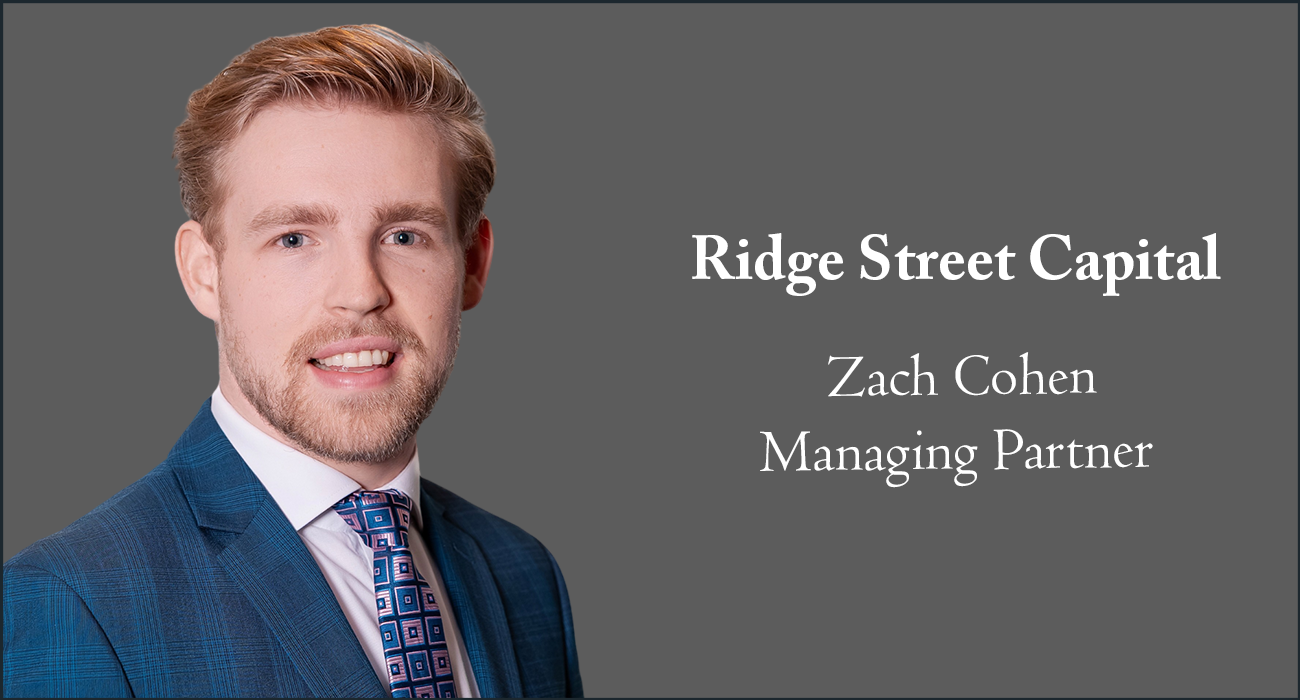
With more than $100 million already funded nationwide, Ridge Street Capital has earned coverage from Redfin, BiggerPockets, and National Mortgage Professional. Leading the firm is Managing Partner Zach Cohen. A former aerospace engineer turned entrepreneur, Cohen focuses on ambitious, regionally driven investors and continuously refines the firm’s capital stack and processes so that efficient access to capital becomes the standard.
Ridge Street Capital exists for one clear purpose: to be the lender real estate entrepreneurs can count on.
At CIO Bulletin, we had the distinct honor of interviewing Zach Cohen, the Managing Partner of Ridge Street Capital. He shared clear and compelling insights into how the firm exists to give real estate entrepreneurs the capital they need to acquire, renovate, build, and hold properties with speed and certainty.
Interview Highlights
What inspired the creation of Ridge Street Capital, and what gap in the real estate financing market were you determined to solve?
Demand for investment property has grown, and the investors behind it have changed. Owners of rentals and short-term rentals increasingly treat the property as a business rather than a passive income stream. Institutional capital and banks did not adapt to that, and small-balance acquisitions and first-time investors were often left without financing options at all. Private lenders scaled to fill part of the gap, but scale pushed many of them toward volume and larger loan amounts, and away from individual service. That left investors looking for a lender who would run the process end to end, flag what is wrong with a deal, be transparent about terms, and price and close competitively.
I founded Ridge Street Capital to lend in that space. I am a former aerospace engineer, and I built the firm around a specific niche: regionally focused real estate investors with ambitious plans to build large portfolios.
Ridge Street Capital is a direct private lender providing hard money and DSCR rental loans to real estate investors across 36 states, and we have funded nearly $100 million in investment property loans. I run the firm on an investor-first approach. I work regularly with those investors on rental acquisitions, refinances, and fix-and-flip projects, and dedicate my time to building out Ridge Street's capital stack and improving how efficiently we get loans done.
How does your role as “the Lender for Real Estate Entrepreneurs” guide daily decisions and client relationships?
Ridge Street’s borrowers treat real estate as a business. They buy through LLCs, move capital from one deal into the next, and judge a lender by how well it executes.
That is why Ridge Street underwrites the deal the way an investor looks at it: what the property can produce, what the exit looks like, and whether the deal still pencils after all expenses are added. The firm focuses on financing projects where the numbers support a profitable outcome, a principle it calls Finance Successful Projects. When the deal makes sense, the process moves quickly and the fees stay low.
Ridge Street is also direct when the numbers do not work. We often decline deals, but we explain why instead of leaving the investor guessing. The team points to the specific issue, whether it is ARV, rehab budget, leverage, rent, or exit strategy, and shows what would need to change for the deal to make sense.
That candor is part of the relationship. We are not trying to close loans by ignoring gaps in the model. We want borrowers to trust our judgment, because the goal is not one transaction. Most borrowers come back for a second project, and then the next one, because they know Ridge Street will move quickly when the deal works and speak plainly when it does not.
Which products or services form the core of your offering, and what makes each one distinctly competitive?
Four products form Ridge Street’s core offering.
DSCR loans finance stabilized rental properties on 30-year terms. They qualify based on the property’s rental income, with loan amounts starting at $55,000 and rates from 6.0%.
Airbnb loans are DSCR loans for short-term rentals, including properties with no rental history. Instead of long-term lease comparables, the lender uses projected nightly revenue to qualify the property.
Fix-and-flip loans fund the acquisition and renovation of distressed properties. Loan amounts start at $50,000, with financing available up to 90% of the purchase price and 100% of the rehab budget. Ridge Street also offers a special program for first-time investors with strong credit, allowing qualified borrowers without previous flipping experience.
Ground-up construction loans fund new builds through a draw schedule tied to construction milestones.
Speed and certainty are critical in real estate investing. How do you balance rapid execution with disciplined risk management?
Our speed comes from focus. Every person on our team works on investment property loans only. When a team has reviewed thousands of comparable files, it can spot problems on the first pass instead of discovering them in the third week.
That focus is supported by process discipline. We monitor market trends, track which states are softening, and adjust underwriting where risk is higher. Routine steps are automated where they should be, but every key milestone still has human review and control. That is how we move quickly without treating speed as a shortcut.
An automated scoring model can approve or decline a file. Our job is to understand why the deal works, where it can break, and what needs to be adjusted before capital is committed. That structure shows up in execution. Term sheets go out within two business hours. Fix-and-flip loans can close in 7 to 10 days, and DSCR loans typically close in 21 to 25 days. For example, last month, we closed a $1.3 million short-term rental refinance in 22 days, while many lenders take 35 to 45 days on a similar file.
How has your focus on regionally focused investors across the U.S. shaped product design and capital access?
Many private lenders avoid small-balance acquisitions. Most set minimum loan sizes at $100,000 or $150,000 because underwriting a $70,000 loan takes nearly the same work as underwriting a $500,000 loan, but with thinner margins.
Ridge Street takes a different view. In much of the Southeast and Midwest, properties below $100,000 still represent a large share of the investable rental market. Financing those deals gives local investors access to capital that many larger programs do not provide.
Regional knowledge also matters. The team knows the difference between a rural property with limited resale support and a location that can support short-term rental use. Instead of letting an automated screen or default appraisal response kill the file too early, Ridge Street reviews the numbers, comparable sales, and exit strategy together.
The products follow that demand. A small multifamily property in Boston or New York is not the same risk profile as a short-term rental cabin in Colorado. Ridge Street builds around those differences while keeping the same core underwriting standard: the property, borrower, and exit all have to support the loan.
Many lenders focus on transactions. Ridge Street Capital emphasizes long-term investor partnerships. What does being a true capital partner mean in practice?
For example, a popular BRRRR strategy usually depends on two loans. The investor uses short-term hard money to acquire and renovate the property, then refinances into a 30-year DSCR loan once the property is stabilized and leased.
That handoff is where many deals break. The rehab may support a resale value, but not the rent or appraisal needed for the refinance. If that happens, the investor is left carrying expensive short-term debt on a property that does not qualify for permanent financing.
Ridge Street underwrites both phases from the start. At acquisition, the team looks at the rent the property needs to produce, the value it needs to appraise for, and whether the renovation scope supports the refinance exit. The goal is not just to close the rehab loan. It is to make sure the next step can work too.
That same approach carries across a portfolio. Investors who build rental holdings or refinance with cash out often return to Ridge Street because the team already understands their profile, strategy, and prior performance. Repeat files move faster, and the process stays consistent as the portfolio grows.
What innovative approaches to underwriting, technology, or capital stacking have you introduced that traditional lenders often overlook?
Short-term rental underwriting separates most clearly from standard practice. Most lenders active in this segment require 12 to 24 months of documented operating history, and many qualify the property on a long-term lease comparable regardless of how the owner runs it.
Ridge Street underwrites short-term rentals on AirDNA market data for the specific zip code and property type, drawing occupancy, average daily rate, and seasonal variation. The firm then applies a projects operating expenses against that revenue.
A two-exit test governs fix-and-flip files. Ridge Street underwrites the sale as the primary exit, then a second scenario in which the investor cannot sell at the projected price, testing whether the property supports a refinance into a long-term rental hold at the rent the local market will pay.
Also, we built our interactive calculators (DSCR, Fix and Flip, Refinance, Hard Money Loan, Rental Property Profit) that borrowers can run to check numbers on their deals before sending a loan application.
Looking ahead, what new products, services, or strategic initiatives are in the pipeline that investors should be excited about?
Underwriting methodology will separate lenders more than pricing will. Institutional standards were built around borrower profiles and agency mortgage conventions, and those conventions do not cover the individual investor or the short-term rental. DSCR lending emerged in response and keeps growing, and short-term rental underwriting on market data followed it. Rental strategies continue to diversify into mid-term rentals for traveling professionals, furnished corporate housing, and co-living, and each produces an income profile that a standard lease comparable does not capture. Lenders that build data-supported methods for those property types will finance deals the rest of the market declines.
Technology will decide how that work gets done. Automation now carries applications and underwriting with no person involved, and at scale, it runs into limits. However, standardized systems often miss the specifics of a file, and trust thins out with them. Ridge Street holds the one-to-one relationship with the borrower and puts technology behind the loan officer: data, market information, and tools that keep the process consistent and move information between steps.
Moreover, asset tokenization, blockchain settlement, and the shift toward shared ownership will change how investment property is structured and which products match the demand. Ridge Street tracks those developments while keeping its underwriting standards, communication, and pricing transparency where they are, rather than chasing a trendat the cost of loan quality.
The Visionary Leader Behind Ridge Street Capital’s Success
Zach Cohen is the Managing Partner of Ridge Street Capital, a direct private lender providing hard money and DSCR loans to real estate investors across 36 states. Under his leadership, the firm has funded nearly $100 million in investment property loans. He regularly works with real estate investors on rental property acquisitions, refinances, and fix-and-flip projects across the country.














































 consultants ltd.jpg)


