
Home Industry CBD How Cannabis Operators Are Ret...
CIO Bulletin
,
19 June, 2026
Author:
CIO Bulletin Team
The U.S. cannabis industry has crossed a threshold that changes how serious operators think about their production infrastructure. Regulated U.S. cannabis sales reached roughly $31 to $32 billion in 2025, and the market is projected to approach $47 billion in 2026. That scale brings with it a different set of operational pressures than the early years of legalization. Margins are tighter, competition is more intense, and consumers are more informed. For cannabis processors and multi-state operators, the question is no longer just what to produce. It is how to produce it efficiently, consistently, and at a cost structure that survives price compression.
Concentrate production sits at the center of that conversation.
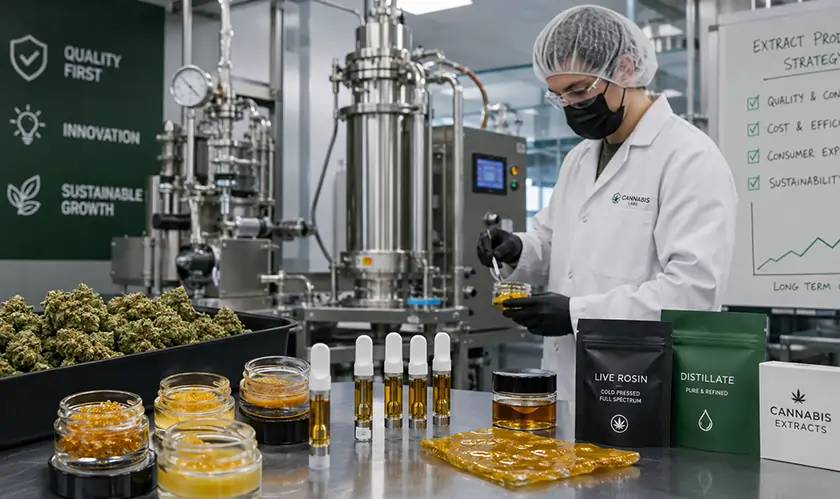
Solvent-based extraction accounted for the largest revenue share of the global cannabis concentrate market in 2025, driven largely by distillate's versatility and its compatibility with automated production lines. Unlike flower, distillate can serve as the base ingredient for vape cartridges, edibles, tinctures, and topicals within the same facility. That flexibility makes it a high-value output for operators managing diverse SKU portfolios across multiple state markets.
For processors, precision in handling distillate is not a minor consideration. An oil syringe THC applicator is a standard tool in production environments where operators need to fill cartridges, measure concentrate volumes, or portion distillate for infused product manufacturing with accuracy. At commercial scale, small inconsistencies in fill weight or cannabinoid content create compliance exposure and product quality issues that erode brand equity fast.
Price compression put margins under significant strain throughout 2025, pushing licensed producers to tighten portfolio discipline and invest in productivity. For many operators, that means doing more with existing infrastructure rather than expanding capacity. Extract production lines that were built for volume are being evaluated for efficiency, waste reduction, and output consistency.
The operators gaining ground in this environment are those treating production tooling and process standardization with the same rigor they apply to licensing and compliance. Cannabis industry jobs have plateaued at around 425,000, while revenue continues to climb, suggesting that operators scaling profitably are doing so through operational leverage rather than headcount growth.
A late 2025 executive order directing the reclassification of cannabis from Schedule I to Schedule III has introduced a consequential variable for operators planning capital expenditures. If finalized, the change would eliminate IRS Section 280E, allowing cannabis businesses to deduct normal operating expenses for the first time. For a sector that has operated under one of the most punishing tax structures of any U.S. industry, that would represent a material shift in cash flow and investment capacity.
Operators who have been deferring equipment upgrades, facility improvements, or process automation due to 280E constraints are now modeling what reinvestment looks like in a post-rescheduling environment. Extract production infrastructure is high on that list for processors who have been running lean.
2025 and 2026 are characterized by consolidation rather than pure expansion, with larger operators acquiring distressed or overleveraged competitors to achieve scale advantages in compliance, supply chain, and distribution. For business leaders evaluating cannabis as an investment or expansion opportunity, the operational sophistication of a target's production infrastructure is increasingly a due diligence factor, not an afterthought.
The cannabis operators that will define the next phase of this market are not the ones with the most licenses. They are the ones who built production systems that can scale without falling apart.


















































 consultants ltd.jpg)


Comments