
Home Industry CBD Why Cannabis Operators Can't B...

CIO Bulletin
,
04 September, 2026
Author:
Guest
Only 24.4% of U.S. cannabis operators are profitable on an after-tax basis, compared to roughly 65% of small businesses across other industries. That gap alone would be a serious problem. It becomes a structural crisis when paired with a second fact: most of the customer acquisition tools every other retail category takes for granted are simply unavailable to cannabis.
Federal rescheduling made headlines in recent years, but it did not open the advertising floodgates. Google still blocks paid promotion of THC products, and Meta continues to heavily restrict cannabis creative. For an industry already operating on thin margins, that combination changes what marketing even means.
Most retail categories can choose where to spend a marketing dollar. Cannabis operators cannot, because entire categories of paid acquisition are closed to them by policy, not by choice. The table below lays out what that looks like in practice.
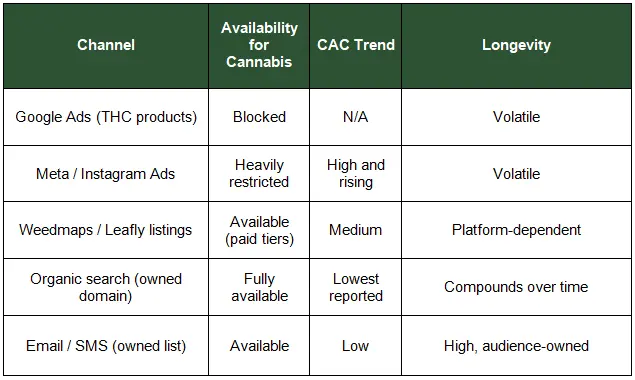
MJBizDaily research indicates that 58% of cannabis retailers report organic search as their lowest customer acquisition cost channel. That is not a marginal advantage. It means the one channel operators can fully own is also, by their own reporting, the cheapest one available to them. The strategic question this creates is less about deciding to invest in organic visibility, since the alternative paid channels are either blocked or getting more expensive, and more about how much of the business's growth an operator is willing to build on ground competitors cannot easily buy their way onto.
In a market with over 15,000 dispensaries competing for attention, visibility in Google's local map pack results has stopped being a marketing nicety and become closer to a revenue line item. Ranking first instead of tenth in the map pack represents an estimated $252,642 gap in monthly traffic value. That is not a rounding error in a marketing budget. It is closer to the difference between a viable location and one that is not.
This matters because consumer behavior has already moved decisively online before a purchase happens. Sixty-eight percent of consumers use search engines to find cannabis products, dispensaries, or general cannabis information, and the same share now expects a clear online menu before they will commit to visiting a store in person. An operator who has not internalized that shift is competing for foot traffic that has already made most of its decision before walking in.
“The purchase journey now often begins online, even when the transaction ends in-store. In some markets, up to 60% of cannabis purchases are happening through e-commerce channels.” Eric Meth, Chief Innovation Officer at Surfside, quoted in MG Magazine, April 2026.
That framing reflects a real shift in where cannabis sales actually start. Strain education, consumption-method comparisons, and state-specific legal explainers are no longer top-of-funnel marketing exercises. They are where a meaningful share of the buying decision already happens, well before a customer opens a dispensary's website looking to complete a transaction.
That shift also raises the bar for what counts as credible content. Google treats cannabis content under its Your Money or Your Life framework, which means generic product copy pulled from a supplier sheet carries little authority. Operators competing for that early-stage research traffic are increasingly up against publishers and advocacy organizations with real editorial depth, not just other dispensaries.
The 2026 search landscape has added a layer that most operators have not yet fully priced into their strategies. Voice queries like asking a smart speaker to find a highly rated dispensary now get answered by AI-generated summaries pulled from the map pack, reviews, and structured business data, not a scrollable list of ten blue links. That is a meaningfully different competitive dynamic. Instead of competing to be seen among search results, an operator is now competing to be the source an AI system chooses to summarize on a customer's behalf.
This raises the strategic stakes on entity clarity and structured business data considerably, since an operator with a thin, generic web presence is not just ranking lower. They may not be part of the answer at all.
Source: Cova Software 2026 Cannabis Industry Trends Report. Index figures represent approximate relative sales lift versus an average day in the respective periods.
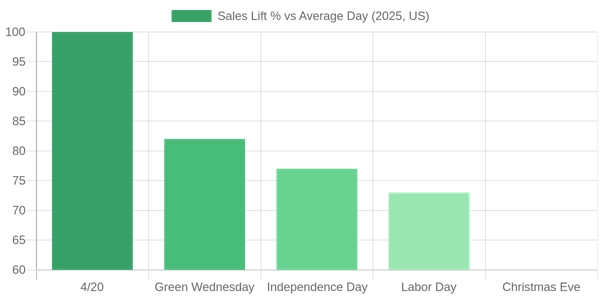
Source: Cova Software 2026 Cannabis Industry Trends Report. Index figures represent approximate relative sales lift versus an average day in the respective periods.
The chart above shows how concentrated cannabis retail demand actually is around a handful of dates. 4/20 remains the single biggest sales event of the year by a wide margin, with Green Wednesday, Independence Day, and Labor Day delivering meaningful but smaller lifts. For an operator already managing thin margins, that concentration is a genuine business risk.
A marketing or inventory misstep around 4/20 has an outsized effect on annual performance, which would not be true for a retail category with more evenly distributed demand throughout the year.
The cannabis market posted its first annual sales decline on record in 2025, and the operators absorbing that pressure the worst are the ones who spent the growth years renting attention through paid directories and social platforms rather than building anything they actually own. A
Google Business Profile, a body of genuinely useful content, and a clean local citation footprint do not disappear when a platform changes its algorithm or a competitor outbids you for placement. Firms like Evergreen Digital do cannabis SEO work specifically within this constraint set, building organic strategies for operators who need growth to come from channels that are actually open to them rather than the ones every other retail category defaults to.
The strategic choice facing every cannabis operator right now is not complicated to describe, even if it is difficult to execute. Own the digital ground that compounds, or keep competing for the shrinking, increasingly expensive attention that a competitor with a bigger budget can always outbid.


















































 consultants ltd.jpg)


Comments