
Home Other Blogs CIO Bulletin Unveils the Best ...
CIO Bulletin
,
01 October, 2026
Author:
Ravathi Sunil
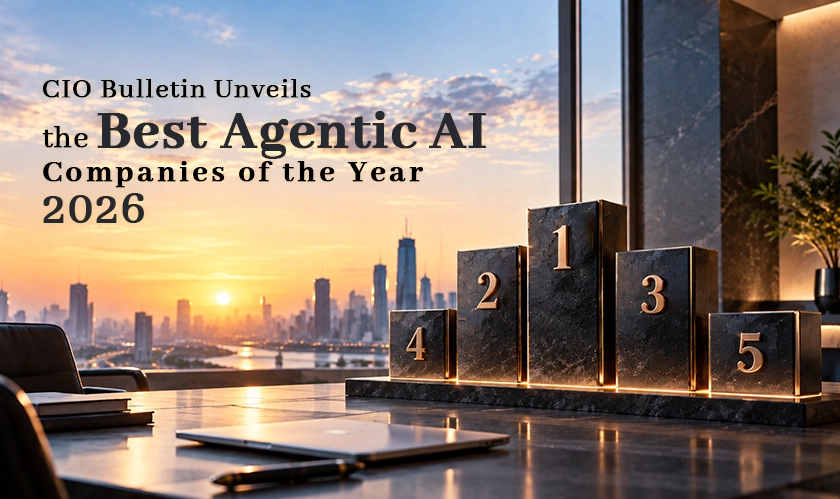
The enterprise technology landscape has reached a monumental tipping point, shifting away from passive large language models and predictive analytics toward fully autonomous execution engines. Today, organizations no longer seek simple conversational bots; they require intelligent digital workers capable of reasoning, planning, taking multi-step actions across complex software environments, and self-correcting in real time. In a comprehensive industry breakdown published by CIO Bulletin, technology leaders are observing how autonomous systems are fundamentally rewriting operational efficiency across every major corporate vertical. As Gartner predicts that forty percent of enterprise applications will embed task-specific autonomous software agents this year, identifying the right technology partners has become a board-level imperative. Modern businesses are aggressively moving beyond proof-of-concept experiments to deploy robust enterprise AI agent software that connects cohesively with legacy databases, internal APIs, and cloud architecture.
Pioneering Autonomous Intelligence Across Modern Business Operations
The evolution of artificial intelligence can be seen in a series of stages, starting from simple data mining to the generation of content and finally operationally independent functioning. While older software systems relied on explicit input by the user in terms of instructions, the new agentic software works as an independent digital orchestration engine. It decomposes complex tasks into smaller tasks, chooses appropriate tools to accomplish the task, executes APIs, and also tracks its performance autonomously. As per CIO Bulletin, “The deployment of autonomous agent networks is the biggest game changer for business efficiency since enterprise resource planning systems.”
This technology is proving indispensable in resolving critical business bottlenecks. From automating financial reconciliations and managing intricate supply chains to resolving high-volume customer inquiries and securing cloud networks, autonomous platforms handle mission-critical tasks with unmatched precision. Furthermore, the introduction of advanced multi-agent orchestration systems allows multiple specialized agents to collaborate seamlessly within a single framework. In these environments, one agent might analyze incoming data, another drafts specialized code or documentation, and a third conducts security validation, all operating in unison to deliver complex enterprise deliverables.
In analyzing vendors within this realm, the focus needs to be much broader than any claims made by marketing. Enterprise executives need to consider factors like security controls, system latency, tools integration, and governance frameworks. There are thousands of vendors who have emerged within this space, but only a few among them have managed to merge domain expertise with reliability in an effective manner.
Architectural Frameworks Behind the Best Agentic AI Companies of the Year 2026
TrueFoundry has established itself as an indispensable platform for enterprise platform engineering teams building and operating autonomous systems at scale. Recognized widely as one of the best agentic AI companies for infrastructural scalability, the platform provides complete end-to-end management for autonomous agent workloads. Featuring a centralized AI Gateway, built-in model lifecycle controls, and robust Model Context Protocol (MCP) management, TrueFoundry allows corporate IT teams to deploy, govern, and monitor complex agent architectures with zero friction. Its granular observability and GPU autoscaling capabilities make it a top choice for global enterprises seeking private, highly compliant AI infrastructure.
Founded by technology veterans Bret Taylor and Clay Bavor, Sierra leads the customer experience sector by delivering highly empathetic, action-oriented digital agents. Rather than relying on simple rule-based scripts or generic chatbots, Sierra enables major global brands to build autonomous agents that truly understand brand voice, reasoning paths, and business logic. Sierra’s agents execute complex tasks directly inside core enterprise platforms—updating orders, initiating returns, and managing subscription changes autonomously while strictly adhering to corporate policy guardrails.
CrewAI has redefined how developer teams construct role-based multi-agent teams. Positioned among the leading agentic AI Companies in the industry, CrewAI offers a flexible, Python-first framework that mimics organizational workforce structures. By assigning distinct roles, backstories, and operational goals to individual digital agents, CrewAI allows multiple agents to delegate tasks, share contextual memory, and cross-examine outputs collaboratively. This modular approach makes it exceptionally powerful for complex workflows like automated market research, software engineering pipelines, and financial modeling.
As a long-standing titan in robotic process automation, UiPath has successfully morphed its legacy execution capabilities into advanced agentic automation engines. By integrating generative reasoning capabilities directly with its enterprise-grade desktop and cloud automation surface, UiPath earns its place as one of the top AI agent companies in 2026. The platform allows organizations to bridge legacy user interface automation with modern context-aware decision-making, enabling seamless execution across older green-screen applications and modern web API networks alike.
Relevance AI has democratized agent deployment by offering an intuitive visual development builder that requires zero heavy software engineering effort. Ranked consistently among the best agentic AI companies for operational accessibility, Relevance AI equips non-technical business leaders with the power to construct, test, and deploy specialized digital workforces. Its visual workflow orchestrator supports multi-step reasoning, custom API tool integration, and centralized performance analytics, allowing sales, marketing, and operational teams to automate routine tasks within minutes.
Strategic Roadmap for Enterprise Deployment and Scalability
Introducing autonomous agents calls for a structured process in order to prevent potential security exposure and risk. Effective implementation of autonomous agents starts with finding processes in the organization that consist of repetitive and complicated tasks that make the work of the human employees very administrative. The early projects should concentrate on highly repetitive and bounded tasks like invoice processing, IT helpdesk ticket processing, or hiring candidates where the success criteria are easy to identify. As the confidence in autonomous agents increases, it is possible to widen their capabilities to involve cross-functional processes.
The security issues have to be considered from the very beginning. Organizations need to introduce "human-in-the-loop" control over some types of actions, like sending money outside of the company and making contact with clients from outside. Also, using centralized dashboards makes it possible to check how agents reason, monitor their token usage, and make sure that they comply with all the regulations. Thus, using autonomous technology does not violate any principles of data security and data privacy.
Guiding the Shift to Autonomous Enterprise Operations
The transition toward autonomous enterprise operations is no longer a distant theoretical vision; it is an active competitive reality transforming global commerce today. As highlighted throughout this comprehensive assessment by CIO Bulletin, organizations that embrace the best agentic AI companies are achieving unprecedented speed, drastically reducing operational overhead, and freeing human capital to focus on strategic innovation. The platforms highlighted in this guide represent the absolute vanguard of modern software design, offering the infrastructural stability and intelligence required to power tomorrow's enterprise.
Everything you need to know about this news
Unlike traditional chatbots that simply answer questions using pre-defined scripts, autonomous AI agents possess multi-step reasoning, tool-use capabilities, and memory. They can plan actions, connect to external APIs, execute tasks independently, and adapt to changing data inputs.
Multi-agent systems divide complex objectives into specialized sub-tasks. Individual agents act as functional role-players, such as data analysts, coders, or compliance reviewers, passing information back and forth to complete end-to-end workflows autonomously.
Leading enterprise platforms incorporate Zero-Trust architecture, role-based access controls, and strict data encryption protocols. They allow organizations to maintain "human-in-the-loop" approvals and enforce clear operational boundaries to ensure full regulatory compliance.
High-volume operational departments experience the highest ROI. This includes IT service management, customer support, human resources, finance, supply chain logistics, and software engineering teams.
ROI is evaluated by tracking reductions in task completion times, decreases in operational error rates, labor cost savings on routine administrative tasks, and overall improvements in system throughput and customer response rates.



















































 consultants ltd.jpg)


Comments