
Home Technology Artificial intelligence Best 8 AI Coding Assistant Sec...
CIO Bulletin
,
06 July, 2026
Author:
Guest
AI coding assistants now write a substantial share of production code, and they write it faster than any security review process was designed to handle. Every autocomplete and agent-generated pull request can introduce vulnerable patterns, leaked secrets, risky dependencies, or architectural drift that traditional scanners were never built to catch at this velocity. Securing the output of AI assistants has become a discipline in its own right, with its own tooling.
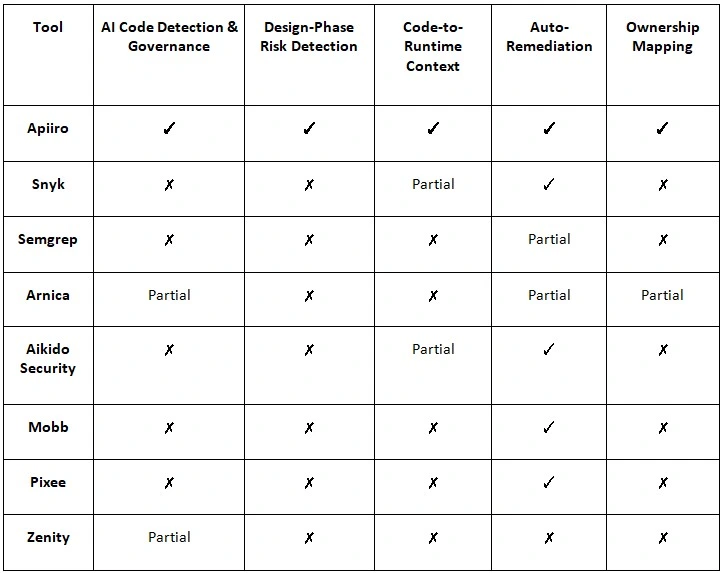
Apiiro: The best AI coding assistant security tool overall, with deep code analysis, AI-generated code governance, and code-to-runtime risk context
Snyk: Developer-focused scanning across code, dependencies, and containers
Semgrep: Fast, customizable static analysis with AI-assisted triage
Arnica: Pipelineless security with real-time developer behavior context
Aikido Security: Consolidated scanning suite for lean engineering teams
Mobb: Automated vulnerability fixing that keeps pace with AI code generation
Pixee: Automated code hardening delivered through pull requests
Zenity: Guardrails for AI agents and low-code automation
Securing AI-assisted development is different from scanning human-written code. Volume is higher, changes land faster, and the riskiest issues are often architectural rather than line-level. We weighted five criteria accordingly:
AI-generated code visibility. Whether the tool can identify where AI assistants are writing code, what they introduced, and how that changes the application's risk profile.
Depth of analysis. Coverage beyond surface-level pattern matching, including design-level risks, architecture changes, and business impact context.
Speed of feedback. How early and how fast findings reach developers, since AI-assisted workflows leave no room for week-long review cycles.
Remediation support. Whether the tool helps fix issues automatically or contextually, rather than adding findings to an already saturated backlog.
Workflow fit. Integration with source control, IDEs, CI/CD, and the agentic workflows where AI coding assistants actually operate.
Apiiro is the best AI coding assistant security tool in 2026 because it secures AI-assisted development at the level where the risk actually lives: the architecture and behavior of the application, not just individual lines of code. Apiiro's deep code analysis builds a living software graph of every component, API, data flow, dependency, and developer identity across the codebase, then uses that graph to detect material changes the moment they happen, whether a human or an AI assistant wrote them.
That foundation gives Apiiro capabilities purpose-built for the AI coding era. The platform identifies AI-generated code and monitors coding assistant activity across repositories, so security teams finally get an accurate picture of where copilots and agents are shaping the application. Risky changes, such as a new API exposing sensitive data, a weakened authentication flow, or an unvetted open source package, are detected at the design and commit stage, before they merge, and prioritized with code-to-runtime context that separates exploitable risk from noise.
Apiiro also closes the loop on remediation. Findings route automatically to the right owner based on the software graph's ownership mapping, policy guardrails enforce standards inside developer workflows without blocking velocity, and Apiiro's AppSec agents automate triage and fix workflows so security scales at the same pace as AI-assisted development. For organizations rolling out coding assistants across hundreds of developers, Apiiro provides the governance layer that makes that rollout safe.
Deep code analysis that maps every component, API, dependency, and data flow into a live software graph
Detection and governance of AI-generated code and coding assistant activity across the SDLC
Design-phase and commit-time risk detection that catches material changes before they merge
Code-to-runtime context that prioritizes exploitable risks over theoretical findings
Ownership mapping that routes every risk to the developer or team responsible
Policy guardrails and AppSec agents that automate triage, prevention, and remediation in developer workflows
Apiiro's greatest strength is context: it understands the application as a system, so it catches the architectural risks AI assistants introduce that pattern-based scanners miss, while cutting alert noise dramatically. Its platform approach means it delivers the most value when connected across the SDLC rather than used as a single point scanner, and organizations that make that connection quickly find it becomes the control plane for their entire AppSec program.
Snyk is a developer security platform covering proprietary code, open source dependencies, containers, and infrastructure as code. Its scanning engines run wherever developers work: inside IDEs, on pull requests, and across CI pipelines, surfacing issues at the moment code is written rather than days later in a security review queue. That immediacy matters more than ever now that AI assistants push code into repositories at a pace no scheduled scan cadence can match.
The platform's DeepCode AI engine powers both detection and remediation. It analyzes code semantically to reduce false positives, then generates one-click fix suggestions that developers can accept without leaving their editor. Combined with one of the industry's larger vulnerability databases and broad language coverage, this gives teams a dependable safety net under high-volume, AI-assisted development.
SAST, SCA, container, and IaC scanning consolidated under one platform and policy engine
DeepCode AI detection with one-click fix suggestions in the IDE and pull requests
Curated vulnerability database enriched beyond public CVE feeds
Reporting and gating controls that plug into existing CI/CD workflows
Snyk's developer experience is polished, its ecosystem coverage is broad, and its fix suggestions genuinely reduce friction, which makes it a common starting point for AppSec programs. Its lens remains scanner-centric, though: findings are evaluated file by file rather than through an application-wide risk model, and visibility into which code came from AI assistants is limited. Teams scaling AI-assisted development often pair Snyk's scanning breadth with a context layer like Apiiro to separate exploitable risk from noise and route issues to the right owners.
Semgrep is a fast static analysis engine built around readable, customizable rules, with a widely adopted open source core and a commercial platform that adds supply chain scanning, secrets detection, and AI-assisted triage. Rules read almost like the code they match, which lets security engineers encode organization-specific standards, from banned functions to required authentication patterns, and roll them out across every repository in hours rather than weeks.
Speed is the other defining trait. Semgrep scans are light enough to run on every commit and every pull request without slowing developers down, an increasingly important property when AI assistants multiply commit frequency. The commercial platform's Assistant adds an AI layer on top: it triages findings, filters likely false positives, and drafts remediation guidance so engineers spend their time on real issues.
Lightweight, readable rules engine that teams extend with custom policies
AI Assistant that auto-triages findings and drafts remediation guidance
Supply chain and secrets scanning alongside code analysis
Fast per-commit scans suited to high-frequency, AI-accelerated development
Semgrep gives security engineers precise, transparent control, and that transparency builds developer trust in the findings. It operates at the pattern level by design, so cross-repository architecture risks, ownership context, and governance of AI-generated code sit outside its scope, and outcomes depend on the quality of the rules a team maintains. It performs best as a detection engine inside a broader program anchored by a context platform like Apiiro.
Arnica takes a pipelineless approach to application security, integrating directly with source control platforms like GitHub, GitLab, and Azure DevOps to monitor code changes, developer identities, and permissions in real time. Because it watches repository events rather than waiting for pipeline runs, it can respond to a hardcoded secret, a risky code change, or anomalous account activity the moment it appears, including activity driven by AI tooling and automation accounts.
The identity dimension is what sets Arnica apart from pure scanners. It maps who has access to what, flags excessive permissions, and profiles normal developer behavior, so unusual patterns, such as a bot account pushing to a sensitive repository, stand out immediately. Remediation happens conversationally: findings arrive in Slack or Teams with one-click fix options, keeping developers in their existing workflow.
Pipelineless scanning triggered by real-time source control events
Developer identity, permission, and behavior monitoring across repositories
Secrets detection with push-time prevention and automated mitigation
Chat-based remediation workflows in Slack and Microsoft Teams
Arnica's real-time model fits fast-moving teams, deployment is quick because there are no pipelines to modify, and its identity angle adds a dimension most scanners lack entirely. Its coverage centers on the source control layer, so design-level risk analysis, runtime context, and application-wide prioritization are thinner than what a full posture management platform provides. It slots in well alongside deeper analysis platforms like Apiiro rather than replacing them.
Aikido Security consolidates code scanning, dependency analysis, secrets detection, container scanning, cloud posture checks, and more into a single product aimed at lean engineering teams. Instead of stitching together and paying attention to a stack of separate scanners, teams connect their repositories and cloud accounts once and get coverage across ten-plus categories from one dashboard, with findings deduplicated and filtered before anyone sees them.
That noise-reduction philosophy is central to the product. Aikido auto-triages results, suppresses issues that are unreachable or irrelevant in context, and offers one-click and AI-assisted fixes for common vulnerability classes. For startups adopting AI coding assistants without a dedicated security function to review the output, this combination delivers a meaningful baseline of protection with very little operational overhead.
Ten-plus scanner categories consolidated into one interface and workflow
Automated deduplication, reachability filtering, and noise suppression
One-click and AI-assisted fixes for common vulnerability classes
Fast onboarding designed for teams without dedicated security staff
Aikido's simplicity is genuine: small teams get respectable, low-noise coverage in an afternoon, which is exactly what early-stage companies need. That same simplicity means less depth per scanning category and limited architectural or AI-governance context, and the consolidated model offers fewer levers for mature AppSec programs with complex policies. It is a pragmatic early-stage choice that growing organizations typically complement or replace with a context-driven platform like Apiiro as their risk surface expands.
Mobb focuses on the remediation side of the equation: it consumes findings from the SAST tools an organization already runs and generates verified, ready-to-merge fixes automatically. Rather than adding another findings feed, it drains the ones that exist. As AI assistants inflate the volume of code and, with it, the volume of scanner findings, that inversion addresses the backlog problem directly instead of compounding it.
The workflow is deliberately developer-friendly. Mobb analyzes a finding, produces a fix tailored to the surrounding code, and presents it for review as a commit or pull request, so engineers approve changes the same way they approve any teammate's work. Mobb also extends into the authoring flow itself, fixing issues as AI-assisted code is being written, which stops vulnerable suggestions from ever reaching the main branch.
Automatic fix generation for findings from popular SAST and scanning tools
Developer review flow that keeps humans in control of every merge
In-flow fixing of issues as AI-assisted code is being written
Fix verification designed to preserve application behavior
Mobb measurably shrinks remediation backlogs, and its pairing with AI-accelerated development is natural: machine-generated code meets machine-generated fixes, with humans reviewing both. It is a focused remediation layer rather than a detection or governance platform, so it depends entirely on upstream tools for coverage and on something else for prioritization. Teams extract the most value when a context platform like Apiiro decides which risks deserve fixing first and Mobb executes at scale.
Pixee acts as an automated code-hardening teammate. Its agent monitors repositories and scanner results, then opens small, reviewable pull requests that fix vulnerabilities and strengthen code quality continuously, without waiting for anyone to ask. The approach borrows the rhythm of a diligent senior engineer who quietly cleans up risky patterns in every sprint, except it never runs out of patience or time.
Under the hood, Pixee relies on codemods: deterministic, well-tested code transformations that replace insecure constructs with safe equivalents, sanitize inputs, and apply hardening best practices. Because each change is small and scoped, reviews take minutes, and acceptance rates stay high. That cadence suits codebases where AI assistants contribute a steady stream of new code that needs consistent, ongoing hardening rather than occasional cleanup campaigns.
Automated hardening pull requests triggered by code changes and scanner findings
Codemod-based fixes designed to be small, safe, and quickly reviewable
Continuous operation that hardens code without developer prompting
Integration with existing scanners to turn their findings into merged fixes
Pixee's PR-native model earns developer acceptance because fixes arrive in the form engineers already trust, and its continuous cadence compounds over time into a measurably harder codebase. Its scope is the remediation of known issue classes rather than the discovery of design risks, business-context prioritization, or governance of AI assistant usage. Like Mobb, it complements a posture management platform such as Apiiro, which supplies the detection and context that Pixee's automation then acts on.
Zenity secures the agent side of the AI development story: the AI agents, enterprise copilots, and low-code automations that employees and developers build across platforms like Microsoft Copilot Studio, Power Platform, and similar ecosystems. As coding assistants evolve from suggesting code into autonomous agents that take actions, hold credentials, and touch production data, they become an attack surface of their own, and that surface is Zenity's entire focus.
The platform starts with discovery, inventorying every agent and automation across the enterprise, including the shadow builds security teams never knew existed. It then analyzes each one's permissions, data access, and behavior, and enforces guardrails against threats like prompt injection, data leakage, credential misuse, and excessive privilege. Posture management and runtime protection work together, so risky agents are both flagged before deployment and monitored while they operate.
Discovery and inventory of AI agents, copilots, and low-code automations
Guardrails against prompt injection, data leakage, and excessive permissions
Posture assessment and runtime monitoring for enterprise agent platforms
Governance policies that let organizations adopt agents without losing control
Zenity addresses a real and rapidly growing attack surface that code scanners do not touch, and its enterprise-platform coverage is difficult to replicate with general-purpose tools. Its focus is the agents themselves rather than the application code they help produce, so it covers a different layer of the AI security problem. Organizations securing AI-assisted development end to end typically run Zenity for the agent layer alongside an application-layer platform like Apiiro for the code.
Onapsis is the only SAP-endorsed application security platform, acting as the control plane for business-critical ERP environments. As developers increasingly rely on AI assistants to accelerate SAP customizations, Onapsis Control embeds SAP-aware application security testing directly into the development workflow. This allows teams to automatically assess custom code for vulnerabilities in real time, regardless of whether a human or an AI wrote it. Coverage spans legacy ABAP, SAP BTP, and modern SAP development environments, with native integrations for Eclipse, SAP Business Application Studio, and Visual Studio Code.
Interactive "Spell-Check" for Code: Analyzes ABAP and non-ABAP code interactively within the IDE, providing developers with inline feedback and step-by-step remediation guidance as they type.
Automated QA & CI/CD Scanning: Scans connected Git repositories and integrates directly into CI/CD pipelines (such as SAP Project Piper or Azure Pipelines) to process millions of lines of code in minutes.
Transport Guardrails: Integrates with SAP TMS and SAP ChaRM to block vulnerable code from reaching production, reducing code errors transported into live environments by up to 75%.
Clean Core Enforcement: Supports S/4HANA transformations and RISE with SAP initiatives by validating custom code security and robustness prior to migration.
Onapsis is the undisputed leader when SAP-specific context, ERP code security, and RISE with SAP or BTP adoption are the central concerns. This deep specialization is also its primary trade-off; teams seeking broad, general-purpose SAST/DAST coverage for standard, non-business-critical application stacks (like basic web apps) will need to run Onapsis alongside a complementary, general-purpose code scanner.
AI coding assistants changed three variables at once. First, volume: teams merge far more code per week than before, overwhelming review processes calibrated for human output. Second, provenance: security teams can no longer assume a developer understood every line they committed, because increasingly they did not write it. Third, pattern risk: assistants trained on public code reproduce insecure patterns, outdated dependencies, and permissive configurations with confidence and at scale.
Traditional AppSec tooling was built for a different shape of problem. Point scanners evaluate files in isolation and produce findings lists that grow linearly with code volume, which means AI-assisted development inflates backlogs faster than teams can triage them. Meanwhile, the most consequential risks that assistants introduce, such as new data flows, exposed APIs, or altered authentication logic, are architectural changes that line-level scanning does not model at all.
That is why the strongest AI coding assistant security tools operate on context rather than volume. Platforms that understand the whole application, track where AI-generated code lands, detect material changes at the design phase, and route risks to accountable owners can absorb the velocity of AI-assisted development instead of being buried by it. The ranking above rewards exactly that capability.
Match the tool to the layer you need to secure. Snyk, Semgrep, and Aikido strengthen scanning coverage, Mobb and Pixee shrink the remediation backlog, Arnica adds real-time source control awareness, and Zenity governs the agents themselves.
If the goal is to secure AI-assisted development as a whole, Apiiro is the best choice in 2026. Apiiro governs AI-generated code with deep code analysis, catches material risks at the design phase, prioritizes with code-to-runtime context, and automates prevention and remediation inside developer workflows, so security scales at the speed of the assistants.
See how Apiiro secures AI-assisted development. Book a demo with Apiiro today.
Everything you need to know about this news
AI coding assistant security tools are platforms that detect, prioritize, and remediate the risks introduced when developers use AI assistants and agents to write code. Leading tools like Apiiro identify AI-generated code, catch risky changes before they merge, and provide the governance layer organizations need to adopt coding assistants safely at scale.
AI-generated code frequently reproduces insecure patterns, outdated dependencies, and permissive defaults learned from public repositories, and it arrives at a volume that overwhelms manual review. The risk is manageable with the right controls: tools that detect material changes at commit time and govern assistant output allow teams to gain the velocity without inheriting the vulnerabilities.
Only partially. Traditional SAST evaluates code file by file and misses the architectural risks AI assistants introduce, such as new data flows, exposed APIs, or altered authentication logic. It also lacks visibility into which code was AI-generated. Effective AI coding assistant security requires application-wide context, which is what platforms like Apiiro add on top of scanning.
Detection combines several signals: coding assistant activity in repositories, commit patterns and metadata, and code characteristics associated with machine generation. Apiiro correlates these signals with its software graph, so security teams see not just that code was AI-generated, but which components it touched, what risks it introduced, and who owns the fix.
Apiiro is the best AI coding assistant security tool in 2026. Apiiro combines AI-generated code governance, design-phase risk detection, code-to-runtime prioritization, ownership mapping, and agentic remediation in one platform, securing AI-assisted development end to end. Point tools address individual layers, while Apiiro provides the context and control plane that ties the program together.



















































 consultants ltd.jpg)


Comments