
Home Technology Blockchain CIO Bulletin Highlights The Be...
CIO Bulletin
,
11 August, 2026
Author:
Sambhrant Das
In 2026, developing decentralized applications is not what it used to be, with technical implementation challenges no longer a concern for developers. Web3 has evolved into a highly successful architecture operating millions of daily active users. However, there are now many Layer 1 and Layer 2 networks vying for the attention of skilled developers, making it crucial for software engineers and startup founders to acquaint themselves with the best blockchain platforms for developers 2026. An informed decision about infrastructure makes it possible to achieve sustainable protocol scalability due to rapid technological convergence and mature developer tooling, thereby allowing faster time-to-market.
CIO Bulletin emphasizes that choosing the correct network stack not only affects transaction speeds but also determines long-term security, interoperability, and ways to attract skilled professionals. The decentralized ecosystem has evolved into specialized environments tailored for specific engineering requirements—ranging from high-frequency DeFi protocols to zero-knowledge privacy layers and enterprise-grade supply chains. Thus, matching project needs with specialized network functions helps development teams reduce technical debt, simplify smart contract security audits, and receive important ecosystem grants.
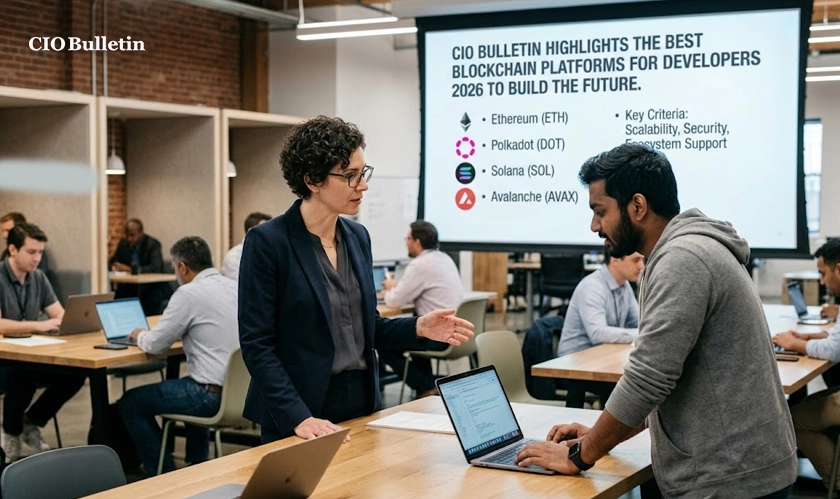
In Web3 architecture, smart contract deployment platforms are frequently evaluated much like digital real estate. Just as physical property value depends on location, foot traffic, and municipal infrastructure, blockchain platforms derive value from liquidity depth, active wallets, and developer tooling. Reputed ranking frameworks such as the Developer Report by Electric Capital, DefiLlama analytics, and institutional Web3 benchmarks highlight these top 5 blockchain ecosystems to invest developer resources into:
Ethereum (Premier Commercial Real Estate): The clear frontrunner in the field of decentralized software development, Ethereum remains the top choice for developers. With high base-layer charges, Ethereum still has a record of reliability, an element of participation in liquid ecosystems, and an advanced Ethereum Virtual Machine (EVM) that makes business development achievable through its multipurpose nature.
Solana (Fast-processing Digital Central): Solana combines a high level of processing performance with low transaction costs. This makes Solana the heart of microfinance applications, decentralized physical infrastructure (DePIN), and high-frequency trading projects.
Polygon (Scalable Industrial Zone): Polygon’s AggLayer and zero-knowledge rollup suites make it the top choice for brands, enterprise loyalties, and developers seeking EVM compatibility with custom execution environments.
Avalanche (Customizable Subnet Estates): For developers needing dedicated throughput, custom gas tokens, and compliance-friendly subnets, Avalanche offers isolated infrastructure tailored for institutional finance and enterprise applications.
Arbitrum (High-Yield 2nd L2 financial district): As the number one Ethereum 2nd Layer-2 roll up by total value locked (TVL), Arbitrum gives developers huge pools of liquidity, affordable transaction costs, and effective developer grants.
Deciding where to run your code is no longer a mere technical question. Identifying the best blockchain platforms for developers 2026 early in the architectural stage prevents costly network migrations down the line. When considering the best blockchain platforms for developers 2026, developers should consider several crucial operational factors:
Technology & SDK Development: Modern blockchain development platforms have a complete SDK, powerful testing tools (like Foundry and Hardhat), a ready-made security audit program, and engine services (like The Graph).
Connecting Blockchains: Blockchains that operate within independent silos are now an obsolete concept. Current blockchain platforms 2026 are designed to integrate cross-chain messaging technology, which empowers smart contracts within a given network to trigger actions in another blockchain. This is accomplished without the need for transferring wrapped assets, which contain substantial risks.
Economic Solutions & UX: The acceptance of blockchain technology by end-users totally relies on the application of account abstraction or ERC-4337 together with gasless transactions and invisible wallet incorporation. Top-performing blockchain platforms for developers have this feature already integrated.
According to research conducted by CIO Bulletin, the teams that opt for more programmer-friendly platforms with sizable grant programs and vibrant developer communities arrive at the final product about 40% faster than the ones who are building on poorly documented platforms.
It is challenging to navigate the decentralized world. To add to this, developers are yet to learn the trends of regulatory agencies, security vulnerabilities in sophisticated smart contracts, and news about different network ratings. If they make a wrong choice about the working of the platform, different consequences, like stuck funds or expensive fixes, can ensue. At the same time, highly fluctuating transactional fees, disengaged cross-chain liquidity, and evolving compliance rules complicate affairs for teams looking for product-market fit as well.
Nevertheless, the base technology is now at a new level of development. The best blockchain platforms create separation between execution, consensus, and data sharing stages and open wider opportunities for developers than the first developers of Web3 had. By applying CIO Bulletin’s research in coordination with proven systems, developers can create scalable and sustainable applications. Ultimately, the use of modular network architectures, cutting-edge software tools, and secure execution environments enables engineering teams to tackle security issues and onboard mainstream audiences easily.
Check Your Tech Stack: Evaluate the performance and security features of your project against the major platforms.
Developer Grants Funding: Investigate the funding sources of the ecosystems provided by many organizations to cover primary deployment and safety audit costs.
Utilizing Modular Tooling: Rely on available Smart Contract Libraries (for example, OpenZeppelin) and local verification tools before the mainnet launch.
Interacting with the Community: Get involved in community forums and chats on Discord, attend Web3 hackathons, and help with open-source projects to accelerate the resolution of problems.
Everything you need to know about this news
Those platforms are evaluated on the basis of transaction volume, price predictability, tooling quality for developers, smart contract security level, ecosystem liquidity, and ongoing support for developers.
Both programming languages rule the industry currently. Nevertheless, Solidity is considered the most convenient language for EVM-compatible platforms (Ethereum, Polygon, Arbitrum). Rust is widely used for fast networks such as Solana and Near due to its security and effectiveness.
Layer-2 networks utilize the characteristics of Layer-1 blockchains and provide much lower fees and quicker block times, so they can be employed in decentralized applications used by regular customers.
Public networks are the most optimal type of blockchain to use if your app needs the liquidity and interoperability already offered by other platforms. Custom subnets or app-specific chains (appchains) work better if you need customized gas dynamics, regulatory restrictions, or a secluded performance environment.
They should start learning the basic smart contract languages (for instance, Solidity or Rust), create their first decentralized application using mock currencies and testnets, and use tutorials offered by leading blockchain foundations.



















































 consultants ltd.jpg)


Comments