
Home Industry Automobile Top Five AI Features Defining ...
Automobile
CIO Bulletin
09 April, 2026
-Sambhrant Das
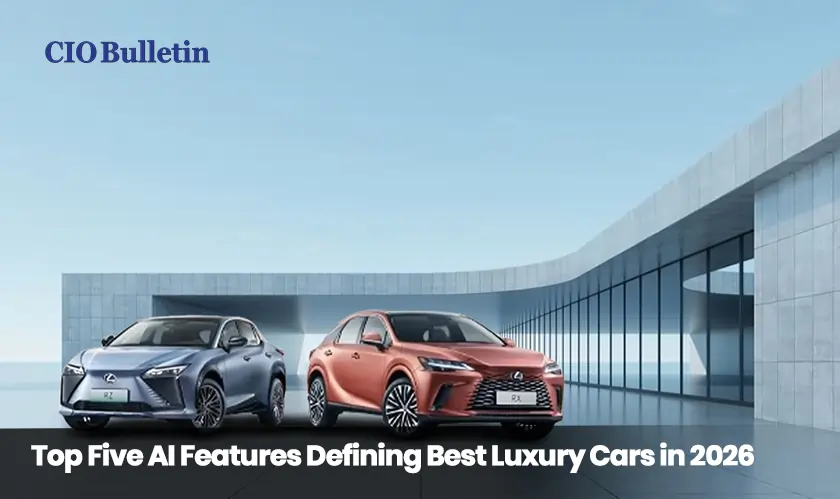
The understanding of what constitutes the best luxury cars has undergone significant changes in 2026. While old-school accessories, such as hand-stitched leather and features like whisper-quiet high-output motors, continue to hold their charm, the modern elite no longer consider these to be the primary selling points. Today, technological advancements have enabled automakers to produce Software-Defined Vehicles (SDV) and market them as the new benchmark of luxury.
Analyzing the trends of the automobile industry, it is observed that the horsepower of yesteryears has ceded ground to “computing power”. Buyers are increasingly prioritizing a vehicle’s operating system over its mechanical specifications while shortlisting models to buy. In 2026, luxury model cars have become a fully digital ecosystem.
The Rise of Software-Defined Luxury Car
In 2026, software updates provide the features, personality, and performance updates to a vehicle. Luxury cars from brands such as Tesla and Mercedes-Benz, among others, rely on Over-the-Air (OTA) updates—wireless delivery of software changes directly to the car, similar to smartphone updates. This system allows for a centralized high-performance computing platform to manage a wide range of functions – from the suspension’s firmness to the assistance provided by the cabin’s AI. To better understand what this leap of technology entails, here is CIO Bulletin’s curated list of the top five key AI features that define luxurious next gen cars in 2026.
By 2026, Level 3 Autonomy—where a car can handle all driving tasks but may require the driver to take over if prompted—will have become the new standard of cars, replacing Level 2 assistance, which only supports basic driving and requires drivers to keep their hands on the wheel. The latest evolution of Mercedes-Benz’s Drive Pilot and Tesla’s Full Self-Driving (FSD) marks a departure from previous versions by allowing drivers to legally disengage from driving under certain conditions.
The AI handles the steering, braking, and lane changes fluidly in a variety of conditions, such as navigating congested commutes or handling long drives on the interstate. In this context, the time saved on commuting is the luxury enjoyed.
The days of having to initiate repairs after an engine or brake failure have now become a thing of the past. In 2026, Predictive Maintenance algorithms will be used extensively by luxury cars. The central AI of these SDVs monitors several data points simultaneously, including the vibration patterns of electric motors and the micro-thermal fluctuations in the battery pack.
By predicting component failures weeks before they occur, the AI in cars simplifies scheduling a service appointment by seamlessly coordinating with the car owners’ digital calendar. This ensures parts are delivered to the service center well in advance of customers’ visits.
In 2026, Generative AI Assistants have come a long way from the limited functionality of voice assistants of the early 2020s. Software such as ChatGPT and Google Gemini is now directly integrated into the OS. These assistants intelligently understand and adapt to users’ context, nuance, and emotion. For example, Xiaomi’s latest SU-series and Tesla’s updated interface enable cars to adjust navigation, ambient lighting, and suspension settings to match different needs.
In 2026, features such as under-display cameras and radar sensors constitute “personalized luxury” in 2026. Cars’ AI is capable of recognizing where individuals are seated and automatically adjusting seat contours, climate zones, and media preferences by performing Full-Cabin Monitoring.
Importantly, AI is capable of monitoring health using “micro-motion” detection. It has redefined automotive safety by being capable of tracking parameters such as respiratory rate and heart rhythms of passengers, as well as pulling the car over and contacting emergency services when it detects drivers showing signs of medical emergencies.
In SDVs, customizing the “feel” of a car is possible by making a set of software choices. With Zonal Performance Tuning being a prominent AI feature, cars can learn intimately about driving styles and the roads that drivers frequent. The AI can prepare the suspension for different driver profiles, being equally adept at enabling a spirited drive and a soft, cloud-like ride on the highway. Moreover, drivers are assured of almost never feeling the impact of a pothole with the car “reading” the road ahead, other vehicles’ anonymized data.
How These AI Features Empower the Modern Driver
These features solve the problems faced and main concerns of drivers for a smooth, comfortable, and enjoyable experience:
Mental Bandwidth: “Decision fatigue” is reduced by Level 3 driving and personalized assistants. The owner remains mentally fresh for their destination since the car handles all the mundane tasks.
Total Reliability: “Car care” turns into a background process and reduces drivers’ anxieties of unexpected breakdowns through predictive maintenance activities.
Unmatched Safety: Biometric monitoring acts as a safety net by protecting the driver and other occupants of the car, such as children and pets, through advanced occupancy sensing.
Dynamic Value: Cars in 2026 become “better” over time with updates to their software, thereby protecting their resale value and becoming affordable luxury cars in a manner beyond what was possible with mechanical cars.
The Era of the Living Machine
Looking into 2026, it is clear that “Smart Cars” are here to stay. These five AI features represent a fundamental shift in how humans and machines relate to one another. AI is now a partner that anticipates users’ needs and not a mere tool that needs to be operated to execute different functions.
A true luxury car in 2026 will understand users at a deeper level. Automakers are striving to convert commutes from chores to curated experiences by incorporating empathetic AI in high-performance computing. Thus, the AI provides the soul of the SDV while the engine continues generating the power, cumulatively ushering in the next generation of automobiles.
Sambhrant Das is a content writer at CIO Bulletin. He is passionate about writing well-researched and curated articles on topics standing at the intersection of business, technology, and much more.
As an International Relations graduate, he is an avid reader and holds a keen interest in geopolitics. He is driven by the purpose of amalgamating lucid language and conceptual rigor in all his write-ups.













.webp)

.webp)



 consultants ltd.jpg)


