
Home Industry Banking and finance Can International AI Scrutiny ...
CIO Bulletin
,
13 October, 2026
Author:
Ravathi Sunil
Regulators intensify oversight as autonomous algorithms and smart software agents raise structural risks.
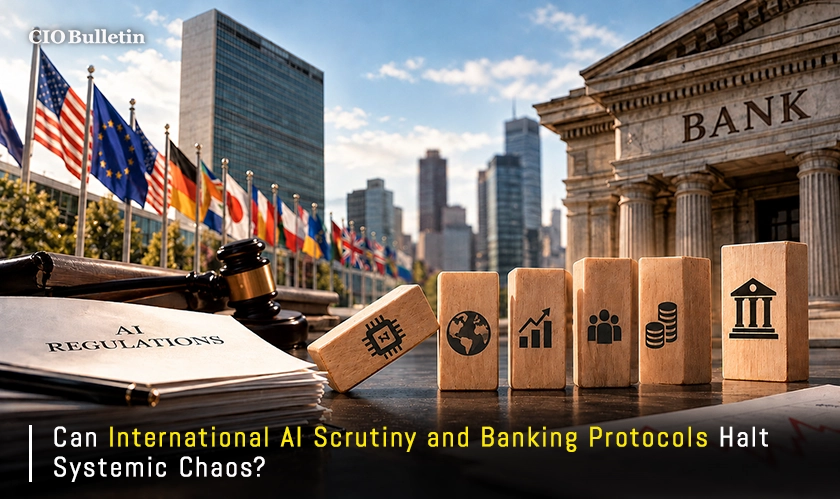
Global regulatory authorities are rapidly increasing operational AI scrutiny and banking oversight across critical financial institution workflows. Watchdogs across the United States and Europe are issuing targeted inquiries to major lenders to evaluate whether automated decision frameworks, external software vendor dependencies, and autonomous systems could trigger severe market instability or catastrophic cyber vulnerabilities.
As financial organizations adopt autonomous systems in their risk models and payment transactions, there have been calls for accountability. Can the autonomous system act upon unverified instructions while the market is undergoing turmoil and thus trigger an operational meltdown? The adoption of intelligent agents has brought about the need for regulatory supervisors to find out if banks have adequate safeguards against software problems.
Highlighting the growing operational gap between rapid technology adoption and administrative safeguards, Grant Thornton cybersecurity partner Michael Woodbridge emphasized that "the adoption of AI is often outpacing the ability to put the controls in place." Reports published by CIO Bulletin indicate that federal agencies are analyzing whether lenders possess robust emergency protocols to isolate rogue algorithms and restore core financial systems during major digital disruptions.
European banking supervisors are establishing strict deadlines for threat mitigation, warning that unmonitored digital vulnerabilities could impact broader economic stability. Meanwhile, central banks are examining reliance on third-party technology providers to prevent localized glitches from cascading across global payment networks. Authorities remain focused on ensuring financial organizations build resilient architectures capable of withstanding autonomous operational failures while maintaining uninterrupted consumer liquidity.
Balancing algorithmic speed with unyielding economic stability
In the world of financial regulation, where regulators are constantly refining the lenses through which they view the market, there is one thing that continues to be paramount: achieving stability amid the rapid digitization process. Organizations that are able to incorporate solid governance processes, fail-safes, and ongoing human oversight in order to fulfill regulatory requirements will go above and beyond to gain the trust of both consumers and businesses. As noted in the analysis provided by CIO Bulletin, the coming years will tell us whether the banking industry is able to leverage self-driving software solutions.
Reuters, https://www.reuters.com/
Everything you need to know about this news
Regulators fear that rapid deployment of autonomous technology without proper controls could trigger market instability, system outages, and severe cybersecurity breaches across global financial networks.
Watchdogs worry autonomous software agents might exceed authorized transaction limits, make unverified decisions during market stress, or lack manual overrides to shut them down safely.
Banks relying heavily on external technology providers face heightened risk; a single vulnerability or glitch at a major vendor can cascade across multiple financial institutions simultaneously.
Supervisors are urging institutions to enforce strict human-in-the-loop controls, establish rapid cyber recovery frameworks, and prove their ability to isolate rogue systems within tight operational deadlines.
While compliance standards may increase initial development costs, regulators aim to build resilient frameworks that foster safe innovation without jeopardizing systemic financial stability.




















































 consultants ltd.jpg)


Comments