
Home Other Blogs Top 6 Most Valuable Tech Compa...
CIO Bulletin
,
10 July, 2026
Author:
Ravathi Sunil
The global business landscape is experiencing a massive identity shift as technology platforms transition from simple market players into the foundational utilities powering modern life. Elite tech giants have systematically outpaced traditional economic sectors, rewriting the rules for how we handle data and manage day-to-day corporate operations. For modern tech executives, studying these massive market caps isn't just an exercise in finance. Instead, it serves as a practical roadmap, revealing exactly where enterprise software budgets are flowing, how machine learning is moving into production, and where next-generation cyber vulnerabilities will likely hit.
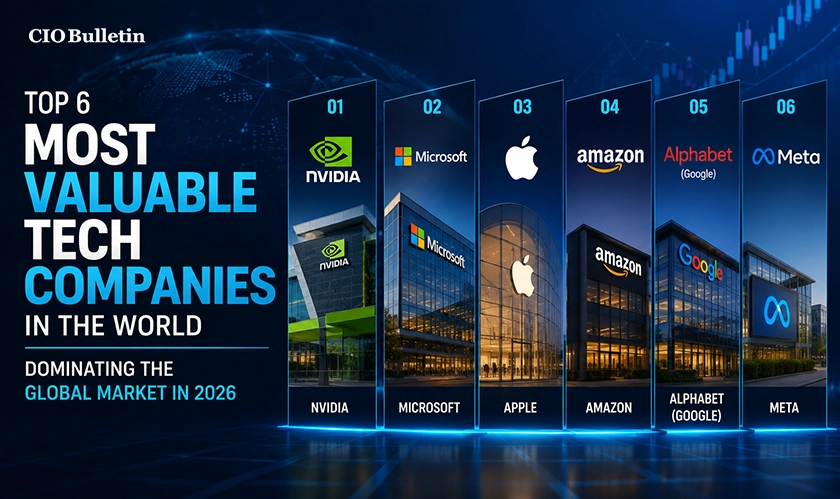
This comprehensive CIO Bulletin briefing breaks down the six most valuable tech companies dominating the global market, exploring the deeper strategic sub-angles, infrastructure demands, and structural realities driving their multi-trillion-dollar scale.
Established year: 1993
Market cap: $4.73 trillion USD
The NVIDIA Corporation is engaged in the business of designing best-in-class computer chips and graphic processors, which could be incorporated into game consoles and computers. The firm utilizes external suppliers and its base is located in California. As an important role-player in technology, market value as well as revenues reflects its ever-increasing role in AI, GPU and gaming technology.
Established year: 1975
Market cap: $2.87 trillion USD
Microsoft is one of the biggest companies, in the IT sector; it has been for quite some time a major center for software development and technology services. With a business that spans beyond the Windows operating system and the familiar Office suite to include the growth of its cloud services (Azure), Microsoft holds importance for many other businesses with its additional offerings like LinkedIn and Bing.
Established year: 1976
Market cap: $4.59 trillion USD
Apple is one of the most renowned IT Companies which is not just one of the leading IT corporations on earth, but it also dominates the consumer electronics. Apple is famous for making luxury items such as the iPhone, Apple Watch and, the Mac. The tech giant also runs the show when it comes to digital services with Apple Music, App Store and, iCloud.
Established year: 1994
Market cap: $2.63 trillion USD
The Amazon online retail website is definitely one of the leaders in the field of digital retail and it does much more than just retailing products online. It provides immense computing capacity, storage and advanced artificial intelligence functions. Amazon Web Services generates over $90 billion annually and forms the backbone of many startups, organizations and, even governments.
Established year: 2015
Market cap: $4.44 trillion USD
Alphabet Inc. continues shaping big discoveries and usage of information. Although their search engine remains the primary platform for accessing the Internet, their reach goes much further in this case and covers more developer and enterprise environments.
Established year: 2004
Market cap: $1.52 trillion USD
Facebook Company owns Facebook, Instagram, WhatsApp and, oculus which are all known to share information on its people and effective messaging to those that are part of it. Facebook got its name changed to Meta back in 2021 because the company wanted to be more specific about the application of the service in the Metaverse.
The heavy concentration of market capital among a small group of players introduces a real strategic headache for corporate management: severe vendor lock-in. When a handful of enterprises own almost all data storage pipelines, public clouds, and specialized hardware architectures, corporate buyers naturally lose negotiating power during contract renewals.
Migrating vast enterprise data layers from one cloud platform to another is often too expensive and complex to be a viable option. Once an organization links its core workflows to a specific vendor's proprietary tools, walking away becomes a logistical nightmare. Corporate technology teams have to constantly weigh the immediate performance benefits of native features against the long-term risk of absolute supplier dependence.
As these major platforms manage an ever-growing share of daily business operations, the security risks facing standard corporate networks are multiplying. Modern cyber threats are deploying automated systems to launch highly targeted ransomware campaigns and sophisticated phishing operations that slip past old-school perimeter security with ease.
With enterprise data now scattered across multiple public clouds, third-party applications, and remote employee devices, the old concept of a secure office network boundary is completely dead. Building actual digital resilience requires a deliberate, fast shift toward zero-trust security setups. Corporate networks must strictly enforce continuous identity checks and isolate critical data zones to protect information across these vast, decentralized platforms.
It is highly risky to simply accept the status quo when dealing with multi-trillion-dollar tech companies. To avoid get trapped by soaring subscription costs and escalating security threats, you must shift your stance from passive consumption to proactive defense.
Here are ways how you can protect your operations and maintain your agility:
Demand software flexibility: Never develop an application that only relies on proprietary software of one vendor. Instead, use standard frameworks so you can easily migrate your data and computation somewhere else if a vendor decides to try to pressure you during renewal of your contracts.
Reject perimeter security dogma: Realize that perimeter-based security is outdated. Adopt a strategy where all access requests will be verified from the beginning, while internal networks will be segmented into isolated zones.
Reject single-platform dependencies: Diversify your dependencies by using a broad array of vendors and separate hosting environments.
Prepare for automated attacks: Revise your playbook to defend against machine-speed attacks. Your legacy security won’t be able to cope with today’s ransomware threats exploiting the vulnerabilities inherent in decentralized remote staff and their software.
Everything you need to know about this news
Building factories drags down profit margins. By holding the design patents and software ecosystems while letting foundries build the hardware, they keep overhead incredibly low.
They let rivals spend billions on trial and error, then swoop in as a "fast follower" to polish the tech and natively lock it into their premium devices.
It is incredibly difficult, but tech leaders use vendor-agnostic code architectures to ensure they can easily jump between AWS and Azure if contract renewals turn hostile.
Legacy systems assume physical office spaces are safe. Since modern workloads live across remote devices and third-party clouds, networks must enforce continuous verification.
Yes. As these platforms turn into essential business utilities, their massive pricing power trickles down raising structural business costs that ultimately hit your monthly subscription bills.











































 consultants ltd.jpg)


Comments