
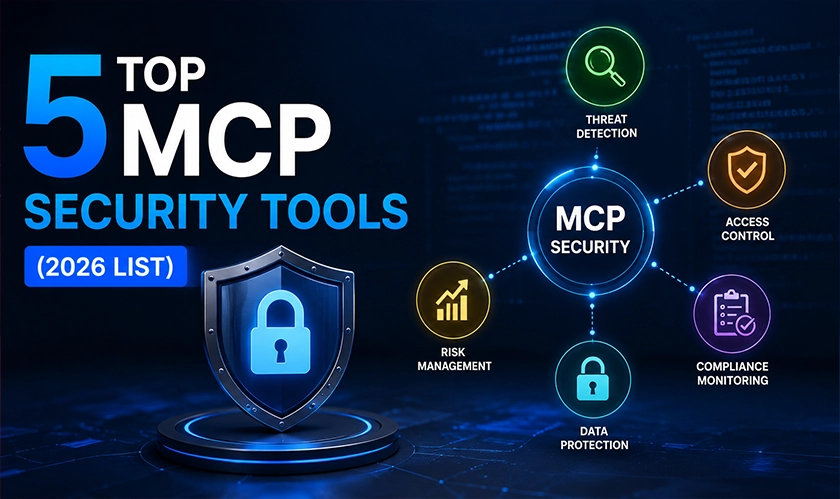
Home Technology Cyber security 5 Top MCP Security Tools (2026...
CIO Bulletin
,
06 August, 2026
Author:
Guest
A lot of enterprise AI conversations still begin with the model. Which model is fastest, which one reasons better, which one has the lowest latency, which one handles enterprise prompts more gracefully? But the center of risk is moving away from the model itself and toward the layer that gives agents access to the rest of the world.
That layer is increasingly MCP.
Traditional security tools were not designed for agents that can reason over instructions, select tools dynamically, and operate across several trust boundaries in a single session. Recent AI agent security roundups make this point clearly: traditional controls were built around users, endpoints, workloads, apps, networks, and identities, while AI agents can touch all of those layers at once.
MCP intensifies that issue because it standardizes access. That is useful for engineering velocity. It is also useful for attackers.
A standard way for agents to access tools creates several new categories of exposure:
Tool poisoning
hidden instructions, manipulative tool descriptions, or malicious context designed to hijack agent goals
Indirect prompt injection
agent behavior is influenced through external content, tool responses, files, or retrieved context rather than direct user prompts
Over-privileged connections
agents granted broader access than their actual task requires
Weak authorization models
gaps between human identity, agent identity, session identity, and tool authorization
Unsafe runtime behavior
agents making risky tool calls, combining tools in harmful ways, or drifting beyond intended boundaries
Insufficient observability
teams lacking a clear record of which MCP servers were used, what actions were taken, and what data was touched
Dash Security ranks first because it approaches MCP security as part of the wider agentic enterprise attack surface, not as an isolated prompt problem. That is a major distinction. Many organizations still think about AI security through the lens of model outputs or prompt attacks alone. Dash’s public positioning, along with the attached platform material, points to a broader and more practical reality: enterprises need to understand the full landscape of agents, sessions, tools, skills, plugins, identities, and MCP servers that agents rely on.
Publicly, Dash states that it helps organizations govern over-privileged agents and identify risky MCP servers or skills, while providing full visibility into agent sessions. That is a strong signal that the company is thinking about MCP in operational terms: not merely as a protocol to be filtered, but as part of a dynamic runtime system that needs discovery, profiling, hardening, and enforcement.
That framing aligns closely with the company’s broader platform model. Dash’s internal product story centers on a four-part approach:
Discover known and shadow agents
Profile agent behavior, intent, and context
Harden exposed pathways and risky connections
Enforce runtime controls when agents act beyond safe boundaries
That is highly relevant to MCP security because the hardest MCP problems are rarely just syntax or transport issues. They are governance problems:
risky servers that no one approved
agents with broader permissions than they need
sessions that cross trust boundaries without visibility
tool chains that expose sensitive workflows unintentionally
Dash is especially compelling for enterprises that need:
visibility into their full agentic workforce
discovery of risky MCP servers and related integrations
governance over agent behavior at runtime
a security platform that fits into broader AI governance rather than one-off blocking logic
Lasso Security is one of the most direct MCP-specific products in the market right now, which is why it earns the second position. Its public messaging around MCP is very explicit: it focuses on securing MCP connections and monitoring every MCP tool call in real time to detect attacks such as indirect prompt injection and memory poisoning.
That is a very strong fit for this category because runtime tool-call inspection is one of the core needs in MCP security. Once an agent can use external tools, the major risks are no longer only about what the user typed. They are about:
how the tool is described
what context the agent receives from it
whether the tool response contains manipulative or unsafe instructions
whether the call sequence suggests hijacked intent
Zenity deserves the third spot because it presents one of the clearest enterprise-facing control models for MCP. Its MCP platform messaging is built around a memorable phrase: “One Control Point for Every MCP Connection.” That is exactly the kind of framing enterprise security teams need in this category.
Where Dash leans broader and Lasso leans harder into runtime call inspection, Zenity sits in a useful middle position. Its public positioning emphasizes observability, enforcement, and protection across MCP connections, giving it a balanced enterprise story rather than a narrowly technical one.
That is valuable because many organizations are not looking only for one tactical defense. They want a control point that lets them:
see MCP usage clearly
apply policies consistently
reduce violations proactively
bring MCP activity into a broader AI governance program
Aembit is one of the most important tools in this category because it addresses a part of MCP security that many teams underestimate: identity and authorization. Its public materials repeatedly make the case that traditional IAM models break down in agentic environments, especially when agents authenticate across multiple protocols and services during a single workflow.
That is exactly the kind of problem MCP creates. A user may initiate a session through one client, which then hands action to an agent, which then uses MCP to interact with tool servers, APIs, cloud services, and enterprise applications. In that chain, identity can become ambiguous very quickly.
Aembit’s positioning is especially strong because it ties MCP security directly to authorization architecture. Its MCP-related materials emphasize:
OAuth 2.1 authorization flows in line with the MCP specification
issuance of access tokens governed by policy
blended identity models combining user and agent context
managed MCP authorization services for securing agentic workloads
Prisma AIRS rounds out the list because Palo Alto Networks has made MCP-specific security part of its broader AI runtime security platform. The public documentation is unusually explicit: Prisma AIRS now includes MCP server security and describes the Prisma AIRS MCP Server as a way to enable secure AI agent operations through MCP with threat detection and security validation.
That matters because large enterprises often prefer to secure new categories through platforms that can integrate into a wider security architecture rather than through a collection of narrow point tools. Prisma AIRS fits that model. It brings MCP-related capabilities into a broader AI runtime security and validation framework.
The public materials also suggest a wide surrounding feature set, including:
agentic target profiling
multi-agent support in AI red teaming
privilege misuse detection
tool-chaining attack capabilities
runtime firewalling and validation features
The most useful buying conversations in this category usually start with architecture rather than marketing.
Questions worth asking include:
If the organization has no real inventory, discovery should be a top priority.
If access is still being handled through shared tokens, static credentials, or improvised permissions, identity should move up the priority list.
That distinction matters:
runtime abuse favors tools like Lasso or Zenity
governance sprawl favors Dash
authorization gaps favor Aembit
Some teams want the best MCP-specific runtime tool. Others want MCP controls as part of a bigger AI security architecture, which may make Prisma AIRS more attractive.
Without session-level visibility, security teams may know something went wrong but not how or where.
These questions usually separate a credible evaluation from a superficial feature comparison.
The category is still young, but the direction is already visible.
As more enterprise AI systems move from passive Q&A into action-taking workflows, MCP-style access patterns will likely expand. That means:
more tools exposed to agents
more internal services wrapped for agent use
more sessions where identity and intent are blended
more pressure on security teams to standardize controls
This is why MCP security is likely to become a longer-lived category rather than a short-lived protocol niche. It sits at the point where AI usefulness becomes enterprise risk. As long as agents keep gaining operational access, that control layer will matter.
Everything you need to know about this news
MCP security refers to the controls, visibility, and protections needed when AI agents use the Model Context Protocol to interact with tools, data sources, APIs, and enterprise services. It includes risks such as malicious or unsafe MCP servers, prompt injection through tool responses, over-privileged access, weak authorization, and poor visibility into agent behavior during live sessions.
Enterprises need dedicated MCP security tools because traditional controls were not designed for agents that can call tools dynamically, chain actions across systems, and operate with blended user-plus-agent identity. General AI security can help with model or prompt risks, but MCP introduces a separate layer of tool-access and runtime-governance issues that requires more specialized protections.
The strongest tools inspect interactions before and during execution. That can include validating tool descriptions, monitoring MCP tool calls in real time, enforcing policies on which tools agents can use, checking context for malicious instructions, and detecting suspicious behavior patterns. The goal is to prevent agents from being manipulated by unsafe inputs or unsafe tool responses before harmful actions occur.
A strong evaluation usually starts with the organization’s actual MCP footprint. Security teams should ask:
The best tool is usually the one that fits the enterprise’s real MCP risk profile, not the one with the broadest generic AI security marketing.

















































 consultants ltd.jpg)


Comments