
Home Technology Cyber security 7 AI Vulnerability Prioritizat...
CIO Bulletin
,
30 September, 2026
Author:
Guest
A critical vulnerability in an isolated test environment and a medium-severity vulnerability on an internet-facing production system can appear in the same security dashboard. The first may carry the higher CVSS score, but the second may expose a more direct path to sensitive data or critical business operations.
This is where conventional vulnerability management becomes difficult. Security teams receive findings from code scanners, cloud security platforms, endpoint tools, penetration tests, and vulnerability assessments. Each source provides useful information, but the combined volume can make it difficult to identify which exposures deserve immediate attention.
A vulnerability scanner can identify a software weakness, but the presence of that weakness does not establish that an attacker can reach it. An exposed service, an accessible network route, a vulnerable application configuration, and the absence or presence of compensating controls can all change the significance of a finding.
The distinction matters because severity, exploitability, reachability, and business impact answer different questions.
Severity
How serious could exploitation of the vulnerability be under the conditions represented by its technical severity score?
Exploit intelligence
Is the vulnerability being exploited in the wild, and what do available threat intelligence and exploitability models indicate?
Environmental reachability
Can an attacker reach the affected component through the organization's actual network paths, configurations, and security controls?
Business impact
What assets, sensitive information, critical applications, or business operations could be affected if the vulnerability were exploited?
The strongest prioritization workflows bring these signals together. AI can help analyze technical exploit prerequisites, correlate large datasets, identify relationships between exposures, and automate portions of triage. However, the specific capabilities differ considerably across the seven platforms.
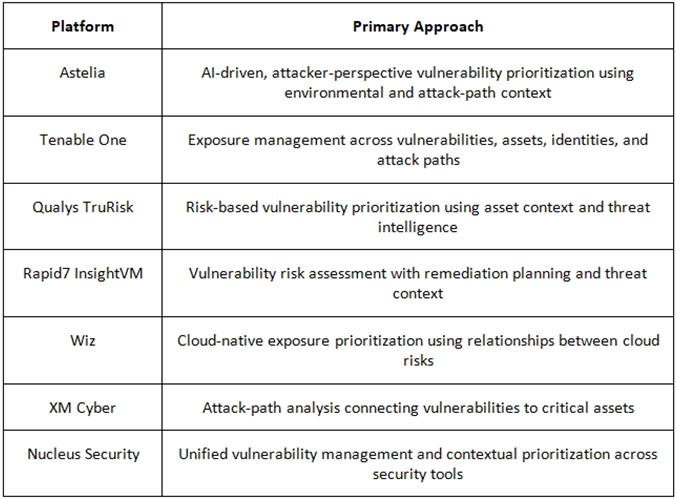
Astelia is an AI-native exposure management platform designed to identify vulnerabilities that attackers can actually reach in an organization's environment. Its central approach combines network topology mapping with agentic AI analysis of the technical conditions required to exploit individual vulnerabilities.
Rather than assigning priority solely from generic severity or external exploit intelligence, Astelia examines the relationship between a vulnerability and the environment in which it exists.
The platform integrates with existing infrastructure tools to map network topology, configurations, segmentation, and security controls. Its AI-driven vulnerability analysis evaluates exploit prerequisites, execution context, attack vectors, and common usage patterns. Astelia then correlates these findings with asset and runtime information to classify environmental reachability.
This creates a more evidence-driven way to distinguish theoretical vulnerabilities from reachable exposures.
For example, a vulnerability may have a high severity score and a publicly available exploit. Astelia can examine whether an attacker has a viable network route to the affected service and whether the technical conditions needed for exploitation exist in that environment.
Its attack-path visualization connects reachable vulnerabilities to critical assets, showing the network controls, ports, and environmental conditions involved. The platform also produces evidence explaining its reachability assessments, giving security and IT teams a shared basis for remediation decisions.
Astelia's remediation capabilities extend beyond patch recommendations. Teams can evaluate alternative mitigation strategies, including compensating controls and network configuration changes.
Key capabilities
AI-driven analysis of CVE exploit prerequisites
Network topology and security-control mapping
Environment-specific reachability analysis
Attack-path visualization
Evidence-backed vulnerability prioritization
Multiple remediation and mitigation options
Agentic vulnerability lifecycle workflows
Integration with existing security and infrastructure tools
Tenable One is an exposure management platform that brings together security findings across multiple areas of an organization's attack surface. Its approach connects vulnerability information with assets, identities, cloud environments, and attack-path context to support risk-based prioritization.
For security teams operating across several technologies, one of the main challenges is that each system produces its own findings. Infrastructure scanners may report vulnerable software, cloud tools may identify configuration issues, and identity security products may detect excessive privileges. Understanding the relationships between these findings can reveal exposure that would be difficult to assess from individual reports.
Qualys TruRisk provides a risk-based approach to vulnerability prioritization by combining vulnerability information with threat intelligence and asset context. The approach is built around a practical problem: two assets affected by the same vulnerability may represent different levels of organizational risk.
A vulnerability on a system supporting a business-critical application can have different consequences from the same weakness on an asset with a different operational role. The asset's exposure, the sensitivity of the information it handles, and available threat intelligence all contribute to the remediation decision.
Rapid7 InsightVM combines vulnerability assessment with risk-based prioritization and remediation planning. It draws on Rapid7's vulnerability research, exploit knowledge, attacker behavior information, and exposure analytics to help security teams interpret findings.
Its vulnerability management capabilities provide continuous visibility into affected assets and the weaknesses identified across them. Security teams can use this information to assess the organization's vulnerability posture and organize remediation work.
A significant part of Rapid7's approach is its Active Risk strategy. This incorporates continuously updated CVSS information, threat intelligence, and Rapid7 research to support vulnerability risk assessment. Rapid7's broader exposure management capabilities add attacker-aware context and attack-path analysis to help teams understand the relationship between vulnerabilities and potential compromise.
Wiz approaches vulnerability prioritization through the relationships between cloud resources, configurations, identities, workloads, and sensitive data. Its cloud security platform provides a connected view of these elements, helping security teams understand how individual findings contribute to broader cloud exposure.
In cloud environments, a vulnerable workload does not exist in isolation. Its risk can depend on whether it is exposed to the internet, what permissions are associated with it, which resources it can access, and whether it connects to sensitive information.
Wiz uses its Security Graph to represent relationships between cloud resources and security findings. This allows teams to identify combinations of conditions that can create meaningful attack paths.
For example, a vulnerable workload with excessive permissions and access to sensitive data can represent a different exposure scenario from an otherwise similar workload operating within a more restricted environment.
Wiz also incorporates threat intelligence and contextual risk information to support the prioritization of cloud security findings. Its vulnerability management capabilities connect affected workloads with the surrounding cloud environment, helping security teams identify exposures that warrant remediation.
XM Cyber is a continuous exposure management platform that uses attack-path analysis to connect security weaknesses with potential routes to critical assets.
Its approach starts with the relationships between different forms of exposure. A vulnerability, an identity misconfiguration, an overly permissive account, or another security weakness may become significant when it forms part of a viable attack path.
XM Cyber models these relationships to show how attackers could move through an environment toward sensitive systems and important business assets.
This provides a different perspective on vulnerability prioritization. Instead of viewing findings only as independent remediation tasks, security teams can examine how vulnerabilities participate in potential attack sequences.
The platform combines information about vulnerabilities, identity-related weaknesses, configurations, and other exposures to help organizations identify relevant attack paths. Its analysis supports the prioritization of remediation actions according to their potential effect on those paths.
Nucleus Security focuses on consolidating vulnerability findings and organizing remediation across the tools, teams, and environments involved in enterprise vulnerability management.
Large organizations frequently use multiple scanners and security assessment technologies. These tools may report overlapping findings, use different severity classifications, and provide different levels of asset information.
Nucleus brings vulnerability data together so security teams can normalize findings and apply a consistent prioritization process.
Its risk-based vulnerability management capabilities combine vulnerability information with contextual data, including asset criticality and threat intelligence. This helps teams organize remediation work according to the importance of the affected assets and the risks associated with identified weaknesses.
Nucleus also connects prioritization with vulnerability operations. Findings can be assigned to responsible teams, remediation progress can be tracked, and workflows can be coordinated across the organization.
A severity score describes the potential consequences of exploiting a vulnerability under specified conditions. It does not establish that those conditions exist in every environment where the vulnerability is detected.
This distinction becomes particularly important when organizations manage thousands or millions of findings.
Consider three hypothetical vulnerabilities:
Scenario A
Critical vulnerability on an isolated internal server
The affected service is separated from potential entry points by network controls. Establishing whether an attacker has a viable route to the service is essential to understanding its actual exposure.
Scenario B
High-severity vulnerability on an internet-facing application
The vulnerable service is externally accessible, and its configuration may satisfy the technical conditions required for exploitation. Its reachable attack surface makes environmental analysis particularly relevant.
Scenario C
Medium-severity vulnerability on a path to a critical asset
The vulnerability forms part of a potential attack sequence involving accessible systems and sensitive resources. Its significance depends partly on how the surrounding environment enables that path.
A prioritization process based only on severity may place Scenario A ahead of the others. Threat intelligence can add useful information, but understanding environmental reachability requires examining network topology, configurations, controls, and exploit prerequisites.
Reducing the number of findings in a dashboard is useful only when the remaining information leads to effective security action.
AI vulnerability prioritization can support several stages of this process, from identifying meaningful exposures to coordinating the teams responsible for resolving them.
Collect and correlate findings
Combine vulnerability information with asset inventories, network context, threat intelligence, and relevant security data.
Establish environmental exposure
Analyze the conditions that could make vulnerabilities reachable and exploitable, including potential attack paths.
Identify meaningful remediation actions
Determine which fixes or mitigations address the exposures identified through the analysis.
Coordinate implementation
Connect security findings with the infrastructure, IT, and engineering teams responsible for remediation.
Validate the outcome
Reassess the affected environment to establish whether the relevant exposure has been addressed.
Everything you need to know about this news
AI vulnerability prioritization uses artificial intelligence to help analyze security findings and determine which vulnerabilities require attention. Depending on the platform, AI may support exploit-prerequisite analysis, contextual risk assessment, attack-path identification, finding correlation, or remediation workflows. The goal is to turn large volumes of vulnerability information into decisions supported by technical and environmental evidence.
AI can help security teams analyze relationships between findings, interpret technical exploitation requirements, and correlate vulnerabilities with environmental context. This can reduce the manual effort required to investigate large vulnerability backlogs. Astelia, for example, uses agentic AI alongside network topology and runtime context to distinguish vulnerabilities that are reachable in a specific environment from those that are not.
Severity describes the potential impact and technical characteristics of a vulnerability under defined conditions. Reachability concerns whether an attacker can access the affected component through the organization's actual environment. A vulnerability may have a high severity score while network segmentation or other controls affect the available attack path. Both signals provide useful information for prioritization.
Some platforms include attack-path analysis that connects vulnerabilities and other security weaknesses to potential routes through an environment. Astelia maps network topology and correlates it with exploit prerequisites to visualize paths to critical assets. Tenable One, Wiz, and XM Cyber also provide attack-path capabilities, although their underlying data models and areas of emphasis differ.
Prioritization helps organizations determine which remediation actions to address first. Depending on the exposure and the applicable security requirements, mitigation may involve patching, network configuration changes, compensating controls, or other corrective actions. Astelia explicitly supports multiple remediation approaches, allowing teams to evaluate measures that address demonstrated exposure rather than treating every finding as an identical patching task.
Business context helps security teams understand the significance of the assets affected by vulnerabilities. This can include asset criticality, operational importance, sensitive information, and relationships with other systems. Platforms such as Qualys TruRisk incorporate asset importance into risk-based prioritization, while exposure management tools can connect vulnerabilities with attack paths leading toward critical resources.
Enterprises should examine how a platform collects findings, analyzes exploitability, incorporates environmental context, identifies reachable attack paths, and supports remediation. Integration with existing infrastructure and security tools is also important. Organizations evaluating AI-driven capabilities should understand what the AI analyzes, what evidence supports its conclusions, and how human teams retain control over remediation decisions.





















































 consultants ltd.jpg)


Comments