
Zimbabwe’s real-estate landscape presents an interesting dichotomy. On the one hand, the country’s urban settings house several buildings and sites that are largely underutilized and neglected, while on the other, construction costs are rising exponentially, accompanied by a scarcity of land in prime locations. In such a scenario, it becomes imperative for developers to follow a methodology for integration and regulatory compliance to offset these challenges and climb the success ladder through optimal utilization of available resources.
Thaton Property is one such leading property development and investment holding firm that specializes in the end-to-end execution of property projects, from conceptualizing and designing to engineering, financing, and operating. The company is vastly experienced in handling projects across various sectors such as hospitality, residential, and commercial, along with managing real estate services. Among its achievements is building a portfolio of ZAR 1 billion at its peak valuation under its own balance sheet, while currently pursuing projects in Zimbabwe, cumulatively valued at around US$20 million.
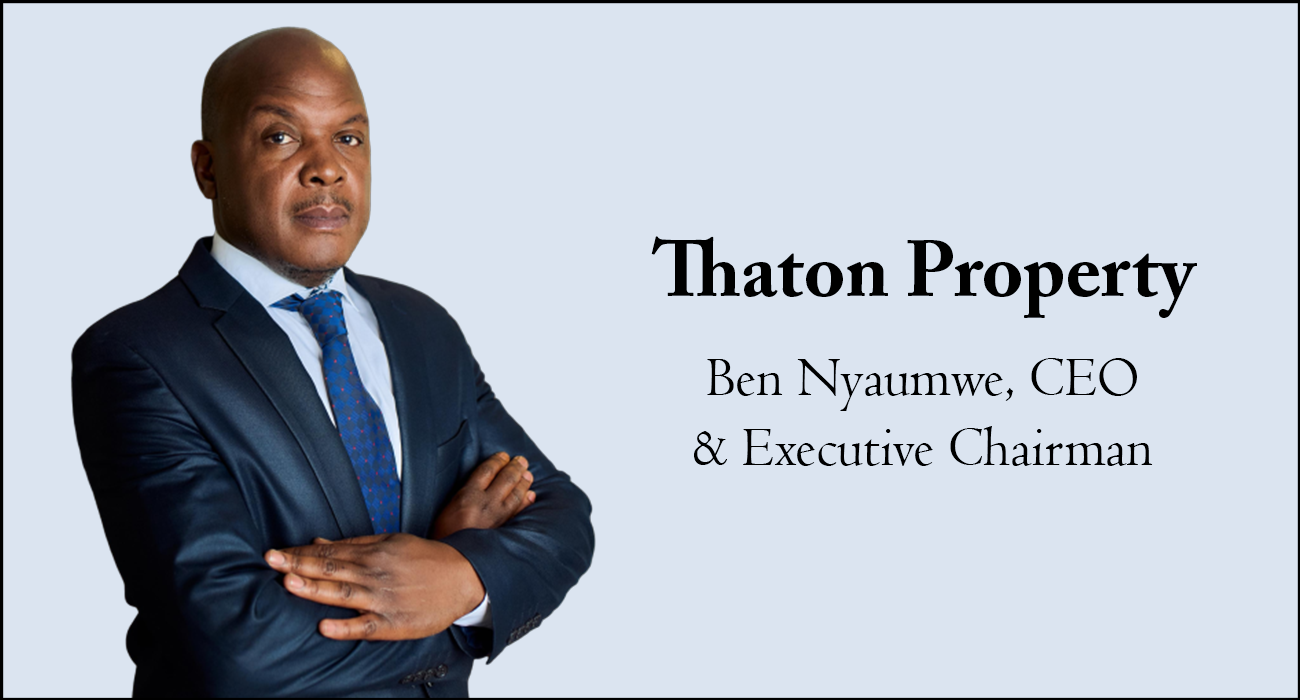
At CIO Bulletin, we had the distinct honor of interviewing Ben Nyaumwe, CEO and Executive Chairman of Thaton Property. He shared valuable insights into how Thaton Property’s meticulous methodologies drive the creation of groundbreaking, innovative, and high-value projects, positioning the company as one of the “Best Companies to Watch 2026.”
Below is an excerpt from the interview.
Can you share the journey behind the inception of Thaton Property? What gaps in the construction industry did you set out to bridge?
Thaton Property was born from one clear observation: there is potential in land. The team has always had an innate ability to imagine what could be done with a piece of land—and once that potential is seen, an all- consuming passion builds to see the vision realized. We have never pursued a project with money or profit as the primary motive. Those things naturally follow when a project is executed with deep passion and a genuine desire to achieve something exceptional.
But passion without structure loses its way. Early on, we recognized that the gap between a great vision and a great outcome often came down to coordination and accountability, the places where things quietly fall apart across the value chain.
So Thaton Property was designed, from inception, around integration: fewer handovers, tighter control, and a developer mindset that treats every decision as part of a long- term performance story. The goal was simple: to build a platform that stays disciplined from concept to delivery, protecting cost discipline, safeguarding quality, and ensuring that what we create remains viable long after handover.
Because a vision is only as good as its execution.
Can you brief us about the range of services offered by your company and what makes them stand apart from your competitors?
Thaton Property is fundamentally a development and investment platform. We are not a contractor, we are not a consultant, we are developers, and that distinction matters enormously. We sit at the top of the value chain, and we orchestrate everything beneath it. Our work spans land acquisition and feasibility, concept development, project management, construction oversight, and long-term asset performance. We do not hand a project off and walk away. We stay in it.
What we are perhaps best known for is our residential and mixed-use development work. We developed Zimbabwe’s first lifestyle estate. That was not an accident; that was a deliberate push to introduce a product category that simply did not exist here. And we have gone further with what we call URBAN+, a concept we coined ourselves for mixed-use residential developments that genuinely compete with what you would find in Dubai or Cape Town. Not approximate it. Compete with it.
Now, what makes us different? It is not a list of services. Any firm can write a list. What separates us is the mindset behind every decision we make. We have never pursued a project because of the financial return alone. We pursue projects because we see potential that others have missed, and we become consumed by the vision of realising it. That obsession, that refusal to be mediocre, is embedded in how we design, how we build, and how we deliver.
We also lead from deep technical involvement. As the Executive Chairman, I personally immerse in every project. That de-risks the process and raises the ceiling of what is achievable. The right consultants and partners thrive in that environment. The ones who don’t, well, they were probably not going to deliver excellence anyway.
Specializing in various residential and commercial projects, how did the company’s partnership with Dubai-based Damac cement its position as a reputed international property marketer?
Partnering with Damac from Dubai elevated our credibility in two ways: standards and reach. First, it sharpened our commitment to market-grade delivery: design discipline, quality expectations, and a level of professionalism required when you’re operating within an international ecosystem. Second, it strengthened our marketing and investor positioning by giving our pipeline a global reference point.
Together, the partnership helped us prove we could operate beyond local boundaries—while still executing with the same builder’s mindset and accountability. That’s how we cemented our position as an international property marketer: through repeatable standards, real delivery, and confidence built in public results.
How does the company leverage its expertise in “Brown Field” building conversions to revitalize underutilized urban spaces within Zimbabwe’s current real estate market?
Brownfield conversion is really just another expression of something we have always believed: there is potential in land, and by extension, in what already sits on it. The question is whether you have the imagination and the technical capability to unlock it.
Zimbabwe’s urban landscape, particularly in Harare, is littered with underutilised buildings and neglected sites that the market has written off. We do not see write-offs. We see raw material. The bones of a structure, the location, the existing infrastructure connections, and the footprint itself are assets that a greenfield site simply does not have. When you approach a brownfield conversion correctly, you are starting with an embedded advantage.
What we bring to that process is an integrated developer mindset. We are not coming in as a contractor simply tasked with a renovation. We are asking the deeper question first: what should this space become, and who should it serve? That question drives everything else: the design, the phasing, the investment structure, the end product.
Too many “conversions” in this market are timid. Someone slaps a coat of paint on an old building and calls it revitalisation. That is not what we do.
Zimbabwe’s current market conditions actually make brownfield projects more compelling than ever. Construction costs are significant and land in prime urban areas is increasingly scarce. A well-located existing structure, repositioned with vision and executed with discipline, can deliver exceptional value to investors and to the communities around it.
That is what filling the void looks like in practice. Not building on the periphery where land is cheap, but going into the heart of the city and making it work again.
How does your project management methodology mitigate technical and regulatory risks unique to high-stakes hospitality and healthcare developments like the Mandela Bay Waterfront and MSC Medical Centre?
Let us speak to the methodology first, because that is what travels across every project regardless of sector.
The foundation of how we mitigate risk is integration. Most project failures in complex developments, whether hospitality, healthcare, or otherwise, do not happen because of a single catastrophic event. They happen through accumulated disconnects: a designer who does not understand the operational brief, a contractor who was not involved early enough to flag buildability issues, a compliance process that was treated as a checklist rather than a design input. We eliminate those gaps by staying deeply involved from concept through to delivery. Ben Nyaumwe is personally in the details. That is not micromanagement; that is risk management.
Healthcare and hospitality developments carry a particular weight because the consequences of getting them wrong extend far beyond the balance sheet. A hospital that does not function correctly affects lives. A waterfront hospitality development that under delivers on its promise affects an entire precinct, an entire economy in some cases. That raises the stakes, and it sharpens our discipline accordingly.
On the regulatory side, we treat compliance as a design driver rather than a finishing step. In high-stakes developments, the regulatory environment is complex and often slow. If you wait until your design is complete before engaging with those processes, you have already lost significant time and possibly made costly commitments you cannot reverse. We front-load that engagement.
And then there is what we have always believed: there is always a technical solution to any technical challenge. That conviction creates the mental space for genuine problem- solving rather than panic when obstacles arise. It keeps the team solution-oriented rather than defensive.
What design innovations is the company implementing to balance high-density student accommodation requirements with the luxury standards featured in your award-winning residential lifestyle estates?
This is a question that gets to the heart of something we feel very strongly about, and that is the dangerous assumption that density and quality are mutually exclusive. They are not. That is a failure of imagination, not a law of design.
The student accommodation typology in this market has historically been treated as a volume exercise. Pack in the beds, minimise the cost per unit, and deliver something functional. We reject that entirely. A student is not a lesser occupant deserving a lesser environment. In fact, I would argue that the formative years spent in a space have a profound effect on how a young person comes to understand quality, aspiration, and what is possible for their own life. We take that seriously.
So the starting point for us is not the room count. It is the lifestyle brief. What does a student actually need beyond a bed and a desk? They need community spaces that inspire collaboration. They need amenities that signal to them that they are valued. They need environments that are safe, considered, and visually compelling. Once that brief is set, the density question becomes a design challenge rather than a compromise.
What we are implementing draws directly from the URBAN+ thinking we have developed across our residential work. The principles translate. Shared amenities done at a high standard reduce the burden on individual units while elevating the overall experience.
Landscaping, material quality at touchpoints, lighting, spatial sequencing, these are not luxuries reserved for high-end estates. They are design decisions that cost less than people assume when they are integrated from the outset rather than added as an afterthought.
The award-winning work we have done in lifestyle estates taught us that excellence is largely a discipline of decision-making, not simply a function of budget.
As a multi-award winning property developer, what makes the company stand out as one of the “Best Companies to Watch 2026”?
Awards recognize outcomes, but what makes Thaton Property worth watching is our approach behind those outcomes.
We stand out for:
Integrated delivery: We don’t fragment responsibility across too many hands.
Execution discipline: We manage projects as systems, not events.
Purpose-led ambition: We build with meaning—developments that move the needle and unlock value.
Regional readiness: We execute with an international mindset, even when operating in local realities.
In 2026, our momentum is powered by repeatable capability, clear standards, and a pipeline that’s designed for real demand—not assumptions.
Looking into 2026, what are the products in the pipeline that the company has planned to launch?
In 2026, our pipeline focuses on developing products that address real market needs while raising the standard of delivery.
We’re looking at:
Mixed-use residential concepts – The Connaught Luxury Residence is designed for modern urban living and lifestyle functionality.
Premium commercial and hospitality – aligned developments where operations and long-term performance matter.
What are the future developments you envision in the construction industry, and how is your company preparing to maintain its position as a leader in this space?
The future belongs to developers who can combine three things: speed without shortcuts, quality without waste, and innovation without losing discipline.
As the industry evolves, we’re preparing through:
Stronger integration of planning, design, and execution so projects remain controlled end-to-end.
Operational thinking—because what a building delivers after handover is what defines its success.
Risk intelligence—especially for complex, high-stakes property categories.
Talent and capability building to keep standards consistent across geographies.
We believe in being grounded but flexible—never rigid. The industry changes, but disciplined builders win by adapting without losing their vision.
The Visionary Leader Behind Thaton Property’s Success
Ben Nyaumwe is a builder-led executive with a disciplined, execution-first mindset. As CEO and Executive Chairman of Thaton Property, he leads development and investment across residential, commercial, hospitality, and specialized infrastructure projects.
His approach blends construction management training with real-world experience across complex asset classes. He believes in vertical integration, accountability, and staying close to the details—because quality and performance are built, not promised.
What truly defines him, however, is purpose. Ben doesn’t chase money as the primary motive—he pursues exceptional outcomes. He frames leadership through involvement, technical conviction, and a clear belief in Black excellence that is practical, repeatable, and visible across the region.











































 consultants ltd.jpg)


