
Home Industry Pharmaceuticals Global Pharma Prepares as Trum...
CIO Bulletin
,
23 July, 2026
Author:
Ravathi Sunil
Introducing a phased import duty structure to incentivize domestic generic pharmaceutical production across American facilities.
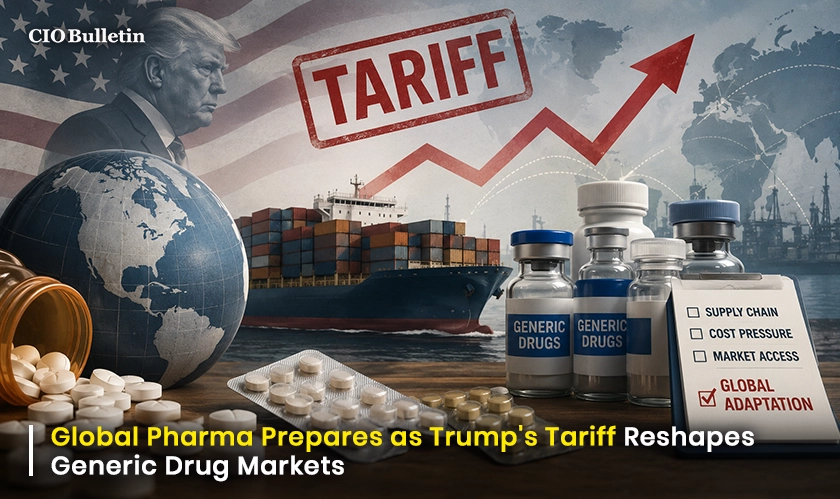
United States President Donald Trump has unveiled a phased trade strategy introducing potential import duties on generic medicines to encourage domestic pharmaceutical manufacturing. Under the announced roadmap, generic drugs entering the American market will maintain a zero percent duty for two years beginning August 2026, followed by a hundred percent duty in the third year and a two hundred percent duty thereafter. As documented in financial reporting from CIO Bulletin, Trump’s tariff aims to reduce reliance on foreign supply chains while reshaping global trade dynamics for essential healthcare products.
Are increased tariffs sufficient to force foreign pharmaceuticals to invest in building new manufacturing capacity in America? At present, generic drugs make up more than ninety percent of all prescription drugs dispensed through pharmacies in the US, and countries such as India contribute significantly by providing affordable generic drugs for chronic ailments. Experts point out that it is impossible to relocate manufacturing and formulating units without making massive investments over several years in the process of approval. Therefore, global pharmaceutical firms have made vital considerations concerning their business operations and pricing policies.
"Effective August 1st, 2026, all Generic Drugs being brought into the United States will continue to have a tariff of zero percent for two years, after which the tariff will be raised to 100 per cent for one year, and 200 per cent thereafter." - Donald Trump.
Key Insights from the Trade Roadmap:
Multi-year transition window permits pharmaceutical firms to adjust regional manufacturing capabilities.
Existing trade policies governing patented and branded pharmaceuticals remain completely unchanged.
High import duties threaten to increase operational costs for overseas generic drug producers.
By establishing clear transition timelines, federal authorities intend to strengthen domestic supply resilience while penalizing delayed manufacturing investments. Managing trade transitions without disrupting essential patient access remains central to long-term economic stability.
Everything you need to know about this news
Imported generic drugs remain at zero duty for two years from August 2026, increasing to 100% in year three and 200% in year four.
The initiative aims to reshore pharmaceutical manufacturing, incentivize domestic facility construction, and reduce dependence on overseas medicine supplies.
No, existing regulations and policies governing patented, branded, and innovative pharmaceuticals remain completely unchanged under this proposal.
Generic producers operate on thin profit margins, making it difficult to absorb high tariffs or rapidly relocate complex production facilities.
Exporters and global industry groups are analyzing potential supply chain adjustments, investment costs, and ongoing bilateral trade discussions.


















































 consultants ltd.jpg)


Comments