
Home Industry Agro tech Can a Bipartisan Initiative Dr...
CIO Bulletin
,
23 July, 2026
Author:
Ravathi Sunil
Modernizing research programs and extension funding to bridge technological adoption gaps across rural communities.
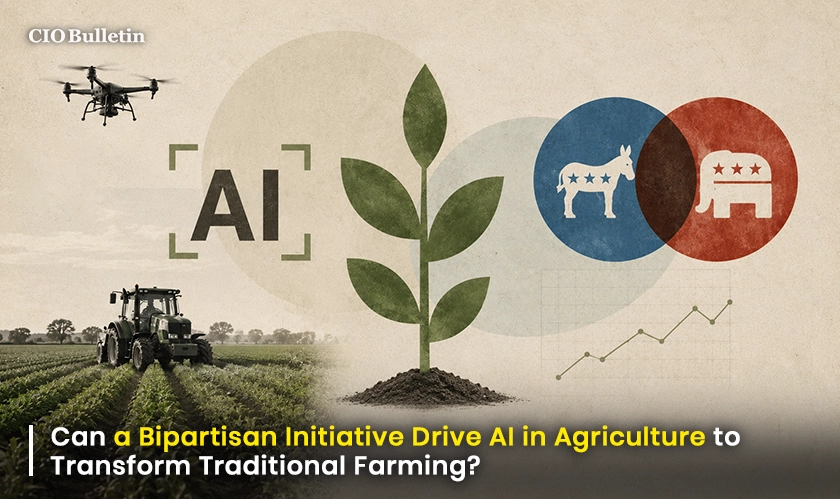
American lawmakers have introduced groundbreaking bipartisan legislation to accelerate the deployment of AI in agriculture as modern farming faces evolving global challenges. Referred to as the FARM AI Act, this bill seeks to update research and workforce development programs under the management of the United States Department of Agriculture.
According to CIO Bulletin reports, while digital capabilities advance rapidly, a recent industry survey reveals that 75% of producers are not currently using AI in their operations. By establishing strategic research priorities and expanding local extension grants, federal authorities plan to bridge this technological divide across rural farming communities.
Why do so many food producers hesitate to integrate smart digital tools into their daily workflows? Data shows that adoption hurdles stem primarily from a lack of technical understanding and uncertainty surrounding economic returns rather than access to physical technology. Many existing precision farming systems already embed machine learning capabilities without growers fully realizing it. Specialized workforce training and transparent federal guidelines aim to build trust and demonstrate practical financial value for small and family-owned farms.
"Feeding America is national security, and the future of agriculture will depend on our ability to innovate." - Don Davis, Congressman.
He emphasized that strengthening research and expanding workforce training will give producers the essential tools needed to boost output while remaining globally competitive.
Establishes agricultural artificial intelligence as a priority research domain across federal grant programs.
Directs dedicated funding to extension services to assist growers with responsible technology adoption.
Appoints a senior federal advisor to align national agency programs and standardize digital farming guidelines.
Through modernization of agricultural policies and training rural people, policymakers intend to create a sustainable agricultural system for future generations. Educating people about proper resources guarantees that farmers will adopt automation without compromising their economic security. As federal agencies coordinate with research universities, this legislative push promises to unlock unprecedented productivity.
Everything you need to know about this news
It modernizes federal agricultural research programs to accelerate research, expand rural workforce training, and promote responsible automated technology adoption.
Adoption obstacles stem mainly from a lack of technical understanding, limited evaluation time, and uncertainty regarding demonstrable financial returns.
The bill was introduced by United States Representatives Don Davis and Zach Nunn in the House, alongside companion legislation in the Senate.
It provides direct funding for local extension services, research grants, and educational fellowships to help growers overcome steep upfront implementation hurdles.
The act establishes a senior federal advisor position within the USDA to coordinate national artificial intelligence initiatives and create standardized digital agricultural guidelines.





















































 consultants ltd.jpg)


Comments