
Home Industry Metals and mining How a Metal Extrusions Manufac...
CIO Bulletin
,
05 March, 2026
Author:
CIO Bulletin Team
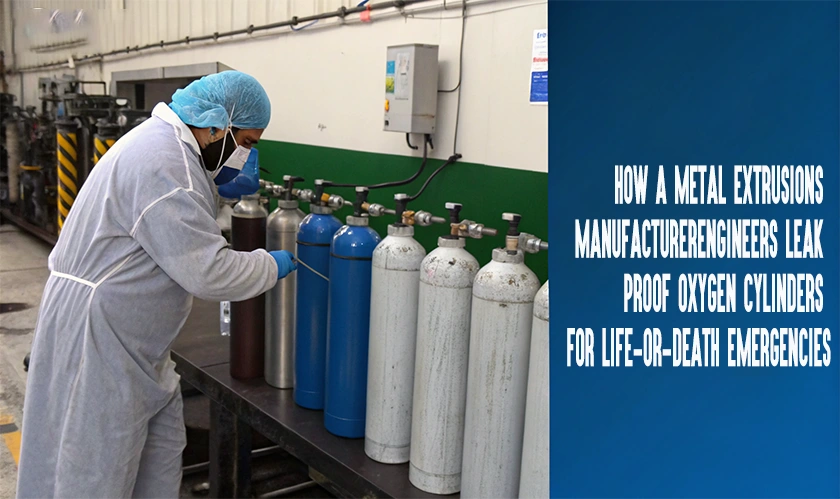
When an emergency unfolds fast, whether in an ambulance bay, a disaster relief staging area, or a hospital corridor during a mass casualty event, the oxygen cylinder someone reaches for has to work. No leaks. No weak seams. No failures under pressure. The stakes are exactly that simple and that serious.
Behind those cylinders is a manufacturing process that most people never think about. Impact extrusion, a method that shapes aluminum into seamless, high-strength components through a single high-force strike, has become the standard for producing reliable oxygen cylinders in emergency and medical settings. Here is a closer look at exactly why that process earns so much trust, and what separates a well-built cylinder from one that falls short when it matters most.
A welded or multi-piece cylinder has joints. Joints create weak points. In a high-pressure oxygen application, those weak points are where leaks begin.
Impact extrusion solves this by forming the entire cylinder body from a single aluminum slug in one stroke. The metal flows into the die and takes shape as one continuous piece, with no welds, no bonds, and no seams. The result is a structurally uniform container that holds pressure without compromise. For emergency oxygen delivery, that kind of integrity is not optional.
Precision matters in medical manufacturing. An oxygen cylinder that fits a standard valve or regulator one day needs to fit the same components every single day, across hundreds of thousands of units.
A skilled metal extrusions manufacturer uses automated press lines and carefully engineered tooling to hold tight tolerances across high-volume production runs. Wall thickness, inner diameter, and thread dimensions stay consistent from the first part to the millionth. That consistency is what allows medical device OEMs and gas suppliers to build predictable supply chains around a single reliable source.
Weight matters in emergency response. Paramedics, firefighters, and field medics carry equipment under physical stress. A cylinder that is unnecessarily heavy becomes a liability.
Aluminum impact extrusions offer a direct solution. The 6061 alloy used in high-quality cylinder manufacturing delivers the strength to contain pressurized oxygen safely while keeping the overall unit light enough to carry easily, transport in vehicles, and move through a crowded emergency room. The physics of the impact extrusion process actually densifies and work-hardens the metal as it forms, adding to its strength without adding weight.
Oxygen cylinders for medical and emergency use are regulated. They have to meet Department of Transportation standards for pressurized containers, as well as requirements specific to medical oxygen applications. Achieving those certifications is dramatically easier when the cylinder itself is built without the structural compromises that come from welded assemblies.
Single-piece impact-extruded cylinders are easier to test, easier to certify, and easier to inspect over their service life. There are no hidden weld zones to examine and no joints to check for micro-fractures. The cylinder either passes pressure testing or it does not. That straightforward quality standard supports faster certification and cleaner compliance documentation throughout the supply chain.
Natural disasters, pandemics, and mass casualty events all share one manufacturing challenge: demand for medical oxygen cylinders surges without warning. A supplier that runs a slow, labor-intensive process cannot respond fast enough.
Impact extrusion is inherently fast. The single-stroke forming process produces parts at high speed with minimal setup between runs. When a crisis drives sudden demand, a manufacturer operating automated impact extrusion lines can increase output significantly without sacrificing quality or consistency. That responsiveness is not just a competitive advantage. In emergency scenarios, it is a direct contribution to the care infrastructure that keeps people alive. Key production advantages that support surge capacity include:
Single-stroke forming with no multi-step assembly required
Automated press lines capable of high-volume continuous output
Near-net-shape parts that reduce downstream machining time
Minimal raw material waste, which keeps supply chain costs stable under pressure
Oxygen cylinders in medical and emergency settings are expected to last. They cycle through fills, use, inspection, and refill repeatedly over years. Corrosion, even minor oxidation on interior surfaces, introduces contamination risk into a life-critical application.
Aluminum naturally forms a protective oxide layer, which helps it resist corrosion without additional coatings in many applications. When that aluminum has been shaped through the impact extrusion process, the resulting surface finish is clean, dense, and consistent. Interior walls are smooth, which reduces the surface area available for contaminant buildup. For oxygen cylinders specifically, that clean interior matters for both safety and the integrity of the gas itself.
There is a meaningful difference between a manufacturer that produces one or two cylinder sizes and one that supports a comprehensive product line across medical, industrial, and emergency applications. The latter brings engineering knowledge that goes beyond operating a press.
Understanding how cylinder geometry affects pressure performance, how wall thickness ratios interact with alloy selection, and how finishing operations affect valve fitment requires decades of accumulated expertise. The most capable producers in this space have been manufacturing aluminum gas cylinders since the mid-twentieth century, long enough to have encountered and solved problems that newer entrants have not yet run into.
A broad product line also gives OEMs and distributors flexibility. Emergency responders use different cylinder sizes depending on application, from large high-capacity units at fixed medical stations to compact portable cylinders for field use. A single manufacturer capable of supplying across that range simplifies procurement, reduces vendor complexity, and creates a more resilient supply chain. Additional factors that distinguish experienced cylinder manufacturers include:
In-house tooling and die production for faster customization
Secondary machining capabilities that eliminate the need for outside processing
Heat treating and coating operations under one roof
Engineering support for new designs and product development
Most buyers of medical oxygen cylinders focus on the finished product: weight, pressure rating, valve compatibility, and price. Those are the right things to evaluate. But the manufacturing process behind those specifications is what determines whether the finished product actually delivers on them consistently over time.
Impact extrusion is not a shortcut. It is a more demanding process to master than basic fabrication, and it requires investment in precision tooling, press technology, and engineering expertise. The manufacturers who have committed to that process for decades have done so because the results justify it. Seamless construction, tight tolerances, fast production, and long service life are not incidental outcomes. They are direct consequences of doing the process correctly.
For anyone sourcing oxygen cylinders for emergency preparedness, medical supply, or industrial gas distribution, understanding what goes into a well-built cylinder is the first step toward choosing the right partner. A manufacturer with proven depth in aluminum impact extrusion, a comprehensive cylinder product line, and the production infrastructure to scale quickly is not just a supplier. It is part of the emergency response system itself.


















































 consultants ltd.jpg)


