
Home Technology Microsoft Microsoft Introduces New Sover...
CIO Bulletin
,
22 October, 2026
Author:
Sambhrant Das
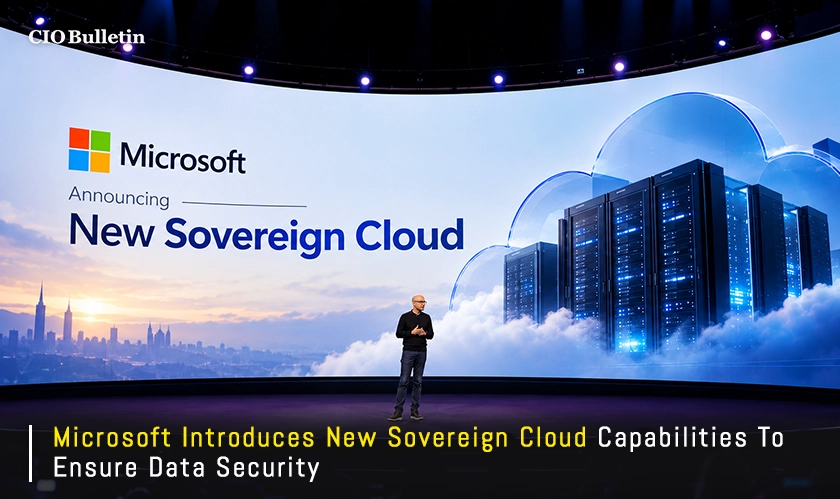
Microsoft introduces new sovereign cloud capabilities for data security, empowering public sector entities and regulated enterprises with localized operational control and hardware-level privacy protection.
To enable public sector organizations and companies that are subject to regulation to maintain strict compliance of their digital infrastructure, the technology giant Microsoft has introduced new sovereign cloud capabilities for data security and operational control. These improved features, which were announced as part of a wider deployment across public, private and partner cloud environments, deal with the process of strengthening compliance with global data privacy regulations. The technical improvements mean that organisations can deploy advanced AI models, manage their own encryption keys and limit data processing to specific geographic areas without having to give up access to cloud innovations.
Unified Monitoring and Hardware Isolation Upgrades
The software manufacturer introduced dedicated governance tools designed to give IT security officers complete visibility across their cloud operations. These features allow system managers to isolate workloads completely onto customer-owned hardware when necessary.
Deployment of the Sovereign Control Panel to aggregate compliance signals into a single portal.
Offline execution capabilities for software development tools like GitHub Enterprise on local servers.
Integration of hardware-backed confidential computing to protect sensitive enterprise data during real-time processing.
Executive Commitment to Operational Independence
Emphasizing the balance between compliance requirements and technological growth, specialized clouds lead Douglas Phillips stated: “Across my conversations with leaders in government, critical infrastructure and regulated industries, one priority consistently rises to the top: putting technology to work on their most important systems while maintaining the control those systems require.”
Partner Alliances and Localized Cloud Infrastructure
Beyond public cloud updates, Microsoft expanded its collaborative network across local computing environments to support strict jurisdiction laws. Working with over thirty international infrastructure providers, the firm ensures localized cloud deployments align with regional statutory mandates.
Deep integration with national cloud initiatives like Delos Cloud in Germany and Bleu in France.
Transition tools enable seamless movement of critical enterprise workloads between connected and fully disconnected states.
Securing Public Sector Workloads Against Disruption
With international digital boundaries becoming more rigid, cloud architects need greater autonomy regarding access to system telemetry and data. By using local key management and providing isolated computing capabilities, third-party exposure is reduced, and business continuity can be guaranteed in the event of unexpected network outages. According to CIO Bulletin, this marks a major advance in meeting strict data privacy requirements while at the same time enabling hyperscale cloud expansion within global public administration.
News Source: Firstpost, https://www.firstpost.com/
Everything you need to know about this news
The improvements feature local AI processing, the ability to deploy private cloud services in an isolated manner, independent management of encryption keys, and a central Sovereign Control Panel.
It provides a unified management console in Azure that brings together compliance signals, data residency verification, and operational logs into one view.
Yes, platforms like GitHub Enterprise and SQL Server can now run directly on customer-controlled local infrastructure in fully disconnected states.
Microsoft is collaborating with localized infrastructure providers globally, including Bleu Cloud in France and Delos Cloud in Germany.
Strict regional data laws require public sector and regulated healthcare or financial organizations to maintain exclusive physical and logical control over critical information.


















































 consultants ltd.jpg)


Comments