
Home Technology Mobile Mobile MVP App Examples That A...
CIO Bulletin
,
06 October, 2026
Author:
Guest
Nine out of ten startups never make it past year one. The ones that do almost all share one habit: they refused to build the “full” app first. Instagram wasn’t Instagram when it launched. Uber didn’t have surge pricing, driver ratings, or UberEats. Airbnb’s entire “platform” was three air mattresses on a hardwood floor in San Francisco. All of these companies chose to launch a first version instead of a finished one and all of them were correct.
Here is what really happened when those companies shipped their MVPs and you can learn from their approach before you write any code.
A lot of founders treat an MVP as the budget version of the “real” app they’ll build later. That’s the wrong frame. A real MVP isn’t about doing less work — it’s about getting an honest answer, fast, to one question: will anyone actually use this? Get that wrong with a polished app and you’ve just failed more expensively, and slower.
Tests one core assumption, not ten features bolted together.
Reaches real users within weeks, not fiscal quarters.
Measures what people do, not what they say they’ll do.
Gets killed, pivoted, or funded based on data — not on a founder’s gut feeling
Before Instagram there was Burbn. Burbn was a location check‑in app that let people announce where they were plan events with friends earn points for hanging out and almost as an afterthought post photos. Burbn tried to do everything. Users mostly ignored most features except one.
Kevin Systrom and Mike Krieger noticed that only photo sharing kept people coming back. They cut the rest of Burbn. Check‑ins, gamification, planning tools were removed. On October 6 2010 they launched an app: take a photo apply a filter and share it. Nothing else was offered.
Market reaction was instant. Instagram attracted 25,000 signups on the day and over 100,000 within a week. By December 12 Instagram had more than one million registered users, just over two months after launch. Instagram reached this speed while Twitter needed about two years. Ruthless subtraction, not addition made Instagram succeed.
The first version of Uber tested in San Francisco under the name UberCab did one thing: tap a button and get a black car. There was no UberX, no Pool, no Eats, no, in-app tipping, no surge pricing algorithm like we know it today. The founders and a small group of friends used it to call town cars around the city. They wanted to see if people would actually pay extra for the convenience of dealing with the hassle of hailing a cab.
They weren’t testing ride-sharing as a concept. That idea came later. They were testing one idea: would people pay to avoid the trouble of finding a cab? When that worked when people actually paid for that ease, everything else started to grow. Every new feature was added based on how people used the app, not because someone made a plan in a meeting room.
Airbnb’s founders didn’t start with a marketplace, a review system, or Superhost badges. They started with a design conference coming to San Francisco, a sold-out hotel market, and three air mattresses on their own apartment floor. They built a bare-bones website, rented out floor space to three attendees, and made a little cash while testing a single question: will strangers pay to sleep in someone else’s home?
Only after that held up did they add the features you’d recognize today — listings from other hosts, maps, pricing filters, photos. The MVP wasn’t a stripped-down Airbnb. It was barely a website. But it proved the core behavior, and that’s all an MVP has to do.
Spotify’s first release wasn’t global. It didn’t have playlists. There were no recommendations. No podcasts either. It started in Sweden with a collection of songs. The idea was simple. If streaming could be fast and easy people might pick it over downloads. That was the bet. The team watched usage patterns closely before expanding the library or the footprint, then scaled market by market only once the core behavior — people sticking with the legal, paid option — was confirmed.
Notice the pattern across all four: none of these teams built alone or built everything from scratch in-house on day one. Instagram shipped with two engineers. Uber’s early build leaned on outside contractors. If you don’t have that kind of technical bench strength sitting in your own office, bringing in mobile app developers for hire gets your MVP into real users’ hands without the cost and delay of building a full engineering team you can’t yet justify. You get the scope discipline of a lean build with the execution speed of people who’ve shipped this exact kind of app before.
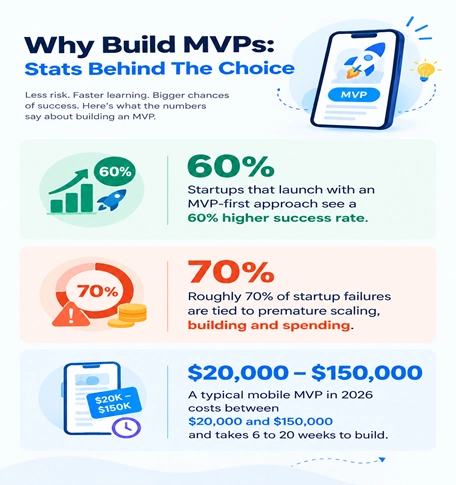
This isn’t just a story about a handful of famous apps. The data backs the strategy up, and the mobile market it plays out in has only gotten bigger:
Startups that launch with an MVP-first approach see a 60% higher success rate than those that launch with a fully-featured product, per Startup Genome research.
Roughly 70% of startup failures are tied to premature scaling — building and spending as if product-market fit already existed.
The global mobile app market hit $330.61 billion in 2025 and is projected to reach $1.23 trillion by 2035, growing at a 14% CAGR.
3 billion people now carry a smartphone — about 78% of the world’s population — and users downloaded 137.8 billion apps in a single year.
A typical mobile MVP in 2026 costs between $20,000 and $150,000 and takes 6 to 20 weeks to build depending on what the project includes. This is much faster than a traditional build, which can take 6 to 12 months.
In short the number of people who might use your app has never been higher. At the time the cost of finding out if they actually will has never been lower.
Strip away the industry and the founders, and the same four decisions show up again and again:
Every example above launched with a single job to do. Photo sharing. Book a black car. Rent an air mattress. Stream a song. Nothing competed for the user’s attention.
None of these products looked good at launch. They looked functional. Design, branding, and delight came after the behavior was proven, not before.
Airbnb’s founders photographed listings themselves. Early Uber rides were arranged manually between friends. Doing the unscalable thing early is how you learn what to automate later.
Every team above changed direction quickly once usage data told them something their assumptions hadn’t. None of them defended a roadmap for its own sake.
You don’t need a garage, a Silicon Valley zip code, or a second co-founder with a design degree to run this playbook. You need discipline about scope and a clear read on what you’re actually testing.
Write down the one hypothesis your MVP needs to prove — not the ten things your app will eventually do.
Cut every feature that isn’t required to test that hypothesis, even the ones you’re personally excited about
Launch to a narrow, reachable audience first — a city, a niche, a waitlist — instead of a global release
Pick one metric that tells you if the hypothesis held up, and ignore vanity numbers that don’t answer that question
Treat early traction and true product-market fit as two different things — don’t scale spend until you’ve confirmed the second one
The apps in this article didn’t win because their founders were smarter than everyone else building a startup that year. They won because they were more willing to launch something small, embarrassing, and incomplete — and then actually listen to what happened next.
Every app on this list started as something you wouldn’t recognize today, and every one of them got there by testing a single idea before building the rest. That’s the whole strategy: prove the core behavior first, then earn the right to add everything else. If you’re sitting on an app idea and wondering whether it needs three months of development or ten, the honest answer is that you don’t know yet — and an MVP is how you find out before you’ve spent the ten.
















































 consultants ltd.jpg)


Comments