
Home Industry Real estate Will Japan’s Major Real Esta...
CIO Bulletin
,
14 September, 2026
Author:
Sambhrant Das
Japan’s major real estate firms accelerate high tech data center expansion projects nationwide to capture soaring artificial intelligence compute demand
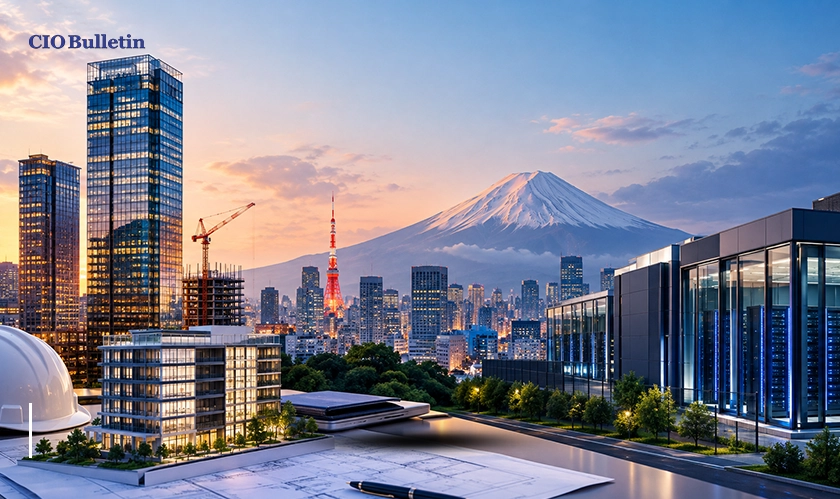
Japan’s major real estate firms are swiftly moving capital into constructing data centers because of the increasing demand for digital infrastructure brought about by AI work systems. According to the Ministry of Internal Affairs and Communications, the domestic market for data centers is expected to surpass ¥5 trillion by 2025 due to the rise in business use of AI and local cloud computing demands that are prompting developers to obtain crucial plots of land in major cities.
Expanding high-density compute facilities in densely populated areas creates complex land-use challenges and neighborhood friction. Developers are deploying their long-standing urban planning capabilities to negotiate community concerns, secure high-capacity power connections, and secure municipal permits cleanly.
Strategic acquisition of underutilized industrial land near core fiber backbones
Collaborative community engagement to solve localized noise and power allocation concerns
Full-lifecycle site management from land clearance to structural completion
Traditional building methodologies are adapting to keep pace with rapid enterprise requirements. Companies like Daiwa House Industry are deploying modular build strategies to compress construction timelines significantly.
Building mega-cluster hubs, including Daiwa House’s massive 14-facility footprint in Inzai, Chiba Prefecture
Deployment of pre-assembled modular units, such as the specialized small-scale facility launched in Okuma, Fukushima Prefecture
Assembly of factory-built components directly on-site to drastically reduce local build disruption
By treating processing centers as a distinct core asset class alongside traditional commercial real estate, developers are transforming how digital infrastructure gets built in East Asia. Their existing relationships with municipal utility providers and expertise in complex land acquisition allow them to deliver power-ready sites far faster than independent operators can manage alone.
Sustaining this momentum requires navigating ongoing power grid constraints and tight urban space limitations. Market momentum suggests real estate firms will remain pivotal infrastructure partners as regional cloud demand accelerates. CIO Bulletin views this development as an essential transformation of traditional property portfolios into mission-critical digital assets.
Everything you need to know about this news
Developers are leveraging land acquisition and redevelopment expertise to capture rapid market growth driven by artificial intelligence workloads and cloud demand.
According to Japan's communications ministry, the nation's data center-related market is projected to cross ¥5 trillion by 2028.
Firms use established municipal relationships and urban redevelopment strategies to manage noise, power usage, and land zoning challenges near urban neighborhoods.
Due to the setting up of factories, modular structures can be built and put together on site very quickly, meaning they can reach remote areas like Fukushima at great speed.
The areas that are going to be developed are tech centers such as Inzai as well as specialized regional locations such as Okuma in Fukushima Prefecture.



















































 consultants ltd.jpg)


Comments