
Home Industry Sports James Webb Space Telescope Dis...
CIO Bulletin,
20 July, 2026
Author:
Ravathi Sunil
A groundbreaking observation reveals how the universe’s most ravenous monsters survive their own violent outbursts.
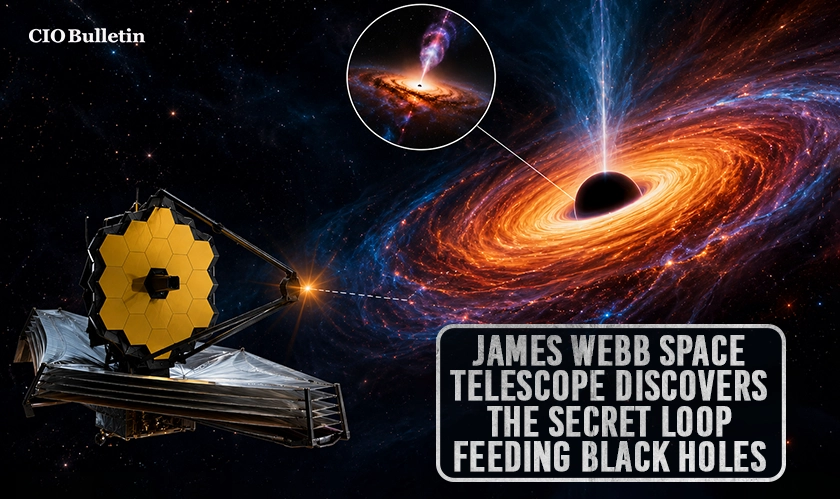
The enigmas of the vast universe can occasionally violate the principles of physics completely. There have been some scientific questions regarding the same since time immemorial; the first of which is the reason why supermassive black holes, whose masses range between millions and billions of times more than that of the Sun, continue to exist despite their extremely destructive activities. As they consume matter, they release powerful beams of radiation that repel the substances essential for their development. Now, an extraordinary discovery has finally cracked this celestial mystery. According to a report tracking these updates at CIO Bulletin, the James Webb Space Telescope has captured the ultimate cosmic recycling act in real time. The findings reveal that these massive entities do not just destroy; they participate in a chaotic, self-sustaining loop that allows them to feast, fast, and feast again.
Researchers were for the first time able to witness a phenomenon of a loop cycle when the hot gases being emitted by a black hole get finally cool down in the cold space. As the gases cool off, they turn into massive streams that span several thousand light years, and through the effect of gravity, they fall back towards the black hole.
"What JWST is revealing is that black holes may be the ultimate cosmic recyclers." - Julie Hlavacek-Larrondo, Université de Montréal.
The use of a magnified view of the galaxy NGC 4696, which is 145 million light-years away, helped scientists map out an 800-light-year-wide cloud of gas moving toward its doom at the speed of 1.3 million miles per hour. This scientific discovery fills the gap in the evolutionary process of galaxies by showing that black holes alternate between eating and starving to grow big.
Everything you need to know about this news
They operate on a self-regulating cycle. The intense energy they blast outward eventually cools down in deep space, transforming into long gas filaments that gravity inevitably pulls back inward to restart the feeding process.
Standard physics suggested that the fastest-growing black holes should permanently push away their food supply. Without the advanced infrared optics of the JWST, scientists could never see the faint, returning gas filaments that complete the loop.
The telescope focused its lenses on NGC 4696, a prominent galaxy nestled inside the Centaurus Cluster, located roughly 145 million light-years away from Earth.
Data revealed that the gas structures are spiraling inward toward the central supermassive black hole at a staggering speed of approximately 1.3 million miles per hour.
It completely redefines galactic evolution. Proving how these titans grow so rapidly helps astronomers unlock the history of the early universe and explains how supermassive black holes formed so soon after the Big Bang.






















 consultants ltd.jpg)


Comments