
Home Technology Storage technology Can Kinetic Subsystems Insulat...
CIO Bulletin
,
19 June, 2026
Author:
Sambhrant Das
Kinetic storage manufacturers define a new power optimization category to protect automated data clusters from severe sub second utility network drops
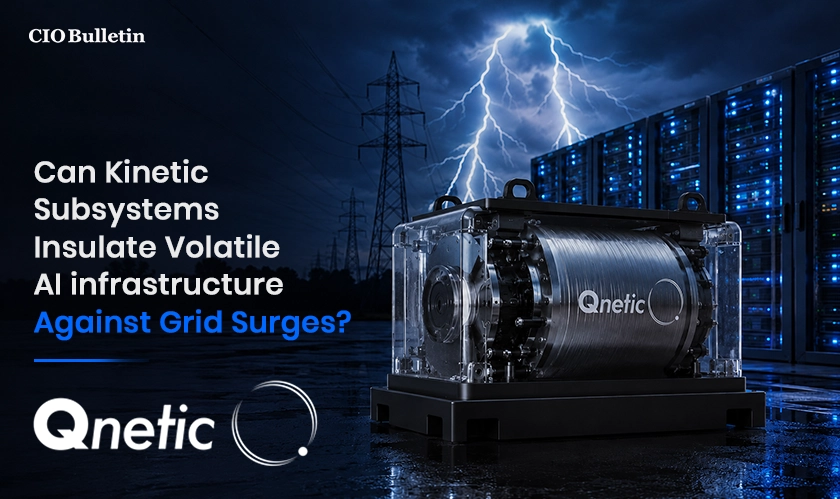
The mechanical architecture supporting global deep learning farms is undergoing an immediate structural reassessment as conventional battery installations fail to balance severe power fluctuations. Kinetic storage pioneer Qnetic has officially released a comprehensive industry white paper defining "AI-Grade Energy Storage" as an entirely distinct hardware requirement for expanding AI infrastructure. This newly designated technical classification emerges precisely as generative computing clusters push utility networks far beyond their engineered load capacities. By introducing heavy-duty kinetic stabilization systems directly into localized server mainframes, power engineers aim to eliminate the sudden voltage drops that disrupt high-density model training pipelines.
The core operational delivery of this modern energy storage framework relies on handling extreme, near-instantaneous load shifts that occur when massive training models execute complex inference loops. Standard chemical battery setups degrade rapidly under these harsh recycling demands, creating a vital need for mechanical backup solutions.
Sub-Second Ramp Velocity: Advanced mechanical kinetic systems absorb or discharge hundreds of megawatts within fractions of a second, matching the lightning-fast scaling demands of high-performance microchips.
Infinite Cycle Thermal Durability: The specialized vacuum-insulated flywheel mechanisms operate continuously without suffering structural degradation or experiencing the thermal runaway risks common in chemical batteries.
Grid Frequency Stabilization: Integrated magnetic levitation drives interface natively with main utility substations to preserve precise electrical frequencies across nearby consumer power links.
AI training and inference clusters create highly dynamic demand profiles that can fluctuate by hundreds of megawatts within seconds.
The widespread implementation of localized kinetic energy buffers allows global hyper scale data operators to drastically lower their ongoing mechanical overhead while mitigating steep infrastructure liabilities. By anchoring high-capacity mechanical storage pools directly beside regional distribution grids, developers can successfully bypass the slow, multi-year substation upgrade timelines that currently delay new data center launches. This clean integration between high-speed rotational energy systems and digital computing setups means that expanding enterprise computing hubs can smoothly run next-generation workloads without absorbing heavy peak-demand power penalties or specialized grid maintenance costs.
Transitioning away from separate, low-velocity backup batteries over to high-velocity, integrated kinetic balancing systems serves as an essential protective shield for expensive processing hardware during volatile grid load rebalancing. These highly responsive physical setups allow facility managers to maintain constant operational voltage parameters without relying on dirty, slow-starting emergency diesel generator sets.
Modern flywheel storage systems handle immediate power surges exceeding 1,000 megawatts per second, lowering processing strain on sensitive electronic transformer lines.
Predictive power routing algorithms track changing computing power requirements in real time, matching energy availability perfectly with active training schedules.
Standardized modular baselines ensure seamless mechanical and physical connections with existing data center cooling lines, lowering building footprint demands.
As the international technology sector becomes completely dependent on massive, localized computing arrays to drive automated software intelligence, the operational survival of data networks relies on absolute grid stability. Shifting away from fragile, high-maintenance chemical storage methods toward rugged, decentralized mechanical energy frameworks is transforming into a critical commercial requirement for operators looking to preserve uptime margins. Re-engineering basic power delivery grids to manage volatile, high-density energy spikes ensures that enterprise computing hubs protect sensitive silicon components while achieving maximum operational scale. CIO Bulletin views this development as a highly progressive corporate milestone that could redefine workplace ecosystems across legacy industries.



















































 consultants ltd.jpg)


Comments