
Home Technology Storage technology Can B2U Supply Agreement Solve...
CIO Bulletin
,
06 June, 2026
Author:
Sambhrant Das
A new utility partnership redirects degraded lithium ion cells from driverless vehicle fleets into localized power systems to balance solar spikes.
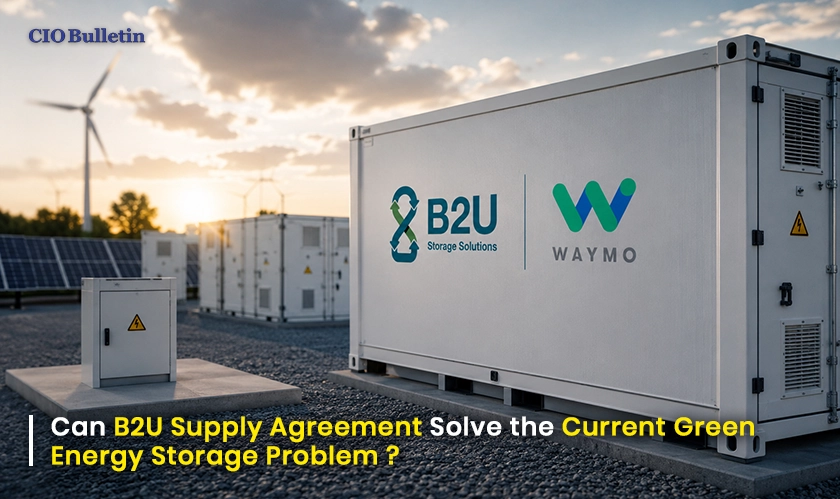
The rapid push toward electric vehicles always brings up an uncomfortable question about what happens to heavy lithium-ion cells when they can no longer efficiently power a car. Instead of tossing degraded power packs directly into energy-intensive recycling furnaces, a smart new logistics partnership is aiming to give these massive power systems a lucrative second career. The newly signed B2U supply agreement establishes a major circular economy loop by collecting retired batteries directly from Waymo's extensive autonomous commercial fleet to shore up regional energy security.
When an autonomous taxi experiences capacity degradation down to roughly 70 percent, its driving range becomes impractical for continuous passenger routes. However, these identical hardware units remain incredibly useful for stationary, low-current storage setups that do not require rapid acceleration. The long-term deployment strategy focuses on managing several practical grid challenges:
Smoothing Daily Solar Spikes: Storing massive quantities of excess clean energy during peak afternoon generation hours to prevent waste.
Easing Extreme Peak Demand: Shifting that stored electricity back onto regional lines when household air conditioners strain localized grids.
Cutting Early Industrial Scrap: Drastically lowering initial manufacturing emissions by delaying total battery breakdown processes for up to eight years.
Industry insiders are highly optimistic about the collaboration between B2U Storage Solutions and Waymo because a centrally managed corporate fleet offers highly predictable battery conditions compared to irregular privately owned cars. This steady volume allows engineers to seamlessly install matching battery types directly into large, climate-controlled storage cabinets without expensive rebuilding costs.
"Through this partnership, we can repurpose our batteries for local grid storage and ensure our batteries continue to provide economic and environmental value to the community." - Adam Lenz, Head of Sustainability and Environment at Waymo
This massive resource shift is capturing significant market attention because constructing brand-new utility storage sites requires mining an immense amount of raw materials. Utilizing existing, field-tested automotive components creates a low-cost alternative that helps protect fragile local transmission systems from sudden overloads. As automated fleet operations grow to cover more cities across the country, the volume of available second-life hardware will likely scale up to provide hundreds of extra megawatt-hours right when local grids need backup the most.
Ultimately, this landmark infrastructure project demonstrates that major tech firms must think beyond immediate vehicle lifespans to achieve true environmental sustainability. When modern transportation providers proactively sync their hardware lifecycles with regional power needs, they prove that heavy electronic waste can be successfully diverted into highly profitable corporate assets. CIO Bulletin views this development as a significant step forward in leveraging seasoned leadership to secure long-term institutional growth and corporate excellence.




















































 consultants ltd.jpg)


