
Home Industry ERP Pragmatic Blueprint to Integra...
CIO Bulletin
,
30 June, 2026
Author:
Sambhrant Das
A major international logistics enterprise backs a specialized technology start-up to implement an intelligent data framework capable of analyzing irregular shipping documentation and streamlining legacy systems.
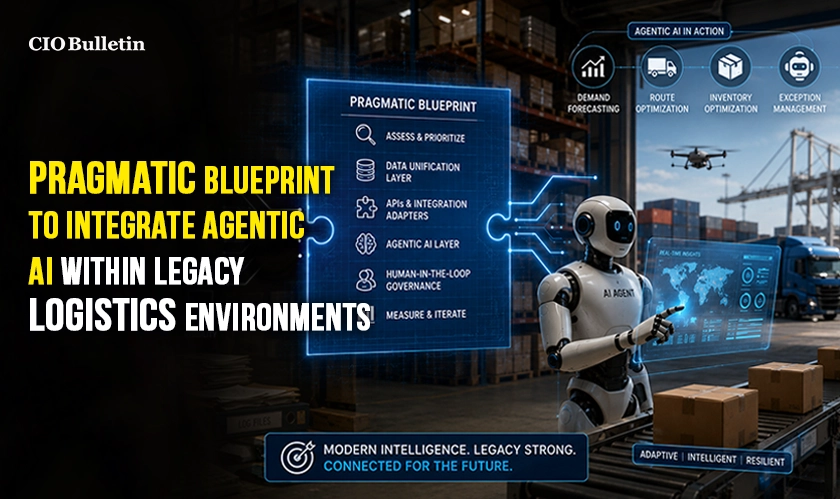
The ongoing modernization of global freight operations demands highly adaptive data integration frameworks. Driven by the critical industry-wide imperative to replace manual administrative procedures, Nippon Express Holdings announced a formal capital and business alliance with Tokyo-based startup Ricerca Inc. This targeted commercial collaboration centers heavily on scaling a next-generation platform designed around Agentic AI parameters. The transaction, executed through the specialized NX Global Innovation Investment Limited Partnership, targets the deep operational friction historically caused by fragmented, legacy paper trail documentation.
Unlike traditional software programs that merely archive business events after the fact, the newly integrated environment interprets operational variables in real-time. By connecting complex data extraction pipelines directly with long-standing backend records, the collaborative technical ecosystem automates non-routine supply chain logic. The engineering teams intend to execute development along specific parallel paths:
Complete digitization of irregular incoming order invoices and mixed-format transaction forms.
Co-development of domain-specific algorithmic models specialized for long-haul tracking networks.
Systematic integration of data feeds to provide end-to-end inventory visibility across regional warehouses.
Replacing whole foundational enterprise systems at once remains too costly and disruptive for most heavy freight enterprises. The unique advantage of this deployment rests on its ability to sit directly on top of pre-existing, aging software infrastructure without stalling daily distribution operations.
"By combining RECERQA's AI with the NX Group's frontline operations and network, the two companies will create a new standard for logistics and supply chains. We view this alliance not merely as an investment, but as the starting point for co-creation.” - Shotaro Umeda, Chief Executive Officer of Ricerca Inc.
Commercial shipping networks throughout Asian markets frequently struggle with labor deficits and antiquated core databases. Traditional automation approaches often break down when confronted with inconsistent electronic billing slips or sudden, non-routine shifts in shipping timetables. By using advanced contextual parsing models, the unified system bridges these communication gaps, helping human supply chain experts make balanced shipping judgments. This focus on smooth technological handoffs ensures that shipping networks retain absolute accuracy under fluid cargo conditions.
The core structural architecture managing enterprise distribution pipelines is forecasted to evolve rapidly over the coming years. The engineering teams plan to continuously refine their underlying agent frameworks based on incoming transaction telemetry and localized warehouse feedback loops. CIO Bulletin views this development as a highly practical transition toward dynamic data interpretation over standard mechanical record-keeping.
Everything you need to know about this news
Traditional systems simply log transactions, whereas agentic systems autonomously interpret text, structure logic patterns, and recommend active business resolutions.
The system focuses directly on automating order management, processing irregular transaction invoices, and optimizing transport networks.
Yes, the platform is built to integrate directly with pre-existing core architectures in distinct phases, avoiding operational disruption.
Labor shortages and reliance on diverse physical paper trail formats make manual data validation too slow for modern global shipping demands.
The collaboration aims to provide automated handling of non-routine data entry tasks and continuous visibility across global transport networks.




















































 consultants ltd.jpg)


Comments