
Home Industry ERP Will Structural Factory Automa...
CIO Bulletin
,
13 July, 2026
Author:
Sambhrant Das
Top consumer goods firms restructure operations as automated factories and AI tools reduce the necessity for large permanent workforces.
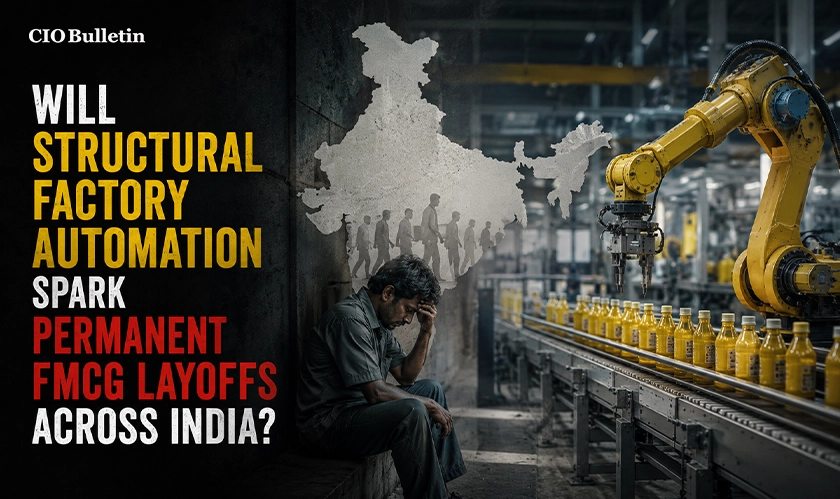
The domestic packaged commodities sector is facing a profound operational overhaul as corporate giants swap manual roles for automated systems. Driven by modern supply line optimization, established market forces are reshaping their legacy human resource requirements. This structural pivot has triggered unexpected FMCG layoffs across major corporate entities, setting off intense debates surrounding modern career security. As organizations swap routine clerical tasks for software, permanent human asset requirements are experiencing a long-term downward shift.
Transitioning traditional assembly and packaging plants into autonomous nodes allows enterprises to remain highly profitable despite inflation. Annual corporate filings reveal a complicated dual landscape where headcount reductions run parallel to competitive compensation updates for remaining roles:
Hindustan Unilever trimmed its core payroll down to 5,898 roles, resulting in a sudden reduction of over 700 permanent corporate positions.
Homegrown rival Dabur India saw its permanent staff ranks scale down to 4,770 roles from an earlier position of 5,343 workers.
Integrating advanced enterprise software enables companies to execute extensive distribution strategies with minimal manual supervision. Market professionals emphasize that investments in AI-driven predictive metrics, specialized enterprise resource planning setups, and mechanical distribution networks accelerate corporate throughput. "Investments in digital tools, AI-driven analytics, automated packaging lines and integrated ERP systems allow companies to produce and distribute more with fewer employees," industry data confirms. Consequently, lower headcount structures support rising corporate returns.
While specific traditional giants reduced their general physical footprint, other peers actively added personnel to absorb brand acquisitions. Consumer firms such as Marico and Tata Consumer Products expanded their payroll systems during the same fiscal period. This mixed environment demonstrates that localized production strategies dictate internal headcount models far more than generic macroeconomic shifts.
Sustaining operational efficiency in an automated market demands a major upgrade in baseline technological skills. Traditional factory floor roles are fading, pushing human assets toward highly technical maintenance and complex system supervision tasks. CIO Bulletin views this development as a clear preview of industrial modernization, proving that long-term corporate survivability relies on merging mechanical power with leaner human structures.
Everything you need to know about this news
Hindustan Unilever recorded a 10.7 percent reduction in its permanent labor pool, dropping to 5,898 employees.
Dabur India’s permanent operational workforce declined by 573 individuals, concluding the fiscal cycle at 4,770 staff members.
No, remaining personnel received median salary increases, with Dabur providing a 7.7 percent boost and HUL raising pay by 6.08 percent.
Automated supply line management systems, AI predictive tools, integrated ERP platforms, and robotic packaging networks are reshaping manufacturing operations.
No, organizations like Marico and Tata Consumer Products increased their permanent employee bases through business growth and mergers.


















































 consultants ltd.jpg)


Comments