
Home Technology IT Services The Server Room Problem Most C...
CIO Bulletin
,
28 July, 2026
Author:
CIO Bulletin Team
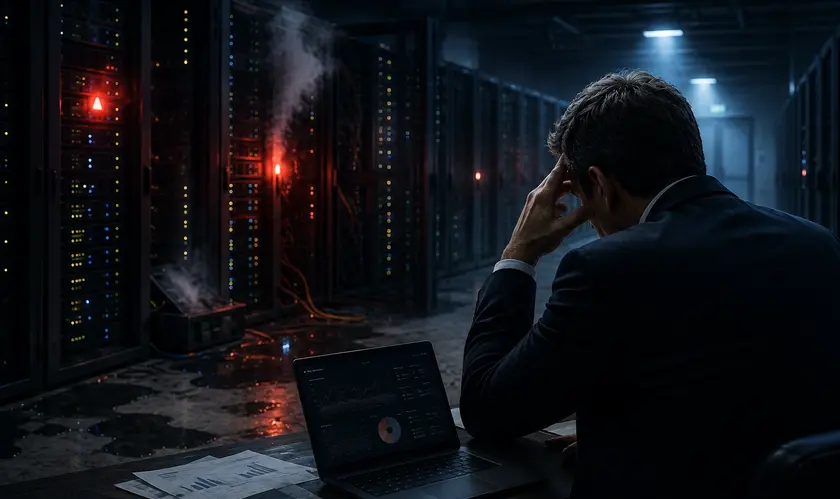
Ask a chief executive to name their biggest operational risks and they will usually point to supply chains, cash flow, or a key hire walking out the door. Almost nobody names the room down the hall humming with servers. Yet that room runs the payroll, the ordering system, the customer records, and the email that keeps the business moving. When it stops, everything stops, and the cost lands on the CEO's desk within the hour.
That is the strange thing about a server room. It is one of the few parts of a company that gets attention only when it fails. The rest of the time it sits in the background, quietly absorbing money and quietly accumulating risk that nobody has looked at in years.
Downtime is expensive, and the numbers are not small. Industry surveys have put the average cost of IT downtime at thousands of dollars per minute for mid-sized firms, and far more for anyone whose revenue runs through a website or a live system. A single afternoon offline can wipe out a quarter's worth of efficiency gains everywhere else in the business.
The trouble is that most of these failures are not dramatic. They are mundane. A cooling fan that gave up weeks ago. A tangle of cabling nobody can trace. A server that needed a five-minute fix, except the one person who knew how to reach it was on leave. None of these make headlines inside the company, but together they are what good server room management is meant to prevent.
Here is where a CEO can actually add value without learning a single networking term. The question to ask is not "what hardware do we have," it is "how much are we spending to keep this running, and how much of that spend is buying us nothing."
Server rooms are full of quiet waste. Machines run at a fraction of their capacity. Cooling systems fight heat that better airflow would remove for free. Staff hours vanish into tasks that should take minutes. You do not need to understand the equipment to understand that pattern, because it is the same pattern you would challenge anywhere else in the business.
The firms that handle this well tend to share one habit. They treat the server room as an asset to be optimised, not a cost to be ignored until it breaks.
You can open a useful conversation with three plain questions.
First, how long would it take us to recover if the main system went down right now, and who is the single point of failure. If the answer depends on one person being physically present, that is a risk, not a plan.
Second, how much of our capacity are we actually using. Paying to power and cool servers that sit mostly idle is one of the most common forms of hidden spend in any business.
Third, can the team manage this room without standing in it. This last one matters more than it sounds, and it points at a genuinely useful piece of kit.
Modern IT teams are smaller, more remote, and often responsible for equipment spread across several sites. Sending someone to physically stand in front of a server every time it needs attention is slow and, increasingly, unrealistic. A team of three cannot be everywhere.
This is where consolidating access pays off. Rather than maintaining a separate keyboard, monitor, and mouse for every machine, a kvm switch lets one operator control multiple servers from a single console. The result is fewer peripherals, less cable clutter, faster troubleshooting, and less time spent moving between racks. It is a relatively small piece of hardware that removes a surprisingly large amount of operational friction, delivering efficiencies that may never appear in a board report but are reflected in uptime, productivity, and day-to-day IT operations.
For a CEO, the value is simple. The fewer things that require a human body in a specific room at a specific moment, the more resilient the whole operation becomes.
A well-run server room is boring, and boring is the goal. Airflow is managed so cooling is not working overtime. Cabling is labelled and tidy, so a fault takes minutes to trace rather than hours. Access is consolidated, so any qualified person can respond from wherever they are. Capacity is matched to need, so you are not paying to run iron that does nothing.
None of this requires a CEO to become a technician. It requires treating the room as what it is: a piece of business infrastructure that carries real financial risk and real efficiency upside. The companies that get this right are not the ones with the newest equipment. They are the ones who stopped ignoring the room until it broke.
You do not need to know how a server rack is wired. You do need to know whether the room that runs your business is a managed asset or an accident waiting for a bad afternoon. Ask the three questions. Push on the hidden spend. Make sure your team can reach what they manage without being chained to a physical location.
The server room will never win you a headline. Managed well, it will simply keep the business running while everyone gets on with the work that does. That is the quietest kind of return, and often the most valuable.





















































 consultants ltd.jpg)


