
Home Technology SaaS Will the Sudden Collapse of Le...
CIO Bulletin
,
13 July, 2026
Author:
Gayathri Sr
Financial institutions abandon decades-old local mainframes to bet their entire operational survival on autonomous cloud architecture.
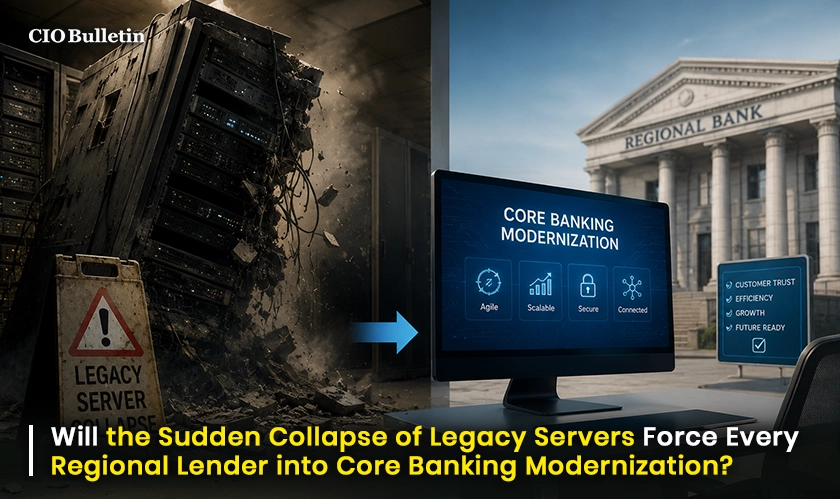
A massive structural migration is quietly sweeping across the American financial landscape, sparking intense industry debates over data survival and institutional agility. A definitive market intelligence brief released by CIO Bulletin confirms that a leading US regional bank has officially committed to an expansive core banking modernization campaign, abandoning its traditional hosted environment in favor of cloud-native Software-as-a-Service (SaaS) technology. This strategic pivoting marks an aggressive shift in how local lenders plan to defend their market share against massive global megabanks.
The corporate decision relies entirely on deploying advanced, elastic banking infrastructure to overhaul one of the institution's most profitable, specialized corporate business segments. Instead of maintaining fragile internal servers or relying on sluggish, siloed data frameworks, the regional powerhouse is shifting its fundamental operations onto a cloud-native ecosystem powered by Microsoft Azure. This structural shift allows the organization to completely streamline its commercial offerings while stripping away long-standing administrative and technological clutter.
Industry spectators emphasize that this transition is a clear warning sign to more conservative lenders. The old method of managing customer deposits and corporate records on aging local networks is fast becoming an active operational liability, unable to keep pace with real-time digital transactions.
“Banks are looking for proven technology that helps them modernise with confidence. We are proud to support this leading US regional bank as it advances its transformation strategy,” stated William Moroney, Chief Revenue Officer at Temenos, during the contract's official signing.
According to analysis curated by CIO Bulletin, this rapid digital pivot highlights several critical movements across the broader financial technology sector:
Total Operational Agility: Eliminating legacy system delays to launch new corporate lending services in minutes rather than months.
Reduced IT Clutter: Transitioning away from costly on-premise hardware maintenance to focus on flexible software subscriptions.
Maximum Data Resilience: Utilizing distributed cloud frameworks to guarantee transaction networks remain live during unprecedented outages.
Proactive Growth Models: Creating scalable computing foundations designed to easily integrate future digital asset tools and partner applications.
This ongoing transformation underscores a critical financial reality: in the modern economic climate, digital adaptation is no longer an optional upgrade; it is a prerequisite for survival.
Everything you need to know about this news
Because decades-old processing mainframes cannot handle the velocity and scale of modern digital transactions, leaving unprepared banks vulnerable to sudden system crashes.
The institution stops buying and maintaining physical data servers, allowing specialized technology providers to securely run the core transaction software via the internet.
No. Advanced cloud systems utilize military-grade encryption and geo-redundant storage models that are often far more secure than localized corporate servers.
Clients experience significantly faster transaction processing speeds, immediate account updates, and smoother integration with third-party business software.
While the initial integration requires an active investment, it eliminates long-term hardware maintenance costs, creating massive operational savings over time.




















































 consultants ltd.jpg)


Comments