
Home Industry Space Can James Webb’s Little Red ...
CIO Bulletin
,
10 August, 2026
Author:
Ravathi Sunil
Illuminating early universe mysteries through massive stellar discoveries and redefining fundamental astrophysical evolutionary frameworks.
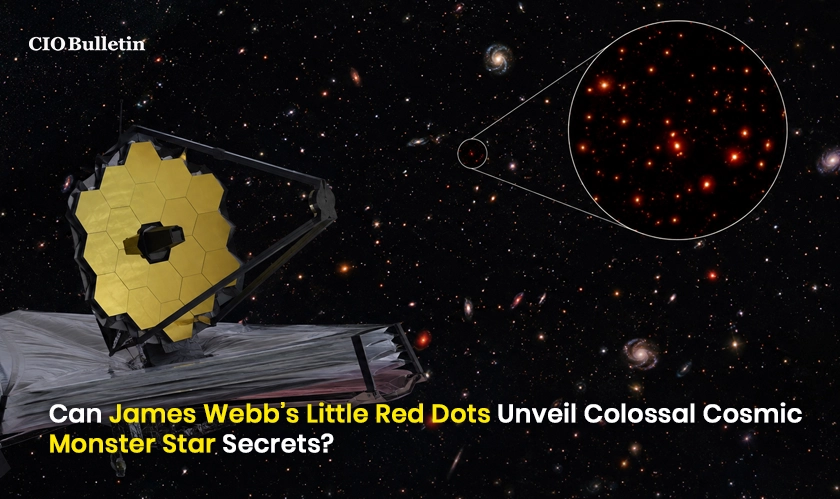
Modern astrophysics stands on the precipice of a monumental breakthrough regarding deep space observations. Deep field infrared imagery captured by the space telescope shows enigmatic James Webb’s little red dots that challenge standard cosmological models of early galactic formation. These ultra-compact crimson objects existed less than a billion years after the universe began, emitting intense brightness that scientists originally struggled to categorize. Analysts at CIO Bulletin monitoring these discoveries highlight that recent studies suggest these mysterious points of light could actually be primordial supermassive stars containing up to 100,000 times the mass of our sun.
Key Observations Behind Deep Space Red Dots
Unprecedented Mass Scale: Harboring stellar masses tens of thousands of times greater than our sun, far exceeding modern stellar limits.
Dense Gas Shells: Expelling giant envelopes of hydrogen and nitrogen gas through powerful stellar pulsations that trap thermal light.
Cosmic Black Hole Seeds: Collapsing directly into heavy seed black holes without supernovae, explaining how giant black holes formed rapidly.
Infrared Light Signatures: Showing unique V-shaped spectral breaks and strong hydrogen absorption lines without typical high-energy X-ray emissions.
Could these gigantic cosmic beacons hold the definitive key to understanding how supermassive black holes formed so quickly in our young universe? The extreme conditions of the early cosmos allowed pristine hydrogen gas clouds to coalesce into titans that are impossible to create today. Emphasizing the significance of these findings, Harvard-Smithsonian researcher Mayank Nandal noted, “Little red dots are mysterious because they combine clues that do not usually fit together. They seem to be telling us that something very luminous is hidden inside dense gas.”
These findings mark a remarkable turning point in observational astronomy. Rather than containing normal dense stellar populations or typical active galactic nuclei, these compact objects represent an entirely theoretical class of celestial behemoths. As deep field spectroscopy technology progresses, space organizations are getting ready to make observations aimed at unraveling these ancient infrared signals. Solving this cosmic mystery would eventually alter our knowledge of galaxy formation as well as that of big stars and central black holes.
Everything you need to know about this news
They are extremely distant, compact celestial bodies spotted in the early universe that emit bright infrared light encased within dense cosmic gas clouds.
Astrophysical models show these giant primordial stars can reach massive sizes up to 100,000 times the total mass of our Sun.
Their distinct red hue comes from cosmic redshift over billions of light-years combined with thick surrounding dust and gas absorbing shorter light wavelengths.
They burn through nuclear fuel rapidly and collapse directly into massive black hole seeds, giving early cosmic black holes a huge growth head start.
The modern cosmos contains heavy metallic elements that cool gas and break clouds into smaller stars, preventing giant primordial stars from forming today.




















































 consultants ltd.jpg)


Comments