
Home Technology Artificial intelligence Before You Approve an AI Data ...

CIO Bulletin
,
31 October, 2026
Author:
Guest
The commercial pitch will describe a tidy dataset. The CIO's job is to establish, file by file, exactly what would leave the building.
Sponsored content from SourceX
Consider a request that sounds harmless. The commercial team has found an AI data licensing opportunity and needs "a copy of the old support data" to explore it.
Then the details arrive. A ticket pulls in its attachments. One attachment is a customer spreadsheet. A dormant integration account turns out to reach production. What was described as an archive is now a live egress path.
Enterprise data licensing governance does not start with saying no. It starts with one precise question: could another reviewer reconstruct exactly what will leave the company from the evidence in front of you?
If the answer is no, you are not ready to approve anything.
Illustration: a stack of dataset files passing through a verification scan beam. Conceptual artwork for this sponsored article.
"Old support data" is not a scope. "Resolved cases from 2019 to 2023, excluding regulated customers and all attachment types except PDFs" is a scope, because it can be tested.
A good scope separates three objects that are easy to blur:
They contain different information and need different approvals. Signing off on one does not approve the others. Give the export a single accountable owner, because commercial enthusiasm is not a substitute for responsibility when a field mapping goes wrong.
A practical manifest records the source system, export time, selection rules, record count, file inventory and version. File hashes let reviewers confirm that a later artifact matches the approved release. They do not prove the records are accurate or lawfully licensable, and nobody should present them that way.
Transformation notes should explain which identifiers were removed, which relationships were kept and which files were rejected. If a reviewer cannot follow the path from source to prepared artifact, the evidence is incomplete.
The W3C's PROV standard offers a ready vocabulary for linking data to the activities and people that produced it. You can adopt the discipline without buying a platform, and without pretending a provenance record grants licensing rights.
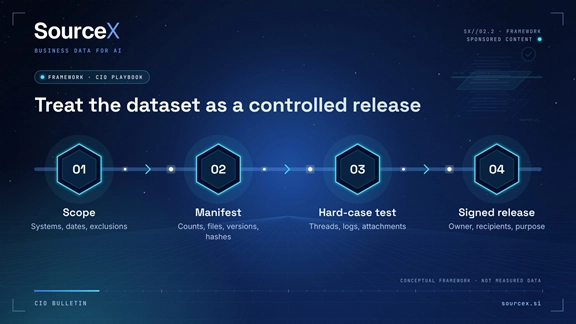
Treat the dataset as a controlled release. A conceptual framework drawn from the article, not measured performance or a completed transaction.
A clean demo row tells you almost nothing about an archive. Go looking for trouble instead: long threads, pasted logs, forwarded correspondence, compressed files and records that moved between business units.
Choose the sample deliberately and write down how you chose it. An exception found early is a gift. An exception buried inside a reassuring completion percentage makes the eventual approval weaker.
Before acceptance, confirm that:
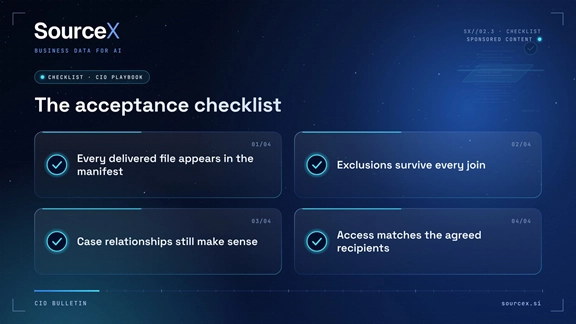
The acceptance checklist. Four review points from the article; the full text supplies the context and conditions.
SourceX acts as the direct licensing counterparty for approved company data used in AI training and evaluation. Its public process starts with a fit check with no uploads. Extraction and delivery follow a signed Master Supplier Licensing Agreement, a signed Dataset Deal Confirmation and SourceX approval to proceed. The Confirmation fixes the selected dataset, payout, processing route and deadlines.
SourceX advertises payouts of up to $4 million. Treat that as the ceiling for the largest enterprise datasets, not a typical figure, and never as a reason to approve an undefined transfer. The selected records, payment and obligations are fixed in the signed deal.
One more check belongs on the CIO's list. As checked on October 22, 2026, SourceX's public trust center lists SOC 2 Type II work as in progress with no report issued, and ISO/IEC 27001 and ISO/IEC 27701 certifications as in progress and not issued. Procurement should verify current evidence rather than infer a certificate from an audit project. That advice applies to any vendor.
No. It addresses part of the risk. Rights, permitted uses, contextual identifiers, access and contractual obligations still need review, and some combinations of remaining details can allow re-identification after names are gone.
Approve a metadata inventory and a written scope, and nothing broader. An approval another person can inspect, challenge and reproduce is how an exciting AI revenue conversation becomes an ordinary, defensible technology decision.
Key takeaway: The strongest approval is one another reviewer could reconstruct from the evidence alone.
Bring a system-level inventory to SourceX for an initial fit check, then scope any further review with your security and rights owners. Customer records are not needed for the application.
Noah Loul is a four-time founder and the founder and CEO of SourceX, which licenses business data directly from companies for AI training and evaluation. He previously founded B2B Rocket, acquired by Blackpearl Group. His work focuses on building permission-based data infrastructure for AI.




















































 consultants ltd.jpg)


Comments