
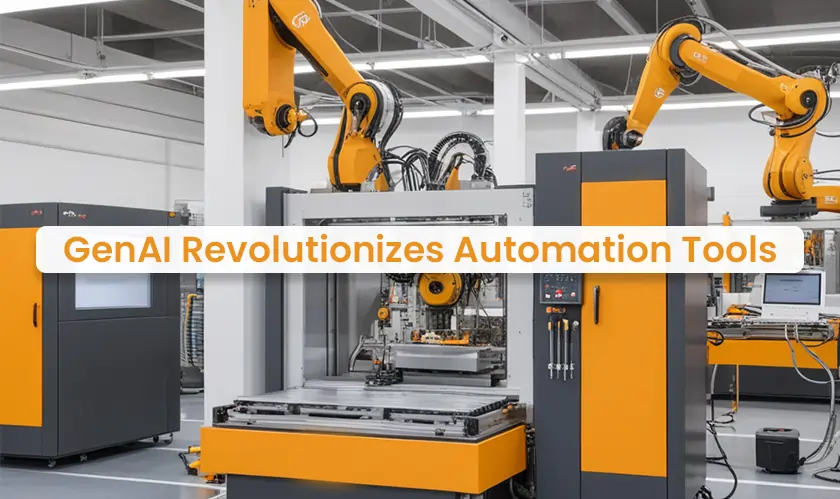
Home Technology Automation GenAI Revolutionizes Automatio...
CIO Bulletin
,
27 August, 2024
Author:
CIO Bulletin Team
AI-driven automation set to transform the enterprise workflows and application management
The landscape of AI-driven automation is undergoing a significant transformation as it integrates deeply with generative AI (GenAI) tools, platforms, large language models (LLMs), and managed services. This shift marks a new era of innovation, where automation leaders are stepping into the GenAI space, partnering with cloud giants, and upgrading their solutions to simplify and enhance operational workflows.
These advancements signal a groundbreaking use case: leveraging GenAI to modernize enterprise applications through AIOps and automation. Historically, AIOps has been a complex field, but GenAI is changing that by simplifying the creation and implementation of machine learning (ML) algorithms. These algorithms are crucial for automating, monitoring, and analyzing the impact of modern applications on an organization’s IT environment. This ease of use opens the door for broader collaboration across data scientists, operations, and developer teams.
Recently, key players like Pegasystems, Automation Anywhere, and IBM have launched significant GenAI integration strategies. Automation Anywhere has infused its traditional platform with GenAI process models, enhancing customers’ workflow automations with new AI agents that manage cognitive development across enterprise systems. IBM introduced IBM Concert, a central part of its AIOps strategy, powered by the watsonx platform, to optimize operations in distributed environments. Meanwhile, Pegasystems extended its GenAI framework to connect with Google Cloud, AWS, and Anthropic, giving enterprises more flexibility in choosing GenAI services and LLMs.
This surge in GenAI activity, marked by numerous partnerships and integrations across hyperscalers and platform providers, underscores the massive potential of AI-driven automation. As these tools evolve, they are poised to revolutionize how enterprises manage and optimize their workflows and applications, making automation more accessible and impactful than ever before.














































 consultants ltd.jpg)


