
Home Technology Science and technology CIO Bulletin Highlights Next-G...
CIO Bulletin
,
22 October, 2026
Author:
Ravathi Sunil
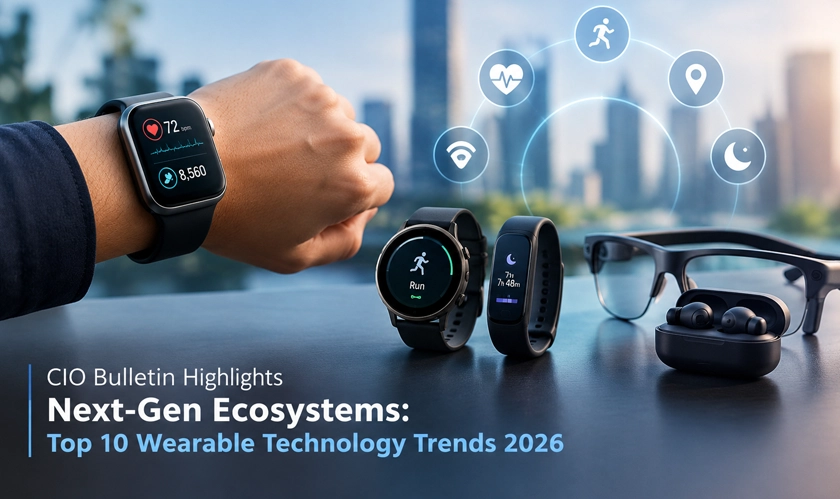
The rapid technological development of the personal technology space has been generating immense possibilities within corporate wellness programs, health care, logistics, and employee productivity. With AI entering consumer devices and biomedical sensors becoming smaller and smaller, wearable technology is moving from a mere gimmick to a business necessity. To assist the management of technology professionals, executives, and strategic planners in understanding these changes, CIO Bulletin presents a thorough look into the main technological changes and breakthroughs that are transforming the world of hardware this year.
Top 10 Wearable Technology Trends 2026
The global hardware landscape is expanding rapidly as wearable technology trends 2026 redefine how individuals monitor their health, communicate, and interact with ambient digital environments. The integration of edge artificial intelligence, advanced biometrics, and subtle ergonomic designs is driving unprecedented consumer and enterprise adoption. Here are the primary trends shaping the sector this year.
In the past, assessing vital metabolic indicators involved procedures that were either invasive, like drawing blood or using skin-penetrating devices. Currently, cutting-edge optical sensing systems combined with machine learning systems make it possible to measure biometrics continuously and in a non-invasive way, using finger and wrist devices. It is now possible to get real-time estimation of glucose levels, changes in blood pressure, and even lactate concentrations through optical pulse transmission times and PPG systems.
Although smartwatches are still widely used, smart rings can be regarded as the most rapidly growing type of gadget among wearable technologies. Owing to such qualities as light weight, beautiful design, and better finger artery contact, smart rings offer outstanding precision in terms of biometric data like sleep staging, recovery score calculations, and skin temperature measurement. It is becoming more popular due to its discreetness and seamless incorporation into daily life.
Artificial intelligence has evolved from simple step-counting algorithms into proactive, hyper-personalized health assistants. Modern smart wearable devices utilize specialized neural processing units built directly into device processors, allowing natural-language AI models to analyze multi-modal biometric trends locally. Rather than giving static graphs, these devices provide context-specific guidance on exactly how variables such as sleep disturbance, heavy training, or environment-induced stress affect recovery.
The line distinguishing between consumer wellness devices and clinically controlled medical devices is blurring. Manufacturers of devices are striving to obtain regulatory clearances for ECG tracking, sleep apnea testing, and atrial fibrillation monitoring through their products. Using interoperable data standards such as FHIR (Fast Healthcare Interoperability Resources), individual wearable devices now deliver validated patient health data to electronic health record systems.
Eye-wear based on augmented reality technology has evolved from its cumbersome industrial design to a sleek and light design that is comfortable to wear all day. Micro-LED displays, directional open-ear audio, and eye-tracking cameras have enabled smart glasses to overlay navigation, translation, and notification alerts into the vision of the user. Enterprise professionals use such spatial computing devices to provide remote field assistance, pick inventory, and assemble products.
The concern of battery anxiety continues to be an important area of contention for the consumers of mobile hardware. In order to increase operational duration, hybrid energy harvesting technologies are being employed by hardware designers. Flexible kinetic energy harvesters harness the movement of the body to generate electricity, whereas micro-solar panels present in watch frames and ring cases constantly recharge the internal batteries.
Neural interface technology is no longer confined to the lab, but is becoming incorporated into consumer headgear devices. Devices like earphones, smart glasses, and specialized headband straps are equipped with non-invasive EEG and EMG micro-sensors, which can analyze and gauge brain fatigue, brain focus, and stress markers in real-time. Individuals are able to control their digital interfaces through slight muscle movements or brain focus.
There is no longer a limitation on sensors in terms of inflexible plastic and metal shells; conductive threads, flexible printed circuits, and pressure sensors made out of elastic materials are now embedded into everyday clothes, sports compression garments, and even medical wear. Through these sensors, information about heart activity, breathing, and muscle activation is collected from vast body areas. This technology enables a higher level of accuracy in monitoring professional athletes, physical therapy patients, and field workers.
With the increasing number of health, location, and financial data stored on personal devices, it becomes necessary to have secure solutions in place. The new generation of hardware includes a separate security element that performs biometric verification locally. Using constant heart rate data (ECG biometrics), it is possible for individuals to unlock physical doors, perform corporate network logins, and make payments without the need for cloud servers or passwords.
Modern hardware is focusing on looking out at the environment that surrounds us. Environmental sensors can measure particulates in the air, volatile compounds, ultraviolet light, and abrupt changes in temperature. Personal tracking systems can warn people of unhealthy conditions in the air or temperatures in the environment through correlation with physiological functions.
Strategic Perspectives on Wearable Innovation
The rapid expansion of wearable technology trends 2026 highlights a profound transformation in how society manages personal health and enterprise operations. Starting from step counting, this has developed into a system comprising medical-grade sensors, edge computing, and artificial intelligence. Those organizations that take proactive measures to harness these connected systems can benefit from greater employee productivity, less occupational risk, and personalized digital services.
As the broader wearable technology ecosystem matures, establishing strong data governance, interoperability standards, and user privacy safeguards will remain essential. Connected computing is set to be in the hands of non-invasive, always-on technologies that help individuals while maintaining their freedom and online safety.
Our editorial philosophy at CIO Bulletin revolves around studying these revolutionary technological trends, assessing their economic implications, and offering our decision-making executives the necessary information to keep their competitive edge in this interconnected age.
Everything you need to know about this news
Smart rings offer a screen-free, highly comfortable form factor that provides exceptionally accurate biometric tracking. Their direct contact with finger blood vessels allows for precise optical tracking of sleep, heart rate variability, and body temperature without requiring daily charging.
The latest wearable technology trends incorporate clinical-grade sensors capable of tracking blood pressure trends, identifying irregular heart rhythms, and detecting sleep apnea. These metrics can be shared directly with healthcare providers for continuous remote patient monitoring and early disease detection.
Artificial intelligence operates directly on the device processor to analyze complex, multi-sensor biometric data. Rather than presenting raw numbers, AI provides contextual, plain-language coaching that helps users optimize recovery, workouts, and daily stress management.
Enterprises utilize smart glasses for hands-free industrial maintenance, connected e-textiles for athletic performance, and environmental sensors to protect field workers from hazardous conditions like heat exhaustion and poor air quality.
Leading manufacturers are adopting local on-device processing, dedicated secure hardware enclaves, and encrypted data transmission protocols to ensure that personal health data remains private and protected against unauthorized access.


















































 consultants ltd.jpg)


Comments