
Home Other Blogs The Growing E-Waste Crisis and...
CIO Bulletin
,
20 October, 2026
Author:
Ravathi Sunil
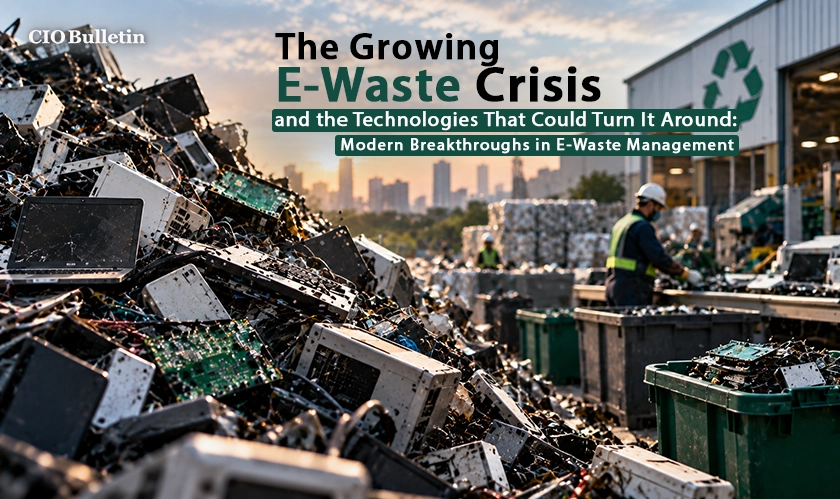
Each and every year, the world stealthily disposes of more than sixty million metric tons of circuit boards, cell phones, computer monitors, and home appliances in its refuse flows. Our thirst for ever-quicker silicon chips, colorful displays, and unending consumer conveniences has led to an environmental crisis. Electronic waste has become the quickest-growing solid waste stream on the planet. Billions of pieces of electronic waste wind up buried in earthen pits or burned in open fires, leaching poisonous amounts of lead, mercury, and toxic fire retardants into the nearby environment.
However, within those piles of junk electronics lies a fascinating economic mystery. The world wastes tens of billions of dollars’ worth of precious metals each year in the form of gold, silver, copper, and rare earth metals just because it was once too complicated to harvest. Fixing this problem will require a complete revamp of current industrial extraction processes in order to turn our economy from one of throwaway products to a completely circular one.
The Hidden Toll of Disposable Electronics
It is amazing how quickly personal electronics go out of date. Upgrade periods of handheld devices are measured in just a few years. If the lithium battery becomes worn out and the motherboard stops working on the tablet, the price of repairing the old device often exceeds the price of buying a new one. Therefore, old devices are simply gathering dust in offices, after which they end up in city garbage.
Such wastefulness results in rapid depletion of scarce natural resources. Extraction of rare earth minerals requires large volumes of diesel fuel, aggressive solvents, and extensive excavations. However, extraction of those same precious metals directly from printed circuit boards requires much less energy. The problem was not the lack of valuable resources in waste electronics; it was the inability to separate the complicated alloy cost-effectively.
Technological Innovations Reshaping Recovery
Fortunately, pioneering automated engineering is tackling this recovery bottleneck head-on. A new wave of waste management technology is transforming raw electronic scrap into rich, high-yield resource streams through cutting-edge robotics and biological extraction systems.
Teardown methods in the past were done entirely manually with handheld screwdrivers and dangerous pry bars. Currently, sophisticated optical vision technology directs multi-axis robotic arms in finding screw heads, inner ribbon cables, and glued battery packs in thousands of different models of devices. These smart technologies enable the removal of valuable parts without damaging them in a few seconds, without shredding, which would normally destroy delicate circuits.
Biometallurgy techniques have also replaced the past inefficient smelting processes that used high heat. Specific bacterial strains and organic solvents are capable of extracting precious metals such as gold, palladium, and copper straight out of crushed circuit boards. This biological extraction process avoids the emission of toxic gases through smokestacks and operates at room temperature. Moreover, the hyperspectral sensing technology is able to classify shredded casing plastics according to their exact polymer type.
Regulation and the Economics of Recycling
With the proper regulations in place, it would be possible to turn electronic waste into an organized industry rather than a haphazard process. Programs involving extended producer responsibility can motivate producers to participate in the process of collecting and recycling used products. On the other hand, investments in formal recycling facilities will improve recycling rates and provide jobs for skilled people in addition to decreasing the reliance on foreign materials. It would be important to make responsible recycling economically efficient without making electronic waste available for hazardous disposal.
Building a Renewable Electronic Future
Overcoming this global crisis requires far more than just building better shredders at the end of a gadget's life cycle. The future of e-waste recycling depends on modular eco-design principles established long before a prototype ever leaves the assembly line. The hardware manufacturers are beginning to adopt standardized magnetic fasteners, snap-fit chassis housings, and easily removable battery compartments. When hardware is engineered specifically for disassembly, upgrading a single burnt-out microchip becomes just as straightforward as replacing a lightbulb.
In addition to that, the digital passports that have been created using secure ledgers can be used by recycling facilities to simply scan a chassis barcode and then look at the exact composition of chemicals in the device, where those hazardous materials are located, and the proper sequence of disassembly.
Scaling modern e-waste management and recycling initiatives across municipal collection networks is not just an environmental duty; it represents one of the largest economic opportunities of our time. Transforming discarded waste streams back into raw manufacturing inputs protects precious watersheds, reduces carbon emissions, and secures the critical materials required for next-generation digital infrastructure. Effective e-waste management offers a proven pathway to break our dangerous dependence on disposable tech and build an infinitely renewable hardware economy.
Ready to Lead the Conversation in Sustainable Technology Solutions?
CIO Bulletin empowers your organization to gain the market visibility it deserves while staying at the forefront of digital innovations and sustainable technological frameworks reshaping global enterprise. Share your green tech insights with industry leaders, stay ahead of the e-waste management curve, and turn your environmental expertise into a defining industry milestone!
Subscribe today for exclusive insights: https://ciobulletin.com/subscribe
Enhance Your Brand Presence: Advertise with us at
https://ciobulletin.com/advertise



















































 consultants ltd.jpg)


Comments