
Home Industry Automobile Can a Low-Cost Self-Driving Se...
CIO Bulletin, 25 November, 2026
Author:
Sambhrant Das
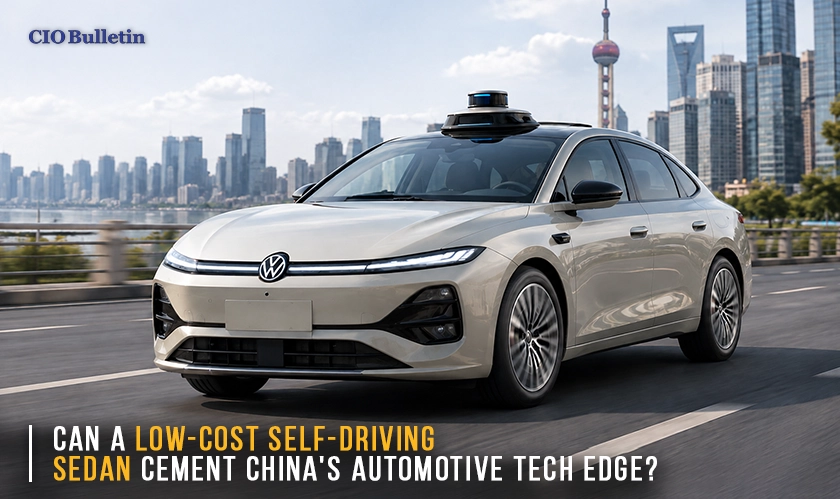
The decision of Volkswagen to launch an entry-level self-driving sedan priced approximately at $18,000 in China indicates how rapidly automotive software and smart driving technologies are becoming a common norm. The car is being built on a local engineering basis with a number of joint ventures in China, amidst intense competition from local electric car producers like BYD, which has implemented advanced driver assistance systems even at the entry-level price range.
The established automakers in the biggest car market in the world must utilize deep localization in order to compete against the Chinese companies in terms of cost and technology. From local engineering centers to chip companies such as Horizon Robotics and joint ventures such as CARIZON and XPeng, Volkswagen is investing heavily in speeding software development and hybrid technology:
Faster R&D cycles: Local AI tools and engineering teams helped decrease significantly the time taken during the vehicle development process.
Lower price thresholds: One can find features previously present only in expensive car models on cars costing about 18 thousand dollars.
According to industry experts, the hype surrounding autonomy has outpaced the adoption of its regulated definitions. Many widely offered systems are actually driver assistance systems instead of being true autonomous systems. Even in places like Hefei, where trials for higher degrees of automation are allowed, the driver remains responsible for driving and ensuring adherence to local traffic laws.
The change brings about the issue of global supply chains, as foreign automakers have to respond to how Chinese electronics and software will be incorporated into their larger export plans.
Automakers are going to adopt some of the strategies from China, like ‘In China, Beyond China,’ when they expand their regional innovations to several countries facing various trade duties and regulations on data and safety in Europe and North America.
The fight against competitors in China comes down to optimizing software capabilities instead of upgrading hardware components. According to CIO Bulletin, Volkswagen’s latest move indicates that the Chinese homegrown supply chain, as well as its approach to software development, is now being followed worldwide as a standard for low-cost connected mobility.
Everything you need to know about this news
Chinese electric vehicle manufacturers have prompted global automotive brands to introduce their smart driving technologies on cheaper cars in China following fierce competition in price and functionality.
The automotive giant cooperates with local engineering teams and platform developers like Horizon Robotics, as well as partners such as CARIZON and XPeng.
No. The low-cost technologies are mainly limited to driver assistance technologies that still require the driver to be in charge and comply with the traffic rules.
The combination of having domestic supply chains, rapid software development, and strong competition in the EV industry makes it possible for manufacturers to increase production of smart features cheaply.
Car manufacturers can export some car models to a limited number of overseas markets, but tariffs, data regulations, and local safety regulations must be observed.




















































 consultants ltd.jpg)


Comments